

The first thing you should do is admit you will never be full Mexican. You will never do this. The second thing you should do is make good on the threat you made to Oscar at lunch the other day and show him your Dad at Fall Festival coming up.
“Even if he is your dad, you’re still not Mexican,” Oscar said. “Look at your lunch.”
Mom packs that. She also does all the cooking. Oscar doesn’t know this, but even though Mom is white, she’s just as Mexican as his. She packs the same thing for you every day with love and care, lining it up like the Tetris games she used to play as a kid. You get a Nutri-Grain bar; a toasted turkey and provolone on wheat (it’s healthier, she said); an apple, which you never eat; and a short, fat water bottle, which Oscar makes sure to say looks like you when you take it out.
“Mira, la botella se parece cómo él!”
You could say something back, something you’ve learned from Dad when the Chivas lose. Something absolutamente diabólico. But that would probably just result in an ass-kicking, an event your pudgy frame is not well-suited for. After all, it’s not the insults that hurt, but the isolation. For the first time, you’re away from your number-one homie, Rodney, the second-biggest kid in fifth grade besides you. In your effort to make friends, you made the mistake of thinking your light-skinned bowl cut-looking ass could get along with the skinny rough-and-tumble crowd. You didn’t stop trying to make friends when Oscar called you a “pinche gordito chino-lookin’ chingón” and you won’t stop now.
“Just you wait,” you say. “I’ll show you.”
Oscar says nothing as he gets up, eyeing you as he walks around the cafeteria table. He holds his hand out to his side, and you can see a hole in the pocket of his ratty blue jacket. Tense up, but not in a way that shows. He walks past, and nothing happens. Let out the air you’d been holding in.
On the night before Fall Festival, beg Dad to accompany you. Mom is going, so why can’t he?
“Es porque estoy cansado, mi’jo,” Dad says.
“Please, Raf, he wants you to go,” Mom half-yells from the kitchen.
Dad looks at you and Mom. He didn’t realize what he was in for when he made the only half-white child in his family. The way his relatives ridiculed you and Mom for being as gordito as y’all were (and still are) will haunt Mom forever. What haunts Dad, he will never say. He looks at the time, stroking his beard, making this calculation in his head the same way he does tracing the arc of how much asphalt he can pour on a North Carolina summer’s day without giving the whole crew heat stroke before finally saying “ok.”
At Fall Festival, the school is lit up with a giant pumpkin out front. Ward Elementary was named after this old white guy who served his community. You and the other kids only look at his portrait in the entrance hall and think, “That’s an old white guy.” But the truth is he always believed in serving kids like you: the ones that society would spit on and shove into hospitality or service, whatever would keep y’all from climbing too high. You won’t recognize that until you start looking into him years later. But the only thought that passes in your head is the same one that always does when you walk past his portrait. But instead of thinking what you always think, you agree with your mother’s assessment when she says, “That’s a nice picture.”
Your parents have two different names: a Spanish and an Italian one. You got your father’s name. He asked for an accent mark, a tilde, over the o in León, and that is what you will find on your birth certificate as you are applying for jobs as an adult. But in school your first name tag only read “Rio Leon,” the vowels’ flatness never once making itself apparent until you say it out loud to the teacher running check-in. Feel a hesitation as Dad walks behind you, the weak handholding your parents do, the first of many signs that something is wrong. But that is not the thing you think about in this moment. The thing you are most excited for is the bounce house in the school gymnasium. That, and the giant slide.
Fall Festival is neutral ground. Kids who hate each other in class are all of a sudden excited, the energy canceling out all other emotion. There are bake sales and even a mini book fair. Your teacher, Mrs. Ingle, stands by the door, and she is so happy to see her (secretly) favorite student (you, doofus) and his parents.
“Is this your dad?” your teacher asks you.
You are dressed in husky blue jeans and a long-sleeve polo. Dad is dressed in the windbreaker his company gave him for ten years’ service. You feel this backward pull as you take his calloused hand and present him to your teacher, her smile brightening as you say, “This is my dad.” And she says, “It’s nice to meet you.” Dad smiles. It’s so rare to see him smile. You don’t have enough time to discern whether it’s false.
Proceed to lose yourself in the gymnasium. Run on the carpet. Your New Balances catch on the fibers and cause you to trip up a bit. Where to go first? The bounce house or the slide? See Rodney, dressed in an orange shirt and cargo pants, by the slide with some of his friends, so decide on that. Forget about Oscar. Forget about lunch. Just be here and enjoy it. Talk with Rodney about what Special Edition Hot Wheels you’ll be looking at at Toys’R’Us this weekend. Deflect when one of the other boys in line says that Matchbox has more variety. Know in your bones that, now and forever, it is Hot Wheels. Climb up the rope ladder to the top of the slide. Notice how tired the teachers look here. Ignore Ms. Thomas, the gym teacher who said that chubby kids don’t perform as well on tests as those kids who are healthy. Know that you will slide down faster than the other kids. Get next to Rodney. Smile at your parents, standing together nearby. Glide on air. You both hit the wall and are laughing as you scoot your way off the slide and go back up. Go and go and go until Ms. Thomas, her outdated ’80’s jazzercise instructor hair hair-sprayed to the point that it’s starting to fray and frizz in the humidity of this godforsaken elementary school gym, says, “Río and Rodney, don’t you have somewhere else to go?”
To which Rodney says under his breath, “Bitch,” and you both run off. See Ms. Thomas walking after you, raising a crooked finger like the witch she is. She trails until the principal calls, “Mandy!” And she sheepishly returns to her post.
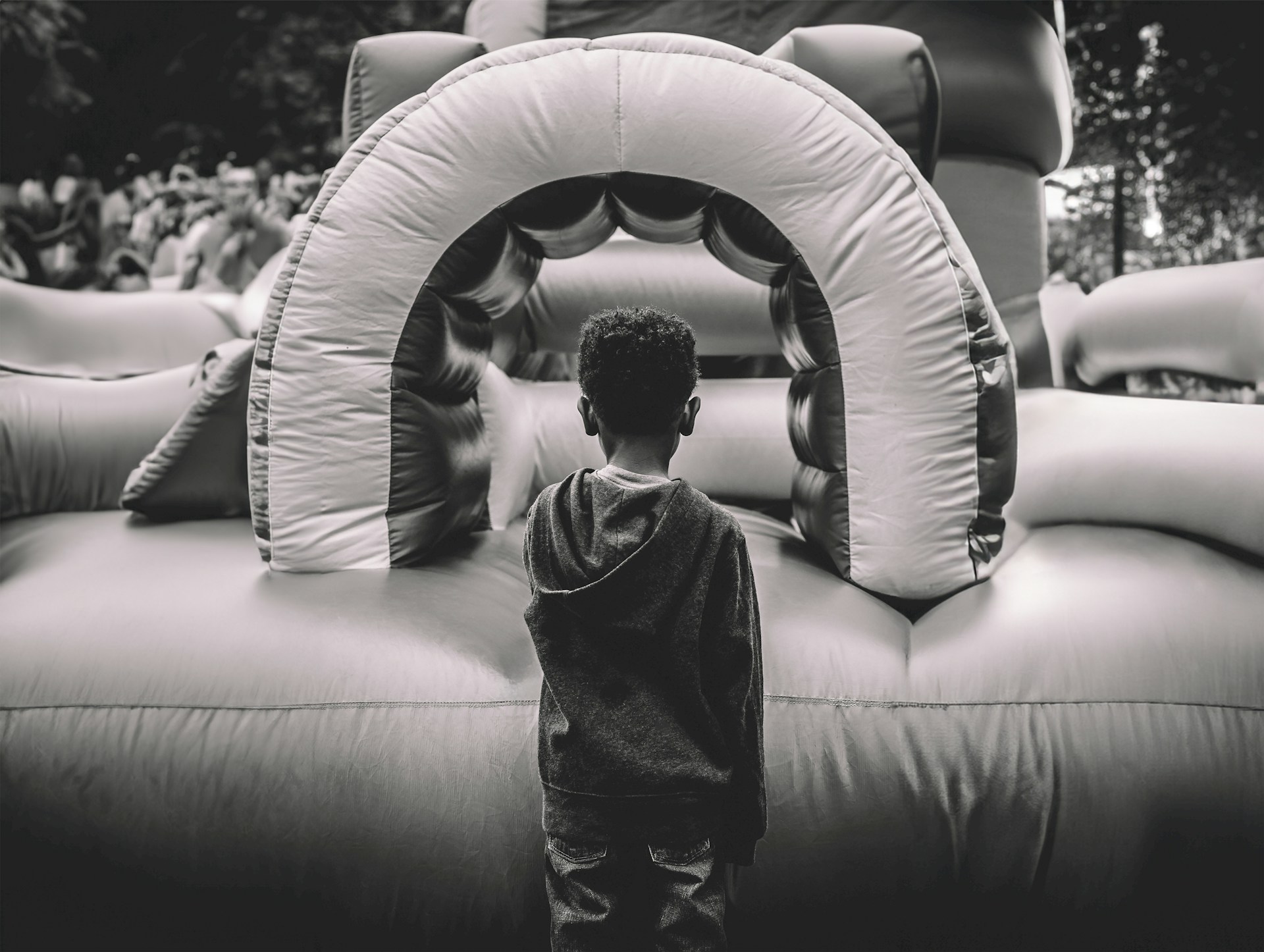
Make your way to the bounce house and jump up and down in your shoes. Get excited—it’s the bounce house! It’s moving with as much energy as you. Watch the net push out with an impression of a child, so much so that it looks as if the kid might break through, then watch it retract. The man operating it calls “next!” and you go, only to be stopped in your tracks by your mother’s grip on your shoulders. Look up and find her staring dead on at a couple ladies off to the side, talking to each other, hands covering their mouths. Watch them walk past you and hear, but don’t listen, to the two of them as they speak Spanish. You know the language, but you don’t, entiende? It’s something Dad tried to teach you when both of you were younger. Forget the meaning, but remember the gestures, the looks as they eye Mom and quiet themselves as they get closer. Turn toward them for a second and watch one smile at you before they turn the corner and burst out in laughter. Look up again and see Mom still watching them, almost through the walls. The light on the gym’s ceiling shines through her hair, shrouding her face in darkness. The way she hovers over you, it’s like nothing can harm you. Look over and see Dad shifting in his shoes, the activity seeming too much for him to bear, but just be happy he’s here. He never gets a chance to come to these things. Forget that he’s standing away from you both. The curtain is open, and Rodney climbs in, but Mom’s fingers are a death grip to your shoulder. She doesn’t let go until Rodney calls to you, saying, “Río, come on.”
Ask her, “Can I go?”
She hesitates before releasing you, her gaze off toward Dad, the exit, some place between.
It’s hot inside. Slip on the floor from the sweat pooled in the ridges of the rubber flooring. Rodney is here somewhere. Think you see his shape in the darkness of the kids. Bounce that way. Ignore the bony little arms trying to push you around. Whispers of “Move fatass” drown out amid the screams of the littler kids getting jostled around by the larger ones. Elbow your way to Rodney. He is sweating more than you are. Decide to bounce your way out so you can have some air. Get sad when you hear Rodney’s mom tell him, “We’ve got to go, Rod,” and follow him outside. You are both bigger kids and that’s why you stick together. You’re a team. Your moms find you both cute. Stand still for a picture. Stand still just a little longer. You will look at the smiles on you both and remember how happy you were in this moment and think that it is good to be happy. If only you had a picture of the photographers, maybe you would have seen Dad looking off to the side, averse to Mom’s gaze, anticipating the shit she would hand him in the car later. Mom would still have smiled at you, because seeing you happy is the only thing she’s ever wanted.
Munch on the homemade brownie the moms at the PTA (yours chief among them) made, savoring the fudgy goodness, the crust as it flakes off, only remembering what you came here for when Oscar walks around the corner with a skinny man stooped over and with hands shoved in his work jacket. He has a thin mustache and hat that says, “Larco Paving.” Dad recognizes him.
“Qué pasa Chico?” Dad says.
Smile brightly at Oscar. Be proud of this moment.
“See,” whisper to him. “I told you.”
He ignores you, watching both of y’all’s parents. Think for a moment that maybe he wasn’t ignoring you, that maybe he just didn’t hear you. There are kids walking around, and he is waving hello to them. The hallway is bright. Your dads talk about work or whatever it is dads talk about. Oscar continues to say hello to the same kids you see in the lunchroom, but you he ignores. Tap him on the shoulder. He doesn’t turn his head. So get in his face.
“I told you I was Mexican,” say to him. This will force him to nod, to give a smile.
“Lo siento,” you hear Dad say. “La decisión no fue mío.”
Oscar’s Dad keeps his hands in his pockets. The brim of his hat casts a shadow over his eyes. You look at the way Dad talks with him, and it is unlike anything you’ve seen before. There is an attentiveness, a niceness, even an apologeticness, to his engagement that is absent from his conversations with you.
Forget about it as Mom comes up.
“Is this your friend?” she asks you.
To your surprise, Oscar looks up at her and puts an arm around your shoulder. He squeezes a little too tightly and says, “Yes, Río and I go way back.”
Smile at this and think you’ve made a new friend. Wait till tomorrow, homie. When Dad is done talking with Chico, follow Mom to the car and wait outside for Dad to catch up. It gets quiet on the van ride home. You will learn over and over again how much Dad doesn’t like to talk. In the time between the school and home Mom brings up something she heard from one of the ladies earlier.
“She called me gordita. She said mira, mira, gordita.” Mom has a way of diminishing Spanish speakers into a voice that chirps. It’s her way of drowning out the chisme.
Dad says nothing. It’s his way of disengaging from a conversation he knows he will lose.
“Why don’t you say anything?” Mom asks.
“Because I don’t know what to say, Abril. I didn’t hear them say nothing.”
“But you were right there. They said it in front of your son.”
Remember the chulas near the bounce house from earlier. The memory is already fading. You were busy having fun. You’re just glad Dad came. Why is Mom talking to him like this?
Say “I don’t remember anything like that, Mom.”
“Your father and I are having a conversation,” she cuts.
Dad throws his hands up, “he say he don’t remember nothing, Abril. So maybe it didn’t happen.”
“Yeah,” you say, “Maybe they were talking about someone else.”
In the passing by of the orange-yellow streetlights, notice tears falling down your mother’s eyes, her lip quivering, but no sniffles.
On arrival to the house, Dad wordlessly gets out, retrieving mail from across the street. Mom jingles the keys a little too much and opens the door into darkness, hanging up her coat. You can’t count the times a night has ended like this. She flips the kitchen light on and sets about putting the dishes up. The clatter as she stacks them hurts your ears. Peek through the blinds and see Dad slowly making his way back to the house. Go to your room and do your homework, Mom coming by later to give you a kiss goodnight. Before tucking in, head back to the kitchen for one last snack. On your way, run into Dad, sitting at the dining room table in his zone of silence. There’s a picture of you as a baby above him on the wall over the table. How’d you get from a baby to where you are now? There are so many things you’d like to tell him: how the Mexican kids in school call you Chinese as an insult; how, in practicing dance in gym class, the girl you were partnered with kept saying “ugh” every time her hand brushed against your back fat. But Dad’s aura is not one broken so easily. So find a workaround.
“Who was that guy you were talking to, Dad?”
The smallest move in facial expression is what he gives. It’s something you’ve grown to recognize over the years as a sign he is ready to receive your words, however briefly.
“What?”
“Who was that guy? In the hall at my school.”
“Oh,” Dad demurs, “some lazy. Got fired.”
It’s not the answer you expected, but it’s the one you got. In the pause between his answers, you’ve already decided to abandon the snack, instead taking a chilled Aquafina from the fridge. Linger around for Dad to say more, but, as with so many times, realize that is all he has to say.
In the morning, find your clothes and lunch prepared when you wake up, and make your way to the kitchen. Dad’s work truck is absent from the driveway. Climb into the van and watch the automatic door close. Next year, when you’re twelve, you’ll be able to sit in the co-pilot’s seat. You will have so much fun swiveling the chair and giving orders to imaginary crew members in the back. Mom will laugh alongside because she will be your helmsman no matter where you go. Dad will not understand. He will watch Sábado Gigante with the scantily clad güeras calling out winners and the game show host—an older, lighter, beardless version of him—giving money to ordinary-looking latinos. Who knows where their lives will go. Someday, you will recall how it was Dad’s dream to open a restaurant, but that never came to pass. What would have had to happen to make it be?
On arriving to school, the teacher who gets you out remarks how, for once, you aren’t late. Wave bye to Mom. Go to the fifth grade trailers the school has built because there are more kids there every year. Stomp up the metal steps. Ignore the kids saying boom boom boom, looking at you because they want to get a rise out of you. Today, you’re learning about geometry. It’s all about triangles, how some are right, some are obtuse, and some are isosceles. Mrs. Ingle says, looking at you but also not, that each has its own dimension and fits in the way it’s supposed to.
In your partner tables, excel at calculating the degrees of the opposite angles of all types of triangles. Geometry will be your best subject. Later on, it will be budgeting, remembering how your parents sat at the kitchen table with their checkbooks out. There are some things no one can take away from you. Feel the soft impact of a paper ball on your arm and turn around. There is a kid, one of Oscar’s friends, holding up the triangle worksheet with what looks like a giant circle drawn crudely within the triangle, and a little circle up top. He’s pointing first at the worksheet, then at you. Understand now that school is where people learn the pecking order and, later, write in your composition notebook (Mom gets you a new one every year) a step-by-step guide on how best to deal with kids like these.
Soon it will be time for lunch and then recess. Show Mrs. Ingle how Mom packs your lunch. She has a son like you, but he doesn’t go here. She says you two would be friends.
“Your food looks delicious,” she says, before ushering you off to join the kids.
It is the same as usual. The assistant principal ushers you all through the hallway and you line up single file along the wall. She walks around in a suit because at this school, the teachers believe in modeling excellence for the young pupils. That’s what it says over the intercom, anyway, but the kids are too loud to actually hear anything. The assistant principal leans over and smiles at you and the rest of the kids. You smile back because, secretly, that’s what they’re training you to do. Don’t talk back, don’t act like the fools some of these kids can be. When you sit down, sit by yourself. You are different from the others, just not in the way you thought you were. The fact one of your parents has enough time in the morning to pack your lunch says something about you. You realize this as soon as Oscar sits beside you, narrowing his eyes at your lunchbox.
“Otra vez?” He says, gesturing at your food.
He knows you don’t speak Spanish, and you know he knows, but he just sits there. He slowly nods, and you nod along.
Oscar takes a bite out of his rectangular slice of pizza, eyeing your sandwich with a side eye the likes of which you won’t forget. He chews slowly, methodically, never taking his eyes off your food. When he finishes, he gives a big gulp. His face is narrow; your face is round. His hair has curls, and yours is still a bowl cut. Stop letting Mom choose your fucking hairstyles for you.
“Tiene buen sabor?” He points to your sandwich.
Again, you don’t know what to say.
“I said, does it taste good?”
Finally, say, “Yeah.”
Oscar holds out his half-eaten pizza. “Trade you,” he says.
You shake your head. He shakes the pizza.
“Come on. I don’t got no cooties.”
Remember what Dad said last night, how Oscar’s dad was lazy. Weird how the guy looked so humble and Dad was so nice to him, only to talk about him like that. Even weirder how Oscar just doesn’t fucking like you. If you just apologize for the wrong that has happened to his family, maybe he’ll leave you alone. Say it in the moment, with that motherfucker’s pizza up in the air holding it out to you like the pig he thinks you are. Fix everything. Just say it and he’ll leave you alone.
“I’m sorry your dad got fired.”
The pizza—nasty, crusty, cheese-on-cardboard shit that it is—hangs in mid-air by Oscar’s grip. There are kids around, a few of them with their jaws open like the cartoon characters you watch. Witty comebacks will never be something you are known for, but the way Oscar takes his pizza and tray back, gets up from the table, and moves down the line is a sight you won’t forget. Pinch yourself to stop from shaking.
Line up with your class when the bell rings. See Rodney coming over and hold your hand out for a high five, the constant greeting you look forward to after every meal.
“Remember, Toys’R’Us this weekend,” Rodney says, “we’ve got to figure out our birthday lists.”
Say, “yeah,” and get excited.
You don’t know yet that you’ll be looking at the toy sets through a black eye, and that Rodney will be holding them out to you with bruised knuckles set in medical tape—not from a fight you two will have; this is one homie who will never hurt you. Exit to recess because that’s what fifth graders get as a reward for going through the six years of hell known as elementary school. Approach the playground out of habit. You and Rodney both like the slides. You’re going on there three, four times when Oscar comes up.
“Oye, ven,” he says.
There’s no one else around. You know he’s talking to you, but you want to keep playing with Rodney. It isn’t until Oscar stands at the end of the slide, daring your big kid frame to crash into him, that you dig your heels into the metal, grounding the soles of the shoes Mom worked so hard to buy, and come to a stop.
“Ven,” Oscar says.
“What?”
Oscar turns as he’s walking, “don’t tell me you’re Mexican if you can’t understand what I’m saying.”
The third thing you should do is never take the bait when someone talks to you like this. You will learn this lesson over and over. There are more things you should do, but I can’t get into that right now. Rest assured, as you are walking toward the underside of the rock-climbing wall that holds a plastic fossilized raptor, that, while things are about to suck, there will be times when they won’t. Like how your college roommate will remark on the way you layer your pots with cloths, saying “that’s the Mexican in you,” or your friend at the gym, when you get big, saying, “that’s the Mexican in you” when you won’t go to the doctor after you bruised your quadricep running. That’s your largest muscle, locura. There will even be a time when you’re in someone’s kitchen and see this magnet on her fridge and it says “be who you needed when you were younger,” and you will wonder whether that person is the same one you’ll need when you’re older.
Approach Oscar cautiously as he goes into the dark of the false cave, the fossilized raptor a frozen observer of what’s about to happen. He stops just at the other side and points down. There’s a pile of what looks like vomit distilled among the mulch.
“Cómalo,” Oscar says, commanding you to eat it.
Say, “what?” Just as the other kid from your class, the one who pelted the paper ball at you, jumps down from atop the cave, and they dog pile you. How you didn’t see his skinny ass around the way is something you’ll puzzle over in later years. As you go down, make hairpin calculations on how to avoid the mess, still getting some on your pants, those husky blue jeans Mom bought you at K-Mart. Hit the ground hard, but bring the skinny kid with you. Shield your face against Oscar’s punches. He’ll get one good punch in that forces your knuckles into your eye, causing blurriness and blood on your brow. You won’t get Oscar this time, but the kid struggling underneath you, blowing bits of mulch out of his mouth, is proof enough you are strong. Look over and see Rodney’s shoes moving toward you, the punches forcing your eyes closed with each hit. Oscar punches harder and faster. Grab the other kid’s head, force it into the mulch, ignore his screams and the dirt kicking up, and cover yourself with your free arm. Your big kid body, the fat, will shield you from not only the blows but the words too. Before Oscar’s final punch, accept that there are some fights you just have to lose. Feel his fist cutting through the air. Look up. There are birds wheeling in the sky. Before the blow lands, wonder where their homes are.

