

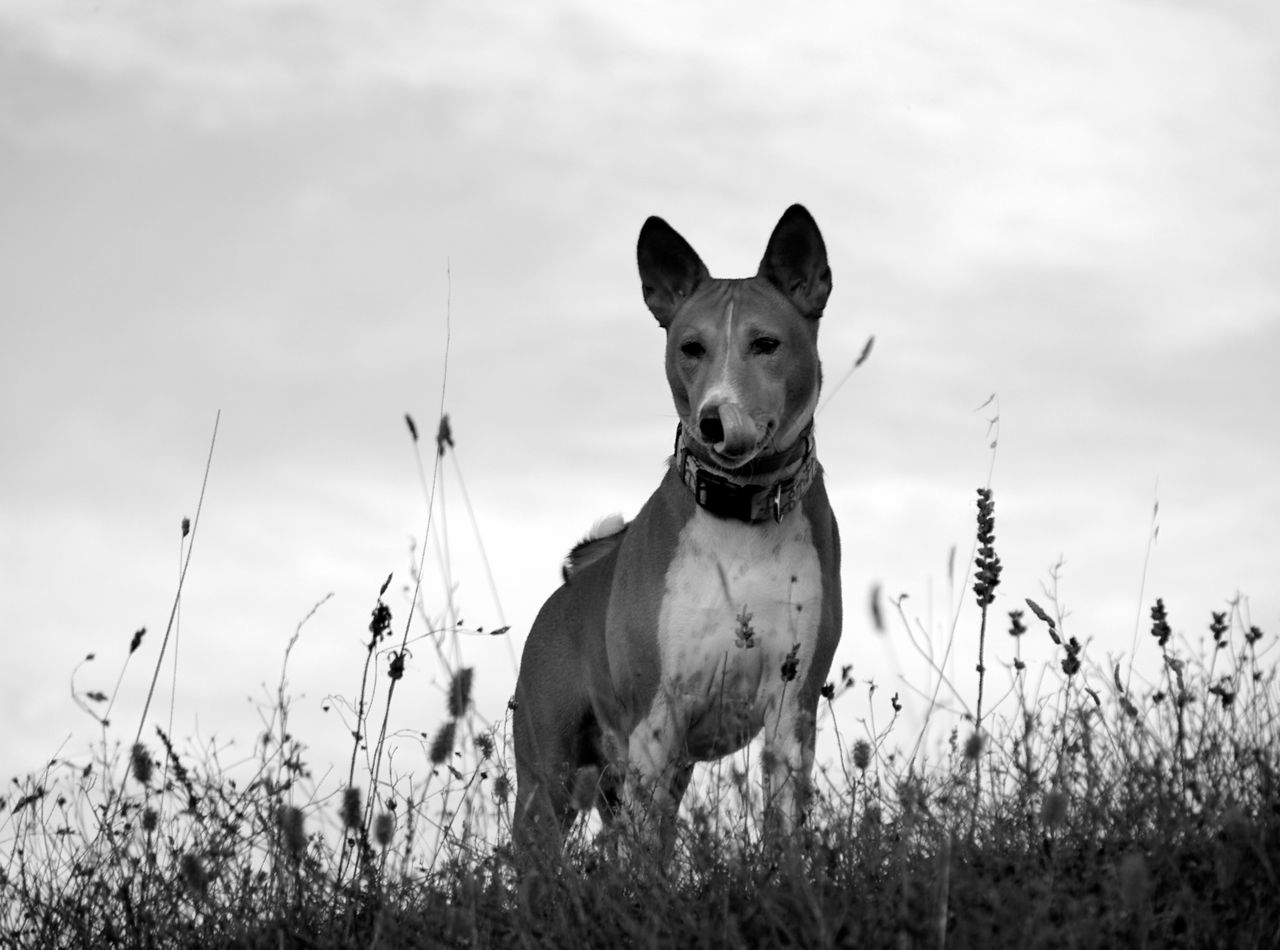
I watch the boys gently lower the body into the little makeshift grave. They tuck back Cruso’s soft, delicate ears so that dirt doesn’t get in them. Carefully, they fold his tail over his back legs. We each pet Cruso’s wiry fur one last time, then shovel sandy, red West African soil over him with the flat side of our machetes. The parched earth sends up wisps of dust that linger in ghostly motes between us. There is no ceremony to the burial, no tears, no words. But before they leave, Moise scratches a crooked cross into the cinderblocks above the mound with the edge of his blade.
I wonder why Moise and Foustin care. They are just my neighbors. Cruso was not their dog. He was mine: my friend, my responsibility. My little guardian. And now, he’s gone.
When the boys troop back to the compound to wait out the heat of the Beninese day, I linger by the grave, finally alone. I remember Cruso’s ruddy coat, his short, sharp barks. I don’t want him to become just an abstraction of a West African dog in my mind. What I really want is to hold him again.
The ear leaf acacia trees don’t provide much shade and eventually, I have to retreat from the relentless sun. I trudge to my tiny two-room, zinc-roofed apartment. In the meager kitchen, I busy myself wiping dishes and shelves of the fine red that the strong winds of the dry season sprinkle over every surface. As I pick up each plate and bowl, spectral outlines are remembered onto the wood of the shelf underneath. There will be more dust tomorrow, more cleaning—I know that. But I need to keep my hands moving while my mind ricochets between thoughts of the little dog who kept me company for months.
“Ko, ko, ko,” my neighbor Marie calls from my front door, using the traditional Beninese greeting instead of knocking.
“Come in,” I say, setting down a stainless-steel bowl. My voice sounds flat. It would be appropriate to lard it with grief, I think. But that wouldn’t be true to how I feel. What I really feel is a shivering emptiness—like a shattered window.
“I’m sorry about Cruso,” Marie says, stepping into my apartment. Brass bangles clink softly on her wrist, reminders of her family in central Benin.
“Me too,” I say.
Marie is a fellow teacher who works with the smallest kids at the primary school just down the street from the middle school where I teach. I can imagine the little ones adore her: she is always sunny and kind, often smiling, always patient. She stays by the door, though all of my neighbors know they’re welcome to take a seat on the makeshift couch in the corner that I made from an old, inflatable mattress.
“In my family, we believe that sometimes when an animal dies, it sacrifices its soul to protect you,” Marie says. “Maybe he saved you from something dangerous.”
“Maybe he did,” I say.
The idea that Cruso had died on my behalf is irrational, I think. But as the idea lingers in my mind, I find it kind of beautiful.
Getting a dog was irrational, too. Dogs were not on my mind when I joined the Peace Corps. I graduated college knowing I wanted to travel the world and do something good—even if I wasn’t sure how I would do that. Being a teacher in the Peace Corps fit the bill. In Benin, I sharpened the skills I would need as a teacher: creating lesson plans, managing a classroom, and coaching students.
Along with the teaching tips, experienced volunteers with months or even years of life in Benin under their belts also coached us on skills we would need to live in villages far from running water, electricity, and grocery stores. Among their stories of opening coconuts with machetes and lessons in negotiating bush taxi fares, some of my fellow volunteers mentioned that they did not live alone: some had dogs. In a country where they knew no one, dogs became their best friends, comforting homesick volunteers as well as keeping them safe in remote villages that had no formal police forces.
Still, I wasn’t planning to get a dog. At twenty-two and living thousands of miles from the Midwest where I grew up, I was still figuring out how I would even keep myself alive. But one day, as I made my way through the dazzling chaos of the main Porto Novo market, I saw Cruso. He was a tiny Basenji puppy tucked in a basket between a kitten and a pair of chickens. Right away, I yearned to hold him. I wanted to feel his warmth close to my heart, his paws in my hands. For the equivalent of three dollars, he was mine.
Over the next month, he transformed from a nervous shadow into a curious, enthusiastic companion, greeting me when I came home and diligently examining my homework as I studied to become a teacher.
When we finally moved to the village where I would teach, Cruso took to his guard duty immediately and without prompting. He met anyone who came to my apartment unescorted with a warning bark and a growl. His patrols also kept chickens from sneaking into my living area, which the nosy birds constantly attempted to explore before he chased them, squawking, across the compound.
I taught him the command to let visitors pass, a feat that awed my neighbors. Before Cruso, no one in the village had ever seen a dog who could sit or offer their paw on demand. They were used to loping, semi-feral animals that scavenged on the outskirts of town or the growling, angry beasts that wealthier families kept chained in their yards. There was no talking to dogs like that, no commanding them.
I couldn’t blame Marie and other villagers for being skeptical of Cruso when I first brought him. But when they learned the words that would summon him, make him sit, or entice him to lie down, he became their friend, too. Each night, after the molten, tropical sun dissolved beneath the palm-hashed horizon and cook-fires blazed to life, I heard Moise and Marie and Foustin call him:
“Cruz! Cruz!”
Hearing his name, he shot across the yard, a little shadow in that greater darkness, the white tip of his tail flashing like a shooting star through the night.
Cruso’s ghost is the afterimage of his life, gliding over earth that still bears his paw-prints. It is dark now and, as I prepare dinner, my eyes linger on four sacks of akassa that would have been his breakfast and dinner over the next couple of days. Everywhere I look, I see fragments of his life. If I wanted to, I could imagine he was still with me: a ball rests where he dropped it after playing, a scrap of cloth in which he liked to curl up still lies near the door. I haven’t had the heart to move it yet and I’m not sure when I will.
When I sit to eat, I notice how quiet the night is. The other families around the compound talk in subdued tones. Music often rolls from one house or another. Tonight, the air carries nothing but insect song.
After dinner, I leaf through my lesson plans for the next day, checking that I have enough to teach my students. As I scan the pages, I notice tomorrow is February fifteenth. That makes today, Valentine’s Day. I pause and let the irony that I lost Cruso on the day marked for love run through me in cold rivulets. It’s just a coincidence that I would lose the dog I loved today, I tell myself. There are no meanings and no evil spirits that his death saved me from. I don’t want to connect any dots, but the weight of it presses in from the darkness.
For the first time that day, tears came.
Monday dawns with sleeves of clouds across the sky. Occasionally, they obscure the sun, though this doesn’t do much against the crushing heat of the late dry season. As I bike the two miles to school, I admire the distended gray and blue bellies of these clouds and wonder if they promise rain. Anywhere else, they might, but we are now in the most oppressive part of the dry season. It is irrational to hope the drought will break soon.
At school, I step into a routine that has nothing to do with Cruso. He rarely left the compound and never came to school with me. My students don’t ask about him. I’m thankful for that. I feel like the clouds that drag themselves across the sky: heavy and ready to break apart. I’m not sure if I have the grace to handle questions about Cruso yet.
My students and I practice vocabulary about family and learn to knit the new words together into full sentences. I encourage my students to play with the language and try it out for themselves. It is miraculous, the way strange sounds gather meaning around them until suddenly, my students understand “mother” and “brother” and “friend.”
About half-way through the day, another miracle arrives. As I finish writing the homework problems across the vast chalkboards at the front of the class, an unmistakable hiss fills the air. In the US, you don’t get to hear the way a curtain of rain sweeps towards you from miles away but here in Benin, you learn the sound intimately. It is the exhale of long-held breath, a liquid “ah” from every lung.
Before I can say another word, my students jump from their seats and run into the field outside the classroom. They dance in the first rain of the season: screaming, laughing. I imagine how Cruso would have played in the rain with them, leaping between puddles, then shaking off the damp and returning to stand with me. Waiting to see what I do.
It brings new life the day after Cruso’s death. Maybe it’s just coincidence. But for now, I choose to believe in magic. And I step out into the downpour.

