

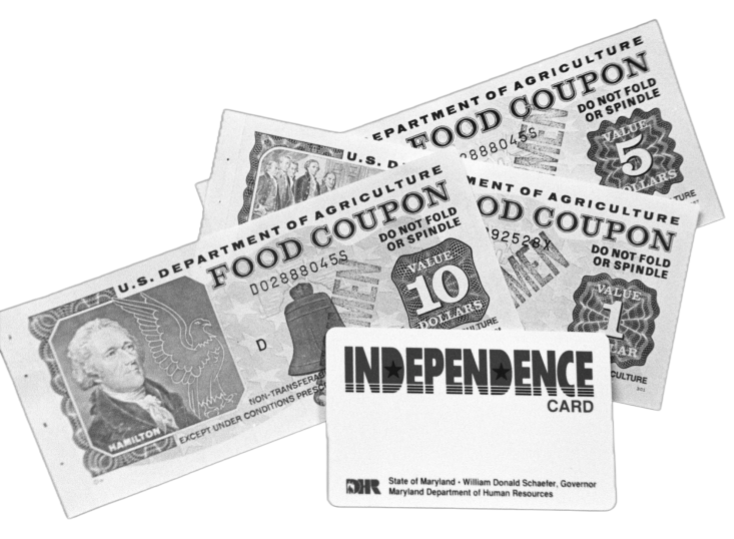
Before being disguised to look like debit cards, food stamps resembled legit, paper money. Smaller than real bills, they came crowded together in wallet-sized checkbooks, in pastel denominations of 5’s, 10’s and 20’s. We’d wander the market, Mom and I, collecting cold slabs of beef, discounted soups, and stacks of bleached, flavorless breads. Government rules for food stamps were unflinching and prepared or “hot” foods were strictly forbidden. So we kept clear of the deli, the bakery, of the shimmering spits of rotisserie chickens and pies baking fresh in roaring, steel ovens. We could see, we could smell, but we absolutely could not touch.
At the register, my mother tore the stamps from the book. The soothing pink of a 5. The cool blue of a 10. The lemon yellow of a 20. In her fingers, a rainbow of stained paper colors emerged. She’d hand the cashiers the bright, make-believe money, and they’d give her real money in change. I watched her shove the crumpled bills down her pocket, an alchemy of conversion that seemed surreal and near magic. Presto! Fake money into real money, from nothing into something.
“This is for us, for free?” The boxes were stacked at our door, dropped off by volunteers from local food shelters. “This is just ours?” I’d ask. “We get all of this?”
Inside the box, an assortment of items sealed in industrialized, black and tan cardboard. Waxy blocks of sharp cheddar cheese. Instant, fat-free dehydrated milk. Unsalted crackers. Every box, every month, the same foods every time, including a white, waxy box labeled in aggressive black caps, “BROWNIE BATTER.”
“Please,” my brother and I begged, presenting the box to Mom. “Please, can we eat this?” Her sigh was a nonverbal surrender, and we’d pour sweet heaps of dirt colored dust into cracked plastic tumblers, blend it with tap water, and drink/chew our way through clots of generic, cake-flavored sludge.
“So good,” we’d say to each other through teeth stained black with saccharine grit. We’d consider our privilege, our luck, that allowed us to drink brownie mix from a cup. What other kids in the world could do that? “So good,” we’d say. “Isn’t this good?”
The Gleaners, a roving band of volunteers who rescued discarded food from local grocery stores and mini marts, set up shop outside of a different house every month. Sometimes they’d be in someone’s backyard, other times spilling out of a cluttered garage, 4×4 parts sneaking up to their backs. Hovering behind a hodgepodge of plastic card tables, the Gleaners would heap past their sale date donuts, cupcakes, and cellophane-wrapped sandwiches into oversized, clear plastic bags.
A mile of people piled ahead in a line, no matter how early or late we arrived. Mom, forced to endure her children’s whining and fighting, would threaten us with spankings, with groundings, with things we knew she lacked the strength to deliver. So we stuck to our fighting, soaking wet grass revealing every hole in our sneakers.
“Thank you so much,” Mom would say when it was our turn at the tables, hoisting the plastic bag she was handed into her arms. Heading home, the air candied and sick from the scent of our haul, my brother and I plunged our hands into the bag’s sticky innards, battling for pastries, our fingers like slight, fleshly scales that could measure by touch the weight of each donut’s freshness.
“A sandwich first, then dessert,” Mom commanded. She’d catch our eyes in the rearview mirror. “And the date. Make sure you check the date.”
I pulled a half sandwich from the bag. Turkey, with cheese, on white bread, mummified in clear cellophane. On a faint, gummy label, a series of numbers I could barely make out. I passed the sandwich up to her. Mom squinted at the label and again, I watched her face strain from the burden.
“Okay. I think… this… should be okay.”
A bright Monday morning, and a girl in my class raised her hand when Ms. D’Aboy asked what we did over the weekend. She’d had a birthday, and she wanted to show off the shining, silver watch she’d received. Other kids followed suit, raising their hands, and an impromptu exhibit of watches, bracelets, and jewelry began. No watch, no bracelets, no jewelry to share, I kept my hands locked at my sides.
That afternoon, I flashed my monthly lunch card, a gift from the county, at a boy in line next to me inside our school cafeteria. He had to pay for his lunch, one dollar a day, every day, with money he got from his parents. All the kids did. Wadded up singles folded into wallets or fistfuls of coins in zipped sandwich baggies, surrendered to our lunchroom cashier. But not me. I received a new card every month, which I signed in my most extravagant cursive, each letter building up to a crescendo that screamed out my name. I finally wanted to show off what I had to share. Look at my name on the back of this card, after all. Look at how fancy, look what it told the world about me.
“I don’t have to pay for my lunch,” I said, revealing my card. “See? This means I don’t have to pay.”
The boy glanced at my card. He snorted. “You don’t have to pay because you can’t afford to pay. That’s what that card means. You get your lunch for free because you’re poor.”
Made out of paper, frail as it was thin, the lunch card collapsed as my fingers wrapped around it. Somewhere inside, some part of me collapsed just the same. I looked down at my clothes, at my plain yellow t-shirt and faded blue jeans, my grubby white sneakers squeaking on the linoleum. They weren’t so different from the clothes of everyone else standing near me. In the same way that food stamps gave an impression of currency, hadn’t I given an impression of sameness? But the county was paying my bill and my bill alone. No one else in the lunch line could brag about that. Look at my name on this lunch card, I’d said, and my classmates did just what I’d asked. And they knew exactly what it said about me.
My turn in line, and I handed my card to the cashier. And suddenly I could see through the eyes of my mother, handing a fistful of food stamps to the grocery store checker.
My turn in line, and I was handed a tray of food I didn’t pay for. And how easy to feel the hands of my mother, hoisting a box of basic foods from our porch, struggling a bag of expiring baked goods and meats into the back seat of her car.
My turn in line, and how easy to now imagine my mother, a child just like me, in a lunch line at school, thinking a paper lunch card made them special, unaware it was for all the wrong reasons, unaware of what it said of them now and what it threatened to say for their future.

