

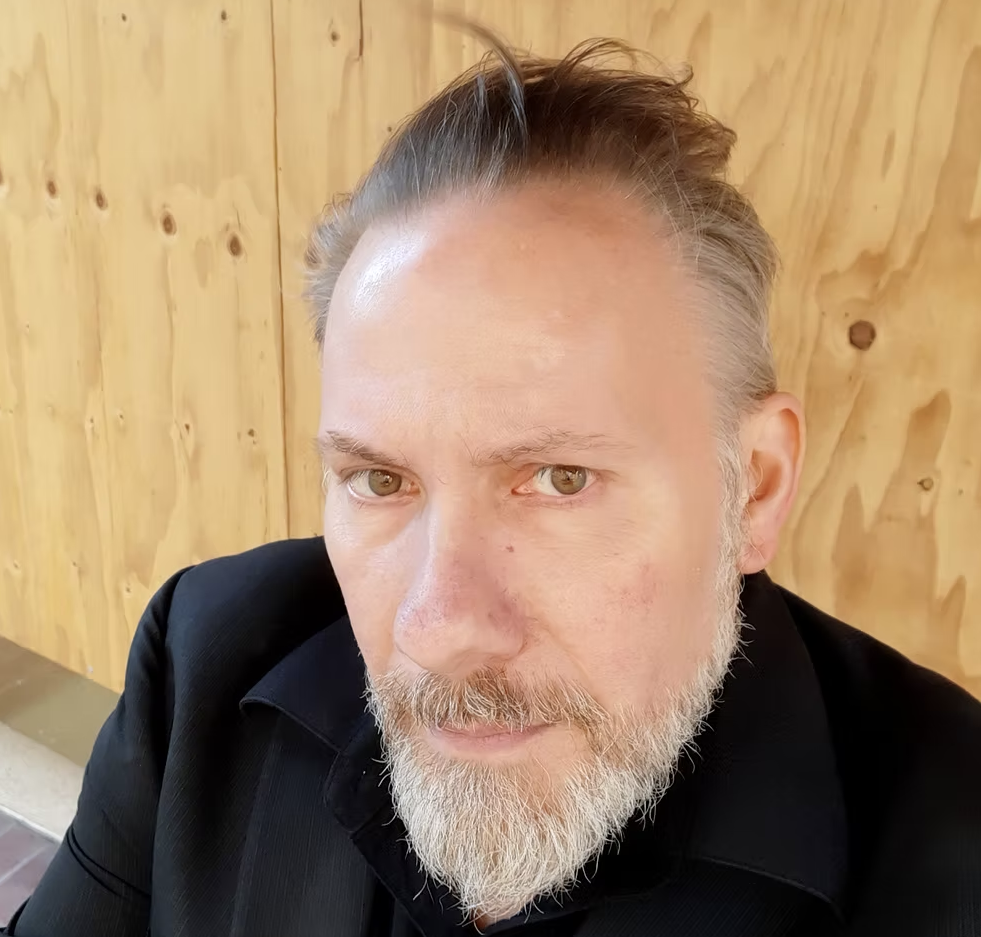
William Taylor Jr.lives and writes in San Francisco. He is the author of numerous books of poetry, and a volume of fiction. His work has been published widely in literary journals, including Rattle, The New York Quarterly, and The Chiron Review. He was a recipient of the 2013 Kathy Acker Award, and edited Cocky Moon: Selected Poems of Jack Micheline (Zeitgeist Press, 2014). His latest poetry collection, A Room Above a Convenience Store, is available from Roadside Press.
FR: I’m going to start with your outstanding collection, A ROOM ABOVE A CONVENIENCE STORE. Do you, or did you actually live above a convenience store? Were they the main inspiration behind the poems?
WT: I’ve never actually lived above a convenience store. In the titular poem (is titular a bougie word? Should I just say, “title poem?”), the room is imagined as a liminal space, like a hotel room, a place where nothing is expected of you, and you can just hide there from the world for a while. It was also an excuse to make a David Lynch reference. In Twin Peaks lore, the “room above the convenience store” is a kind of meeting/waiting room for supernatural beings. It doesn’t exist in the physical plane.
FR: People outside the poetry world don’t really understand that it’s a labor of love. It might bring awards, recognition, even a bit of fame, but what it doesn’t often bring is an awful amount of money, outside the dead or a select few who made dollars from it when alive. That select few is a select few. What keeps you going with this particular art form? You have published solid short fiction, and you also paint, but what keeps the poems coming as your main source of creativity?
WT: In truth, these days I write mostly poetry because it’s a shorter form, and I can usually complete a piece before I get tired of it. When I sit down to write a story, if I don’t get a decent draft completed in one or two sessions, I tend to abandon it and go on to something else. I lose steam, forget why I wanted to write it in the first place. I realize now that I should have really tried to write a novel when I was younger, back when I felt most everything I had to say was interesting. Now I second-guess myself too much. With a poem, you can just get it out there and be done with it before you or the reader gets bored. Little bite-size snapshots. That being said, I plan to revisit my graveyard of abandoned prose soon and see what I can salvage. I think I may have at least one more collection of stories in me.
FR: You used to live in the notorious Tenderloin District of San Francisco. You have since moved to a different area of San Francisco not long ago. How has living in the two locations changed your writing and approach to writing the poems? Are they different in some ways?
WT: Living in the Tenderloin, there was always immediate fodder for writing. Terror, absurdity, beauty, despair, everything everywhere, all at once. I’d look out my window at 2 a.m. and there’d be some guy just sitting in his car and crying, and a few feet away there were some homeless folk whacked out of their minds on something, fucking on the sidewalk, all the tech bros spilling out of the bars, roving around in howling packs…a decent amount of writers and artists still live there as well, because it’s the most affordable place in the city, so there was always something interesting happening. Thanks to the fact of so many people fleeing the city during the pandemic, we were able to afford a bigger place in Lower Pacific Heights. The new neighborhood is nice but boring. A lot of pretty Edwardian apartment buildings, a Whole Foods half a block away, but nothing ever really happens. Luckily, the Tenderloin is still just a 10-minute walk, and North Beach is a quick bus ride.
FR: Did poetry come to you growing up in Bakersfield? Bakersfield and San Francisco are different places. Tell the readers about growing up there, what it was like, and what influence it would have on you through your life to be where you are now as a writer and painter?
WT: Well, as I imagine many people know, Bakersfield is a pretty conservative place. The armpit of California it’s been famously called. It had the distinction at one point of being both the least educated and the most polluted city in the country. But as a kid, of course, I knew nothing about politics, and had nowhere else to compare it to. There wasn’t much to do for a young person there, so I think a lot of kids started drinking or doing drugs fairly early. But I imagine it was that way a lot of places. I just drank because I wasn’t cool enough to know kids who did other drugs. We did the usual things, hung out in parks and drank and played cassettes on a boom box, hung around the mall and the video game arcades, cruised downtown on Saturday nights. I don’t generally have bad memories of growing up there, but now, when I visit as an adult, if I stay there longer than a day or two, I get depressed and anxious.
My parents weren’t big readers. My mom read the newspaper and the TV Guide. My dad subscribed to magazines—National Geographic, Popular Mechanics, and Reader’s Digest. The only books we ever had in the house were the Bible and those Reader’s Digest condensed novels. The first “adult” book I remember reading was the Reader’s Digest condensed version of Jaws. While he wasn’t a big reader himself, my dad was very good at taking me and my brother to the library each week, and I’ll forever be grateful to him for that. I took to reading with the usual stuff—The Hardy Boys, Beverly Cleary, E.B. White. I think I really started to discover poetry around my senior year of high school. We had an English teacher named Bill Miller, he was kind of a cynical aging hippie… had a real George Carlin energy about him. He was very passionate about literature and poetry, and it was infectious. I remember he took the whole class to the theatre to see the film version of Orwell’s 1984 when it was released.
FR: When you first found poetry, who were the first poets who stuck with you? Even today, you might like to go back and read a few of those lines.
WT: The first poets that really excited me, I discovered in my high school English textbook. e.e. cummings, A.E. Houseman, the Stephen Crane poem about the creature in the desert eating its own heart and liking it, “because it is bitter, and because it is my heart.” I was excited about some of the romantics for a while, mostly Byron and Shelley, all dark and melodramatic. Keats always bored me, it just never clicked. The first poet I got truly obsessed with was Thomas Hardy. His poems tended to have this darker worldview that resonated with me—life was cruel, everybody dies, god was indifferent—his poems, in my mind, presented the world as it was. I still revisit him regularly, and Tess and Jude are still two of my favorite novels. I discovered Robinson Jeffers pretty early in a textbook as well, and he was a game-changer for me. I discovered Bukowski, of course, at some point a bit later.
FR: You’ve published many collections of poetry going back twenty years, I want to say PRETTY THINGS TO SAY, might be one of my personal favorites. Most of your poems are open, raw, and honest, but I think you really shine in that book. A man who is completely fed up, yet, still finding comfort in the small things: a jukebox, a beer, a beautiful woman you’ll never see again. What’s your process like putting the poems together to make a collection? A lot of throwaways? Edits? Tell us about the process.
WT: I read a lot of poets talking about sitting down to “write a book of poems,” but it’s never been that way with me. I mean, I never write things with a collection in mind. I just write the poems as they come, submit them to places, and then, when eventually I feel I have enough solid poems to make a full-length collection, I gather them up and start reading through them and ditch the weaker ones, and the ones that just don’t feel right with the others. I tend to do a lot of minor editing once the poems are gathered. Sometimes I’ll send poems out before they are fully polished, and I generally tighten everything up a bit when collecting them in book form. I tend to add more punctuation as well. When I first write a poem, I often don’t use much punctuation, just line breaks. I eventually end up adding more punctuation when I publish them as a book, to make it all a bit more coherent.
FR: You’ve worked with a variety of publishing houses, as do a lot of poets. Most poets are not lucky enough to have a Black Sparrow to bank roll them. How is in it in 2025 working with a ton of different publishers, seeking them out, and simply publishing a poem in a magazine nowadays, compared to when you first started?
WT: As far as publishing my books, I’ve been really lucky in working with a lot of great people over the years. I’ve had very few bad experiences. We just kind of find each other. My last book was published with Michele McDannold and Roadside Press, and they’re a good fit for me. We’ve known each other many years now, and they publish a lot of people whose work I respect. They do a good job of designing the books, and really stand behind them once they’re out in the world. I always like working with a press that does a decent job at promoting and distributing their books, as I’ve never been all that great at the self-promotion game. Roadside Press will be publishing my next book as well, and I’m pretty excited about that.
As far as publishing in journals and magazines, I have to say it was all a lot more fun back when everything existed more in the physical realm. One of the first poems I ever published was a piece about Ian Curtis from Joy Division. I was in some shop in LA. and picked up a gothic music zine called Altered Mind. They had a few pages of poetry mixed in with the music stuff, so I submitted, and they accepted my Ian Curtis piece. This was like 1993 or so. There was another zine I’d see around L.A. at the time called Notes from the Underground. I was a big Dostoyevsky fan, so I submitted and ended up getting along really well with the editor, who started publishing my work on a regular basis, and he wrote an introduction to my first self-published chapbook. I was still in Bakersfield, so having my work published in journals based in LA, and seeing it in stores where people could just pick up a copy, was pretty exciting stuff. I thought I had it made, I’d be the next Bukowski! Notes from the Underground would be my Black Sparrow! They were, in a way. They gave me confidence in my work early on, and seeing my work out there in a major city like LA encouraged me to keep on with it.
Having most everything online these days takes away some of the energy and excitement of it all. The immediate gratification of “likes” when you publish a poem on the internet is all well and good, but nothing beats having your work available in magazines that people could just pick up in record stores, book stores, and head shops. It’s harder now for people to randomly discover your work. Plus, the act of submitting was much more satisfying as well. You’d go to the post office and send off those fat envelopes stuffed with poems… you’d check the mailbox every day, and if the envelopes came back still fat, you knew it was probably a reject… but sometimes the envelopes came back thinner, which likely meant some poems were accepted. Getting a reply from Submittable, if you’re lucky, just doesn’t have the same thrill.
FR: The question I ask everyone, influences. Give me five of your favorite dead poets, and give me a few living poets that you enjoy reading?
WT: Denis Johnson, Thomas Hardy, Charles Bukowski, Baudelaire, Robinson Jeffers. I don’t like mentioning living poets, because then all the living poets that you don’t mention feel slighted. But to name one… there’s this young fellow out of the UK… Tempest Miller. I’ve been seeing his stuff around, and it has this punk/dadaist energy to it that really makes me happy. So much poetry, even stuff I like, tends to be so samey these days. It’s refreshing to see something new that has some vitality and fire.
FR: You have a reputation in the S.F. area and are always out and about giving a reading and now art shows. As much as I hate the word “community,” how does it feel to be embraced by a community of artists and writers, even meeting new people, via this machine from as far as England?
WT: I’ve always been wary of the “literary community” thing, as I don’t necessarily have much in common with someone just because they fancy themselves a writer. But it is nice now and then to connect with other oddballs who are on a similar wavelength. Being a part of the literary and artist community in San Francisco is kinda surreal, as it’s something I had an interest in early on. One of the earliest stories I remember writing was about a guy who sold his paintings on the streets of San Francisco’s Fisherman’s Wharf. I have no idea where the idea came from, as I’d never been to San Francisco at the time. I guess I’d read about it in a book and it seemed romantic. Before living in San Francisco, I was in Santa Cruz for 10 years, about an hour away from SF. I’d go to the City for readings fairly regularly, so it was an ongoing goal to become more a part of that scene. When I finally moved to San Francisco and became more immersed in the literary/North Beach scene, it was somewhat surreal, because I was meeting and hanging around with a lot of people who were almost like fictional characters to me, people I’d been reading, or reading about, for years in the works of others. A lot of people from Bukowski’s circle, like Neeli Cherkovski, Linda King, Al Winans, francEYE, etc. People I knew as characters in poems and letters, and here they are, sharing a beer with me! And old Lawrence Ferlinghetti is shuffling by with a wink and a nod! I remember years ago I showed up at Neeli Chekovski’s place for a reading, but he had changed the date and forgot to tell me. He invited me into his backyard and we sat there drinking wine as he read one of my books out loud. I sat there thinking, “this is some crazy shit.” So, despite my misanthropic, curmudgeonly, introverted self, it is special to me to be a part of the arts community here. North Beach is still a haven for bohemians and weirdos, and there’s residual energy from all the literary history that came before. I mean, my 20-year-old self would think that living in San Francisco, doing readings and showing my art would be the pinnacle of existence, so it’s a kind of victory. And he wasn’t completely wrong.
FR: What’s coming up next? A new collection of poems? A new book? Short stories? More art? Or piddling around until you damn well feel like it?
WT: My next poetry collection, THE PEOPLE ARE LIKE WOLVES TO ME, is set to be published in November by Roadside Press. After that, I’d like to try and concentrate on stories for a while. The poems have been coming slower, and I would like to get another collection of short fiction out there. And keep on with the visual art as well. I’ve been showing my stuff locally in some group shows, I’d love to amass enough pieces that I’m really happy with to do a small solo show. Lastly, I’d like to start thinking about getting a nice “Collected Poems” out there, for posterity’s sake. Or, at least a solid “Selected Poems” to get all the best stuff together in a single volume.
BONUS QUESTION:
FR: You are baking a holiday ham with all of the fixings. You are eating that holiday ham and enjoying a fully stocked bar of liquor and beer while watching the entire David Lynch catalog. You can invite five poets dead or alive, who are you inviting and why?
WT: Anne Sexton—I always thought she’d be fun to get drunk with, and I think she’d dig Lynch; Baudelaire—we could hit the absinthe and talk gloomy shit; Walt Whitman and Allen Ginsberg, they could get drunk and chant and dance and other hippy shit while Eraserhead plays in the background…and you could come and talk shit about Lynch while Whitman does the jig.

