

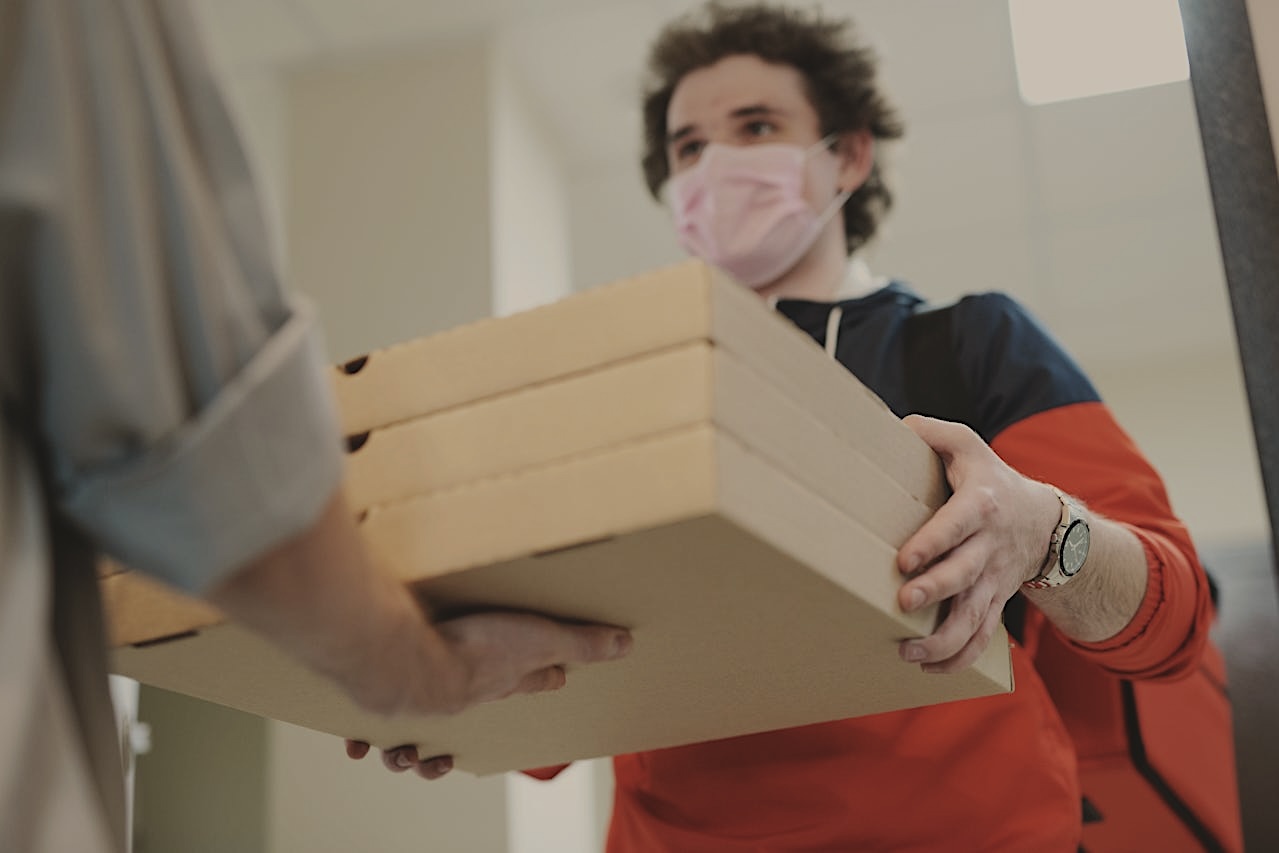
Over the phone, I tell the customer service rep my pizza has disappeared, and more to the point, my delivery driver, Zephyr, has likewise vanished. I watched it happen, I say. I watched the map on my phone as the car icon barreled apocalyptically up Route 4, Pac-Manned its way through town, and turned onto my road, Esker Road, a serpentine path winding for miles through the woods. Around 1:26 a.m., the car—along with Zephyr and, presumably, my medium Carnivore’s Delite—evaporated. Along that stretch, at this time of night, something marginally catastrophic may have happened, and I don’t want to get into a whole big thing here, but this should, ideally, be concerning.
I tell the rep other things. First, I say, I don’t want the credits toward another purchase. Yes, I’ll take the credits, but I don’t want to appear to want the credits. What I’m saying is this kind of thing doesn’t happen. I’ve ordered a lot of food since the advent of lockdown, much more than you’d need to feed a man living alone. A recently unmarried man, by the way. And by the way, a father whose daughter died on purpose. Point is, this doesn’t happen. If there’s a problem, the order’s canceled. Or I get a text message asking if there’s really a house out this far. Something happens, though. Not this. Not nothing.
The rep says he’s doing his best. Which I get. But Zephyr, I say, seems to be on the younger side. Seventeen maybe. My daughter’s age. As old, by the way, as she’d ever get. How is it that I’ve so confidently ascertained Zephyr’s age? Consider that Zephyr is, arguably, a pseudonym. And not the pseudonym of an ancient like me. An ancient like me picks something from his cinematic upbringing, such as Marty McFly. And with a name referring to a gentle breeze, Zephyr must be imaginative, which is a feature of youth. Picture a squirmy sketcher of ink drawings, a lover of dragons. Piercings. Hair that’s occasionally pink. Scars laddering her forearms.
They’re easy to see, these scars. Anybody could see them, I say. Did her father see them? What did he say when he saw them? What did he do? And how can it be that, in the middle of the night, this Zephyr is wending her way up Esker with nothing but a phone glow to guide her?
The rep, audibly vexed, says there’s no reason to think anything nefarious has happened. This, to be clear, is derision. Unsubtle mockery of my unique vocabularic choices. But I take the high road and spare him the full brunt of my prodigious lexicon. This is about Zephyr.
With exemplary patience, I tell him Esker Road traces the spine of an actual esker, a thin ridge formed ten to twenty thousand years ago by the meltwater from the shrinking Laurentide ice sheet.
That’s nice, he says.
You don’t understand, I say. Given this provenance, the ditches flanking the road are steep. Is ditches even the word? Chasms, maybe.
Steep, he says.
I remain calm. I ask him his name.
Patrick, he says.
Okay, let’s go with Patrick. Zephyr needs our help, Patrick. Understand that if my car battery still had a charge, I’d launch a search myself along Esker—looking for skid marks, broken branches, headlights casting needles of light into the forest canopy.
I pause to see if Patrick understands. It’s hard to tell with Patrick.
Imagine being seventeen, I continue. Seventeen today, I mean—an era in which truth yields to loud opinion, when mere reality bends to assertion, when This is not really happening does not contradict This is all your fault. Zephyr’s told to work hard, stay strong, better days are ahead. And yet these days have collapsed into a thin strip of sameness lolling out into an oxymoronic future that all of us made and none of us wanted.
Therein, Patrick, lies my point. The future—not wanting one. Picture Zephyr. There she goes up Esker, her hair soft as a newborn’s. And she knows it’d be easy. A sharp acceleration, a quick unbuckling, a smart flick of the wheel. And that would be it. Pinned in a tree-crumpled car, she could subsist on Carnivore’s Delite for a time, maybe still playing the classic rock she inherited from her dad, himself somewhere ending in his own way, whether he knows it yet or not.
Patrick has, at some point, terminated the call.
Who can blame him? We’ve all had enough.
And maybe, after everything, it’s just a glitch. The signal is, I admit, pretty weak along that stretch. Or maybe the pizza was delivered to the wrong house and then not logged—mistakes eating mistakes.
Maybe Zephyr, at least, is fine.
Maybe more than fine. Maybe she’s absconded. Maybe she’s driven past my driveway and followed Esker until it emerges from the woods, cuts across the salt marsh, and becomes Ocean Boulevard along the coast. She’s a drifter now, this Zephyr, blowing from town to town picking up orders, keeping them for herself, gliding down the unending road.
It’s not so far-fetched.
She’s cruising down the rocky coast in a cherry convertible, a late afternoon in the late summer, her long hair fluttering in the salty wind, aviators glinting in the sun, speakers blasting Lynyrd Skynyrd. The pizza’s wearing a seatbelt.
Everything and everyone is behind her now. They’ll think of her often, of course. Her father, especially. He’ll wonder where she is, what she’s doing, whether she thinks about him. Maybe, after a while, he’ll give her a call, maybe leave a voicemail. Just checking in, he’ll say. Just seeing if you need anything. Call back if you want. It’s okay to call back. We didn’t mean for things to be this way, he’ll say. Come home, he’ll say. We miss you, he’ll say.

