

In the Best Way
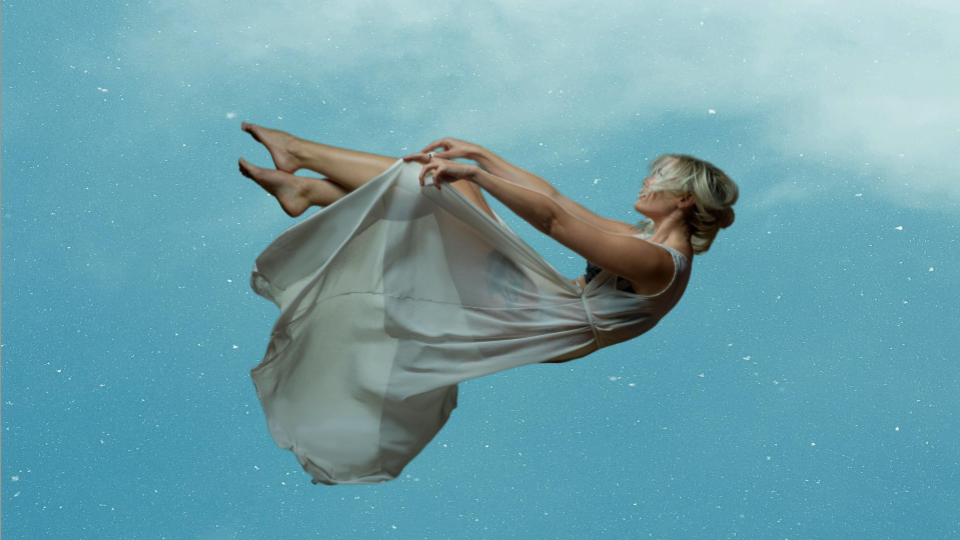
Annie steps out. When she slips from the rooftop, her first thought is not, I’m going to die, but I didn’t feed the cat.
Five stories down from the edge of the parking garage.
Between vertigo and velocity, something unhooks. A thread pulls from a different seam.
The street below is gone. She’s standing barefoot in her kitchen, fingers sunk in a bowl of bread dough. She smells of rosemary and oil. The radio whirs a low, glad song she doesn’t know. Beneath the dusty window, the laminated floor gleams in sunlight. A girl, her daughter, leans over a coloring book at the table, humming. Annie hums back.
The front door opens. A man calls out, not with his usual voice sharp as a knife, but a soft, stupid greeting. “I brought the good tomatoes.”
He squints in the sunlight and holds up a bag like it is treasure. He’s already bitten into a tomato, juice dripping off his knuckles. There’s a tiny smear of dirt on his cheek.
She feels no dread, only love.
She lives here, apparently, in this small life. She doesn’t know how she got here, what she said or did or left undone to arrive at this bright slip of time, but the absence of fear is intoxicating. Her shoulders rest back in their sockets. Her voice, when she speaks, is certain.
“Well, come in. Wash your hands.”
He laughs. “Bossy.”
“You like it.” This version of him does. She smiles and keeps kneading.
She doesn’t linger on the impossibility of the moment. Doesn’t question the sharp relief of safety. She just moves through it and slides the bread into the oven. Boils water. Admires the man’s face lined with wear; it’s not the kind that bruises. It’s the kind that allows things to grow. Her daughter tucks her feet under her chair.
They eat on the porch. Fireflies gather in the grass like small, lit prayers. Her daughter asks if they can stay outside late. The man says yes. Annie says yes. The word feels good in her mouth.
She lives. She ages. Slowly. Not in a blur, but in a calm, legible script. There is no second fall, no hidden rupture. The nights are not all good, but they’re survivable. She works part-time at a library. She learns to swim without fear. Her daughter grows tall and kind and distant in the best way. Annie lets her go. In the best way.
She stands one morning, seventy now, over the same sink, making the same bread, the rosemary still sharp in her palms. Her joints ache, but she is here. The world did not take her. She has remained. Whole. Unremarkable. Saved.
And then, the light shifts. The kitchen buckles. The floor tilts like the roof of a parking garage. Time pulls taut.
She sees pigeons. There’s a woman below in a red coat; there’s the terrible blue of dusk.
Annie is not seventy. She is falling.
A second has passed.
But her mind remains somewhere else, hung in the hush of a possible life. She clutches it like fabric, something she might wear for another second.
Two seconds now. The wind scours her teeth with the grit of asphalt.
Her daughter’s voice comes to her. “I’m glad you stayed.”
Three seconds.
The man’s face surfaces. Not the real one, not the cruel, tired scowl she knows, but the one who holds tomatoes like treasure. The one who softens, who says yes.
Four seconds.
She thinks: What if that version of me is the true one? What if this fall is the dream?
Five.
The sidewalk comes into view, ordinary and exact. Coffee cup. Trash bin. The woman in the red coat pointing.
But Annie doesn’t flinch. She isn’t afraid. She’s steeped in the rhythm of that other timeline, its rituals, its mercies.
Six.
She feels the wind shear past her. Not terror. Not regret.
Seven.
And then, impossibly, she lands.
Not on the street, but back in her kitchen. Back in her body. Her hands are in a bowl of dough. There’s a soft song playing on the radio. Her daughter draws, scrunching her face in concentration.
The bread will rise.
She breathes.
Somewhere across the city, a man opens his mouth to yell and does not.
Pigeons loft and eddy in a startled cloud. Dusk splits the sky open.
The Only Thing in the Air
Let’s say the fire never started. Let’s say you didn’t fall asleep with the burner on, the pan didn’t crackle, the flame didn’t catch the towel edge, & the smoke didn’t slip up the cabinets like a secret. Let’s say the cat didn’t wake first, didn’t cry at the door, didn’t try to pull you back to yourself. Let’s say I wasn’t three hundred miles away, a phone buried in a coat pocket in a room without a signal, dreaming of your shoulder rising with breath, dreaming of you reading something long & slow with your glasses sliding down your nose. Let’s say I missed my train & caught the next, & when I opened the front door, the only thing in the air was the smell of garlic & cumin & heat. Let’s say you were still standing there, barefoot, squinting, reaching for the kettle like nothing had happened, like you hadn’t wandered to the edge of something or almost let it open. Let’s say the pan was just a little scorched & you laughed when I swatted the towel from your hand. Silly man, you know I can take care of myself. Let’s say you could. Let’s say we opened the windows & let the evening in & the neighbors didn’t look over with concern, whisper our names, or ask where the sirens were going. Let’s say I never had to buy a new mattress or paint over the ceiling or throw out the chair you sat in every morning with your coffee & your half-spoken plans. Let’s say your voice never leaves the walls. Let’s say the heat in the room was only from us. Let’s say the clock kept time. Let’s say nothing peeled the ceiling that night to the indifferent stars, & that, later, as you drooled on your pillow, as I watched your long lashes judder, I knew where to put my love.

