

Stanley hung up the phone and looked at the address he had just written down. The numbers were shaky. It had been seven days since his last drink and still, the poison rattled his body.
“It’s all the way on 158th Street,” his cousin said over the phone. “Your dad refused the job. But I figured for you…”
The ellipses were audible.
Stanley’s plumbing career was dead as far as Brooklyn went. No one in Greenpoint would hire him. Word got around, whispers among the babushkas after Sunday mass.
He was late to appointments.
If he shows up at all.
Better than walking in on him, passed out under kitchen sinks, next to toilets, bottles of mouthwash drained.
“Who was that?” his father materialized in the doorway and barked. Stanley flinched. He left the jungle, but the war buried itself in his nerves.
“What’s the matter with you?”
“Nothing. You startled me.”
“I startled you? Can’t ask questions in my own house because I startle you.”
“Someone called with a job.” Stanley’s throat went dry with wanting: the astringent sting of ethanol, the chemical tightening of the vasculature, the fade of unthinking joy.
“For you? In Greenpoint?”
“Manhattan.”
“Buncha cannibals up there,” He waved his hand in disgust and walked back to his room.
Stanley embarked on his long commute the next morning. On the train, someone had a portable Rambler radio. Through the static he could hear a woman’s voice, vulnerable, unaccompanied. She was afraid, she sang, she was petrified.
It made him think of his father, this man who left behind a continent only to settle in a new country where he frightened himself into a two-mile radius. It was the one thing Stanly knew he wanted for himself—that his own life could be bigger. But in Vietnam, it got so big, it swallowed him and he couldn’t find his way out. He looked down at his bag of tools and flexed his fingers. They trembled and rattled like the subway car.
Any life he wanted was on the other side of his quivering hands.
The song exploded. The voice so fearful moments ago was a herald of joy, assuring herself and everyone listening: they would survive. It resonated in a way screeching guitars couldn’t, not with his nerves.
A man in the seat next to him pointed at the source of the music, “You know that disco shit, that’s for queers and coloreds.” He shoved his pointer finger into his mouth and picked at his molar.
Stanley leaned away from him. The volume of the song increased.
When Stanley arrived at the Aragon Ballroom, he was met by a group of dancers. Dressed in head-to-toe leotard, they were short and tall, Black and brown, slender and plump, hairy and smooth. They absorbed him into their own choreography as they navigated him through the hall.
“We’re glad you’re here,” said one of the dancers.
“We’ve got a big competition tonight and this is going to be a full house, honeys.”
“And the toilets keep backing up…”
“This old-ass building…”
Archways stretched the space into architecture normally reserved for churches, where babushkas felt divinity. Stanly felt the same here.
“Tonight is the hands competition,” one of the dancers said, motioning towards a stage with two chairs facing each other.
“Hands?” Stanly shoved his own in his pockets.
“It’s hard to explain, you’ll just have to see it,” one of the dancers said.
“If you have time, you can watch us practice,” invited another.
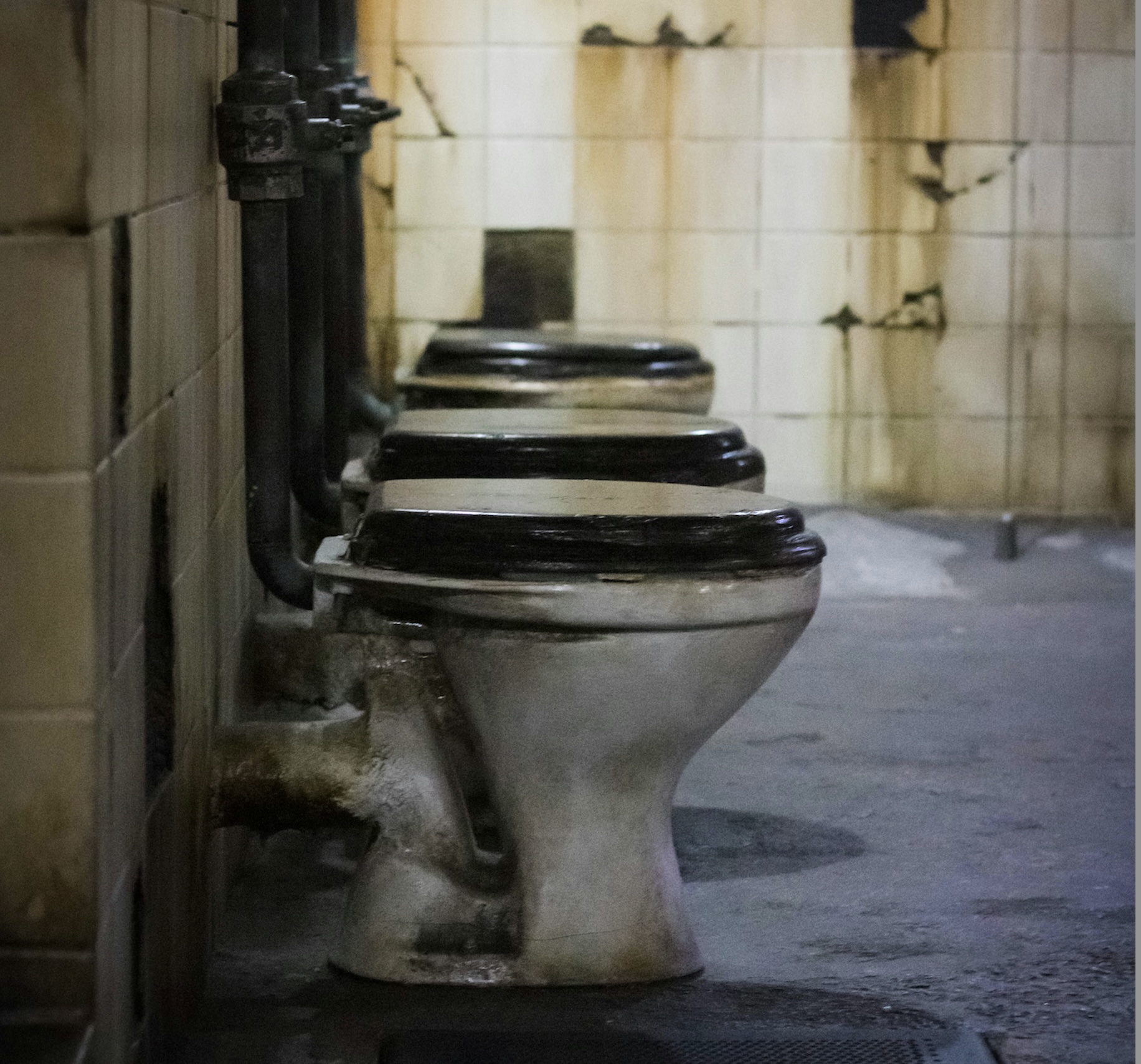
Stanley found his way to the cavernous bathroom. The long rows of toilets let doubt in. Maybe he wasn’t ready for this job. His clammy hands could barely grip his wrench. They were out of practice. He used to search his body for courage, when it was warm and wet. In sobriety, he found only fear—cold and dry. The wrench fell out of his hand.
He steadied himself against one of the sinks. He was helpless and small in these rows of tile. Maybe he should tell the dancers to find someone else.
Stanley walked back to the dance hall where he saw two of the dancers sitting across from one and another on the stage. They looked into each other’s eyes. A woman’s voice filled the room.
The same naked and powerful voice from the train.
Stanley watched the two people on stage. Sure enough, they danced using only their hands.
He was transfixed. When the song tugged at his guts, their hands tugged at the light filtering through the giant windows. When the song soared with blessings, their wrists rolled and fingers fluttered those same blessings. Confident and certain, each pair of hands told the same story. In their own way.
Voice, dancers, Stanley, together in a Harlem dance hall cathedral. Awash in the early afternoon sun, witnesses to a homily of hope. This is how Stanley’s radius widened. He let himself move. The motion was poison leaving his body.
“Look at the plumber! OK, mister. You coming tonight?” one of the dancers knocked their hips against his. Gentle and inviting, his nerves stayed on the train.
“It’s this song.…”
“It’s new, but it’s already our little anthem,” the dancer said. “People here have seen all the ugliness in the world.” The dancer studied Stan, “Maybe you have, too. We do alchemy here, spitting out sulfur, spinning it into gold. There’s no misery out there that we can’t turn into joy right here. Tonight, we celebrate survivors.”
Stanley returned to the bathroom, got on the floor, and gripped his wrench. A version of him, giddy and long forgotten, whistled along with the dancers’ songs. There was something on the other side of sobriety. Something bigger, stranger, and more joyful than what he could have imagined. All he needed to do was get through a day—every day.
He loosed a pipe to the rhythm of the music outside.
These were his hands.
This was their dance.

