

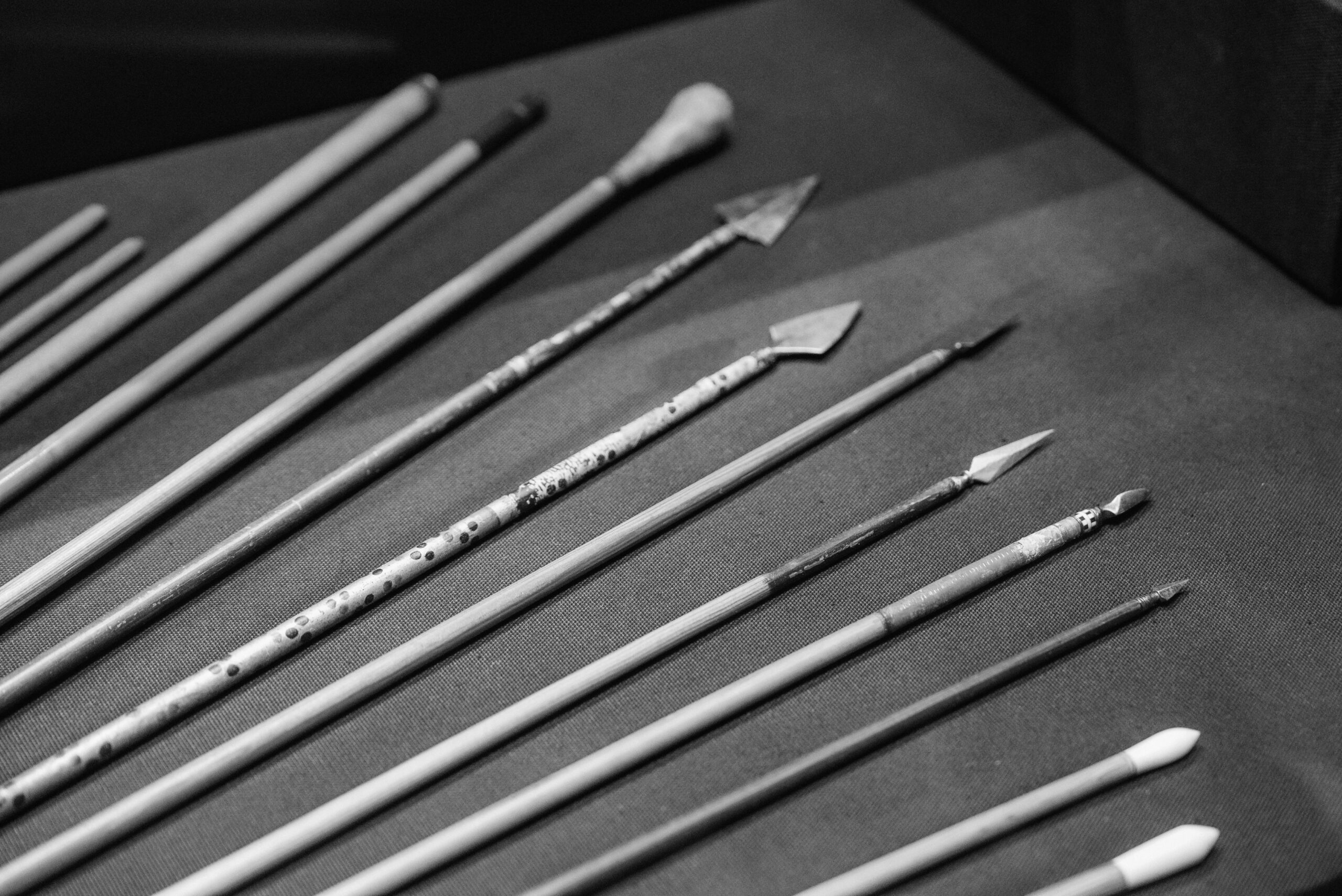
When we get the Good News, I am staring up at the Thomas Kinkade hung over the mantle. I am sharpening my spear, carefully. As to not cut my fingers. Whetstone over metal, the sound close to glossolalia. The shaft bumps my sister’s spear and hers our next sister’s and on and on. Two couches are too small for the seven of us. Dad clears his throat. He says God visited him. That it is time for us to go Home.
The Kinkade is Mom’s favorite painting. She’s not looking at it now. There is nothing inherently godly about the painting but the man is Godly, the Painter of Light, so it is a Godly painting. All acts through belief are Good Acts.
It is titled Bridge of Faith. Dad hacksawed a hole in the ceiling, hung an angled light that always illuminated it. Plants I don’t know the names for erupt in lamentations of carnelian, emerald, jasper, evergreen. The same colors as the Father’s throne in Heaven. Foliage crowns a cobblestone bridge over a brook. I count the stones again and again until the numbers are numbness. Dad’s thunderhead voice folds over me. It looks like the stream out back where my best friend Tim and I try to catch reptiles and make up names for them, where we play Narnians, pretend each stepping stone is a new continent with its own geography claimed for the glory of Aslan.
Dad’s eyes have heavy bags Magic-Markered beneath them. On the floor, our three-legged lab Gabriel huffs, twitches in his sleep. Mom sniffles. Her nose is red. She is nodding profusely at his words, between his words, at the silence.
My sisters tremble but they do not fold. Our spears shiver beneath Dad’s breath. The air is smothered in the smell of leftover Chinese takeout. Our treat for when we’re good, homeschool work finished, floors swept clean as washed feet. But we weren’t good today. Mud from the stream streaks my shins. My earthly possessions are not put into their proper place, their two by-twos.
And yet, a waxy white oyster pail sits empty on the cracked stone table. We came back for seconds and thirds and despite our hunger there was more to be served from the single container. I Sharpie the Jesus fish into my palm. My stomach rumbles but Dad says that we have been properly provisioned, our multitude fed. Now, we must be war-ready.
Dad has been boarding planes, scouring the earth’s underbelly, visiting foreign orphanages and summer camps and sanitariums. He found it, at long last. A country that is far, that is cold, where the children are sometimes born with heads twice the size of their bodies and knife-wound mouths and the adults drag around bloated livers through needle-littered streets and it’s all bleak, starved of His light. No bridge. No brook beneath.
We will plant a church and that church will grow like a flower I don’t know the name for. But we are not gardeners. We carry weapons fashioned against The Enemy. We are soldiers of God.
In church, we roll on thin-carpeted floors and speak in tongues. Our tongues are spears, eternally sharpened by dialogue with Him. In church, I march around a square room hung with our Crayon interpretations of angels. We sing
I may never march in the infantry,
ride in the calvary,
shoot the artillery,
fly o’er the enemy,
but I’m in the Lord’s Army.
I surprise myself by being the first to cry. The first to break. Mom pulls me into her lap. Tells me it’s not all so bad. Dad looks at the Kinkade. His eyes are spent munition shells. I’m not supposed to cry. Eleven is too old. It is not brave of me to cry. In the Book of Joshua it says to be strong and courageous because the Lord will be with you wherever you go. And we will go.
Dad says we will have to give things up, all of us. Our beds, most of our clothes, all but two books each, our lab Gabriel, our Home. Jesus sacrificed himself so that we may live. We can sacrifice our material things.
Dad says conversion is not a compassionate process. We are in a battle for their eternal soul. The non-believers. In the Book of Joshua, they marched around the city walls of Jericho for seven days until they fell. Once inside, the Israelites put every man, woman, and child to the sword. They were beyond the prospect of salvation. It is better to wound one in the process of saving than let them grow, like wicked thorned weeds, beyond saving at all. What if I am not strong enough to cut them down?
We bring the butts of our spears down against the hardwood. The Kinkade rattles above the mantle. I place the point against my t-shirt but it doesn’t pierce. The fabric is heavy as chainmail. Beneath the Full Armor of God, they cannot hear the dread-dredged thud of my heartbeat.
I want to tell Dad how bad I’ll miss Tim, how bad I’ll miss my bunkbed, my sisters singing on the swingset in the backyard, writing verses in sidewalk chalk, the mailman who says hello, the taste of summer rain, Gabriel hobbling after a tennis ball, a girl I clutched sweaty palms with, speaking to strangers in my own tongue, all of the reptiles in the stream behind the house I haven’t yet thought of names for.
Instead, we rise in unison, don our plumed helmets, and step into the dark night of God, front toward Enemy. Together, seven of us in total, raise our spears and pots and pans and shofars, and we begin marching around the house.
Seven times in total we march, and on the final rotation, the bricks collapse in on themselves, our home reduced to rubble, the Kinkade, Gabriel, our lives put to the sword.

