

The woman’s voice had a pitch to it that could strip paint. Good God, was she fucking annoying.
“I told your guys, twice, that there were lines right there.” She jabbed a manicured finger at the strip of chewed-up lawn along the side of her stucco ranch. “And now? I’ve got a goddamned fountain under my house.”
The lines on her face blended with the venom pouring out of her mouth, betraying the beauty that had once been. Her whole seething shell kept bellowing, standing high in her doorway, talking loud enough for the neighbors to hear.
“This is completely unacceptable!”
James stood with his hands loose at his sides, boots planted in the gravel where his crew had been laying rock two days ago. The late-afternoon heat pressed down on them, baking plastic and concrete with the faint, sour smell of wet dirt. The shutoff valve by the foundation still dripped a slow, steady line of water, darkening the soil.
“I hear you,” he said. Calm. Easy. “We should’ve flagged everything before cutting in that deep. That’s on us.”
Her mouth shut with an audible click. People never quite knew what to do when someone just agreed with them. It sucked all the air out of the argument.
“I just put this system in last year,” she said, volume dropping half a notch. “It wasn’t cheap.”
“I believe you.” He glanced at the damage again, mentally tallying cost. A busted main. Water intrusion that probably didn’t go deep enough to screw her foundation, but it’d scare the hell out of her. “Here’s what I’m going to do. I’ll get my plumber out tomorrow morning. He’ll repair the break and check for any hidden leaks. You won’t see a bill. That’s Yard Hogs’ problem, not yours.”
She blinked. The logo on his shirt—YARD HOGS LANDSCAPING, a cartoon boar with a shovel—was dark with sweat down the spine.
“You’re just… going to fix it?” she asked.
“Ma’am, my guys did the digging. That makes this my responsibility.” He softened his tone, just a hair. “We do right by people. It’s how we stay in business.”
The truth was uglier than that, but she didn’t need to hear it.
She exhaled, some of the fight leaving her shoulders.
“Well. I appreciate that. I just—I can’t afford another…” She waved a hand, as if the word bill physically hurt.
“You won’t see one.” He gave her the smallest of smiles—one he’d learned years ago made homeowners exhale and start offering lemonade. “You might see us again next week if the contractor moves your rock date up. We’ll be more careful.”
“You’d better,” she said, but without teeth. “I’ll… I’ll be home tomorrow morning, then.”
“Between eight and ten. My plumber’s name is Manny. He’ll introduce himself.”
He shook her hand. Soft. Slightly damp. A calling card of the upper-middle class.
When he turned and walked back to his truck, the smile dropped off his face like a mask into a trash can.
Goddamn people think they’re fucking royalty, he thought. One busted sprinkler line and suddenly they’re testifying at the Hague.
He didn’t blame her, not really. Fear and money brought out the same screech in everyone. But it still amazed him how fast people forgot what work looked like. What sweat smelled like. What it meant to spend your life hauling rock and soil and tree trunks so their houses could look like something out of a magazine.
He climbed into the driver’s seat of the white F-250, Yard Hogs logo just starting to fade around the edges from too much sun and shut the door on the sight of the woman’s house. The cab smelled like dust, leather, and the faint tang of old fast-food coffee.
He’d learned early on not to let his workers ride in the truck. When he first started, he drove them to the site. But most of them smoked, tobacco or weed, and both stunk the fuck out of a truck’s interior. When he bought his second truck, this one, he told everyone to drive their own damn selves.
He sat with the engine off, hands on the wheel, staring at his reflection in the rearview mirror. Fifty-something. Gray threading through his beard and at his temples. Deep creases around his eyes that had nothing to do with smiling.
“Customer service,” he muttered. “Bend the knee to the almighty dollar.”
He turned the key. The diesel rumbled to life.
He’d take the knee over his old alternative. Better to bow to homeowners than spend the rest of his life with his head on a swivel, watching for a tail, expecting every pair of headlights to belong to someone who wanted him dead.
There had been a time when he didn’t apologize to anyone, when the club cut through problems like this with intimidation and threats, not plumbers and free repairs.
He’d traded all that in for soil and stone. And business was good.
He pulled away from the curb, tires crunching over the same gravel his crew had laid down, heading toward the small industrial park on the edge of town where his yard sat, rows of rock, pallets of pavers, a lean-to full of tools and mowers. He drove with one forearm resting on the open window, sun warming his skin, letting the woman’s voice fade into the background hum of traffic.
By the time he rolled through the Yard Hogs gate, the last of the day’s anger had settled into a familiar, low-level irritation he knew how to handle.
The crew was wrapping up. Two guys power-washing mud off the skid-steer tracks. Another rolling hose, shirt plastered to his back with sweat.
“Day’s done,” James called. “Get the machines put away and go home. You all did good work today. We’ll talk tomorrow about the sprinkler job.”
They nodded, tired, satisfied. Good men. Rough around the edges. Some with records. Some young enough to still think they were bulletproof. He liked them that way. He spoke their language.
He parked by the small office, a prefab box with a warped wooden porch, and killed the engine. For a moment he just listened to the ticking of cooling metal. Then he got out, walked around back, and there it was.
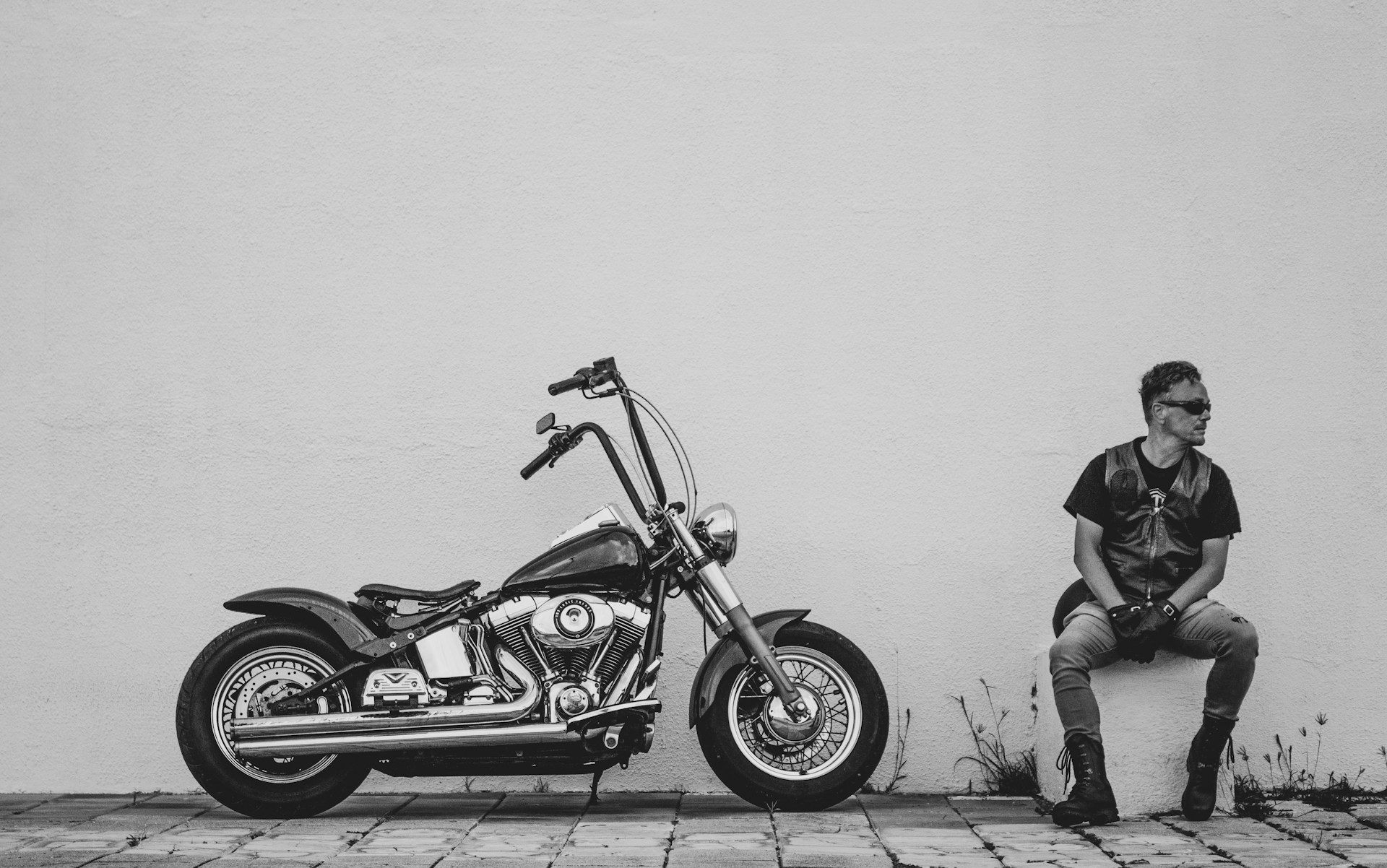
The only thing he’d never put a logo on. Gloss-black paint. Chrome that caught the light and stabbed it back at the world. Bars just wide enough for comfort on long rides, narrow enough to cut through traffic when he needed to. Her name was Raven, and the custom feather paint job shimmered strangely in the setting sun. She sat on her poured concrete pad like a living thing at rest, her exterior seeming to twitch in the golden light.
His shoulders loosened just looking at her.
James unlocked the small storage cabinet beside the pad and pulled out his gear: goggles, helmet, jacket, gloves. He strapped on the armor piece by piece, motions worn into muscle memory. Slide. Zipper. Buckle. Snap. Check.
By the time he swung a leg over the bike and settled into the seat, the last residue of customer service had burned off his skin.
He thumbed the ignition, and Raven rumbled awake beneath him, a deep, throat-clearing growl that felt more like a heartbeat than an engine.
There it was. That sound reminded him he was still there. Tense muscles and anxiety gave way to the calm that settled into him with each piston thump. This was his home. Not the box that held his mattress. This—the saddle, the rumble—was where his soul reassembled itself.
He eased out of the yard, onto the frontage road, then onto the highway cutting through town. The sky over the fields was streaked with orange and violet, igniting the world with a pinkish glow. The air had cooled just enough that the wind on his face felt like mercy.
He didn’t need music. The engine and the rush of air were enough. Music dulled the serenity anyway.
There are two types of calm in motorcycling: the kind you get on an empty stretch of road when the wind and rumble claim your soul, and the kind carved from razor-sharp attention while slicing fast through traffic. His ride home always offered the former.
Within ten minutes, his mind had gone blank in the best possible way. No sprinklers. No invoices. No ex-club brothers whose names still came to him in flashes he’d rather forget.
Just the road. Just the hum of the tires. Just the familiar tension in his thighs and forearms as he leaned through a slow curve, the world tilting and righting itself again.
Riding didn’t fix anything. It didn’t restore what he’d broken or erase the shit he’d done. But it made the ghosts sit down and shut the fuck up for a while.
And that was enough.
A week later, he sat in a conference room that smelled like new carpet and nervous sweat, wearing the only button-down shirt he owned that didn’t have a stain on it.
The man across the table wore a company-branded fleece vest and a watch that cost more than James’s first car. Two younger project managers flanked him, both with laptops open, pretending to be important.
“So,” the man said, smiling in a way that showed too much gum. “We’ve seen your work on the Ridgeview subdivision. Clean lines. Good drainage. Nice choice on the river rock.”
“Thanks,” James said. He folded his hands on the table to hide the fact that they wanted to drum to the fading notes of Who Made Who still echoing in his mind’s amphitheater. “We try to make things that last.”
“That’s what we like to hear.” The man glanced at his laptop. “We’re looking at three new developments over the next five years. That’s over two hundred homes, plus common spaces, entryways, and a couple of small parks. We need a landscape contractor we can rely on.”
The numbers swam in James’s head, translating themselves into payroll, equipment, fuel, materials. Irritation, for once, wasn’t the thing buzzing under his skin. Something like excitement curled its fingers into his ribs.
“And you’re thinking Yard Hogs could handle that load?” he asked.
The man in the vest chuckled. “From what I’ve seen, yeah. You’ve got a reputation for getting shit done, Mr…?”
“James,” he said. “Just James is fine.”
“One of our site supers said you came out personally and fixed a drainage mess another contractor left. Middle of the night, in the rain.”
James shrugged. “Water doesn’t wait for office hours.” Vest Man laughed, and the two laptop kids smiled like they’d been programmed to do it.
“We’d like to offer you a contract,” the man said. “Primary landscape contractor for all three developments. With performance reviews built in, of course, and a five-year general maintenance extension if you want it.” He slid a folder across the table.
James opened it. Numbers. Timelines. Clauses. More paperwork than he liked, but it spelled out what mattered: steady work. Growth. A future.
“You’ll need to scale up,” Vest Man said. “We’ll need more hands on the ground. But you’re already on that road, I assume?”
“I can get there,” James said. “I’ll need a couple of weeks to expand the crew. But yeah. I can hit your timelines.”
Vest Man stuck out a hand. “Then welcome aboard.” James shook it, ignoring the cold, damp status symbol being offered to him. The calluses on both their palms told very different stories.
Scaling up meant headaches. It meant drive-thru coffee at seven a.m. and the glow of his laptop screen at midnight. It meant ads posted on community boards and online job listings. Most of the people who answered didn’t have résumés—just first names and stories.
He built his own application, four questions on a single page:
Can you show up on time?
Can you work hard without whining?
Can you take orders you don’t always agree with?
Can you work on a crew without fighting?
He interviewed in the yard. One folding chair for him, an overturned bucket for them. Some he recognized: a kid who’d once tried to boost a bike from behind the bar where the old crew used to run business, a woman who’d done time for dealing, a guy in his forties with eyes that had seen the inside of a bottle for too damn long.
He didn’t care about their records. He cared whether they’d quit when the sun hit triple digits.
“Look,” he told them, one by one. “This isn’t a family. You don’t have to love me. You don’t have to bleed Yard Hogs colors. You show up, you work, you don’t steal, you don’t endanger the crew. You do that, I’ll pay you fair and on time. You need a day off for court or your kid or whatever? Tell me in advance. You ghost me, you’re fucking done.”
Some flinched at court. Some flinched at family. Most just nodded.
Within three weeks, he’d gone from six steady hands to eleven. Eight men, three women. Tattoos. Scars. Nervous smiles. Hard eyes. All of them wanting something.
He respected that. Wanting something was how you stayed alive.
He did the math one night at his kitchen table, an old legal pad full of numbers, the overhead lamp humming softly above his head. Fuel costs. Equipment maintenance. Payroll. Materials.
For the first time he could remember, the future looked like something other than a long, dark tunnel. He poured himself a glass of water, stared at it for a moment, then drank it down and pushed back from the table.
His palms itched for handlebars…
The article in the local paper annoyed him more than it should have. “FROM OUTLAW TO ENTREPRENEUR,” the headline screamed. The sub-header was worse: “Local businessman leaves troubled past behind to build a better future—one yard at a time.”
He’d told the reporter he didn’t want to talk about the club. Or his record. Or the time he’d disappeared for three months after something went sideways near the state line.
“I want to talk about my crew,” he’d said. “And the work.”
She’d nodded, pretty little notebook in hand, then turned around and made his past the fucking hook.
He read the piece in his truck, parked outside the diner where his crew liked to grab breakfast burritos. The photo they’d used made him look older than he felt, arms folded, Yard Hogs logo on his shirt, Raven in soft focus behind him like he was posing with a ghost.
“You gonna frame that?” one of his guys asked, leaning through the open door.
“Yeah,” James said. “In the bathroom. Right over the toilet so people can aim at it.”
The guy laughed and headed inside.
James folded the paper, dropped it onto the passenger seat, and stared out at the morning traffic. The exposure made him itch. He’d spent half his life trying to be invisible when it mattered. Now the town had his name in twelve-point font.
But it was good for business. The phone had already rung seven times that morning, three new bids, a follow-up on an old one, a homeowner asking if he did tree removal, the main contractor wanting a meeting about the second subdivision.
He could live with discomfort. He’d lived with worse.
He’d built something. Eleven paychecks went out under his name. Eleven livelihoods depended on him not fucking this up. That felt… right. Heavy, but right.
He turned the key in the ignition and felt the truck rumble awake.
It was a good day to ride.
That night, the air had the first taste of fall in it. Not much, just a subtle cool edge that made the sweat feel less sticky under his shirt and carried that faint sweetness that comes when the world starts shutting down for winter.
Raven sat waiting in her usual place behind the yard office, chrome catching the last light. James suited up without thinking. Goggles. Helmet. Jacket. Gloves. Slide. Zipper. Buckle. Snap. Check.
He swung onto the saddle and fired her up. The engine’s low growl rolled across the lot, making one of the new guys look up from where he was closing the trailer gate.
“Night, boss,” the kid called.
“Night,” James answered, voice swallowed by the rumble.
He pulled out, eased onto the frontage road, then onto the two-lane highway that led south out of town before curling back in a lazy loop. It was his route. His ritual. Twenty-five miles of farmland, low hills, and long, sweeping turns that let him lean just enough to feel alive without courting death.
The world dimmed to headlight cone and skyglow. The last band of orange slipped away, leaving blue and purple and the first shy stars.
He let his thoughts drift to the endless frustration he felt every night when the sun went down and left him with that narrow fucking cone of light. Engineers had put two spacecraft outside the solar system and had created an artificial heart but couldn’t figure out how to light a goddamn highway on two wheels.
The cool air washed the irritation out of him as he settled into the ride. Wind pressed against his chest, tugged at his sleeves. The road hummed beneath the tires. He felt every vibration through the soles of his boots, up through his calves, into his spine.
Out here, there were no sprinkler lines. No invoices. No headlines. No club. No blood. No prison phone calls. No reporters stitching his life into a redemption narrative so strangers could feel good about reading the paper. Just asphalt and engine and breath.
He thought briefly about the future, about the new contracts, the extra mowers he’d have to buy, the trailer he’d been eyeing that could haul twice what his current one could. About Manny’s kid wanting a summer job next year. About the way his crew looked at him that afternoon when he told them about the developments.
Pride. That’s what it had been, he realized. They were proud of themselves, of what they’d built with him. He liked that feeling.
The road curved gently left, then right. He took it without thinking, body moving with the bike, trust implicit between man and machine.
A pair of headlights appeared in the distance, approaching in the opposite lane. Far enough away to ignore. He rolled his shoulders, let his jaw unclench. He weaved the bike side-to-side in his lane to make himself more visible, a trick from the club days.
He was halfway through thinking, I could get used to this, when another set of headlights exploded into his peripheral vision from the left.
Too close.
Too fast.
There was no warning squeal of tires. No horn. Just a dark shape stabbing into the intersection from the side road that cut across the highway. A small sedan, nose pointed exactly where his body already was.
For a fraction of a second, time stretched.
He saw the driver’s face lit white by the dashboard. Mouth open. Eyes wide. Hands clenched on the wheel in that useless way people did when they’d already blown the red.
James had just enough time to think: Fuck. So, this is it, then. Fuck it.
He didn’t have time to swerve.
Metal met metal with a sound that didn’t sound like anything earthly, just one brutal impact that shattered the bike out from under him and flung his body into the air, but not before the machine popped him in the face a couple of times with really hard things.
The world went white.
Then there was sky.
He was aware of being weightless, of seeing stars pricked into the dark above the sodium lamps. He thought, detachedly, that they looked a lot closer than they had a second ago.
Then the ground came up and hit him. The impact drove the breath out of his lungs in a soundless grunt. Something snapped in his chest. Something tore in his shoulder. His helmet bounced, and the world spun into a tight, nauseating circle. He came to rest on his back on the asphalt.
Silence.
The engine noise was gone. The wind was gone. The hum of tires was gone. He stared up at the night sky, vision narrowing at the edges like someone was slowly drawing curtains.
He tried to move his fingers. Maybe they moved. Maybe they didn’t. He couldn’t feel them.
Voices. Distant. Warped. A woman screaming. A man shouting for someone to call 911. Footsteps slapping pavement. None of it felt connected to him.
He thought about the yard. About the eleven people who’d show up tomorrow expecting orders. About the woman with the sprinklers. The kid who’d called him boss. The headline—OUTLAW TO ENTREPRENEUR—and how fucking stupid that sounded now.
He thought about the years he’d spent waiting for violence to find him. All the precautions. All the exits mapped. All the habits of a hunted man. And in the end, it wasn’t the club. It was just some asshole in a fucking Subaru who didn’t look twice. Didn’t look left long enough.
His chest tightened. Breathing turned into work. Each inhale felt like dragging a cinder block up a flight of stairs. The edges of his vision crept inward, black eating the world from all sides.
He wasn’t afraid. That surprised him. Pain, yes. Regret, maybe. But not fear.
He’d already died, in some ways. The day he walked away from the cut. The day he threw his last bottle out. The day he signed the first Yard Hogs contract and realized he was responsible for more than just himself.
Maybe this was just another door.
A shadow passed over his face. Someone knelt beside him, hands hovering, not quite touching.
“Stay with me, man,” a voice said, thin with panic. “Hey—hey—stay with me, okay? Don’t close your eyes.”
James wanted to say They already have, but his mouth wouldn’t cooperate. He tried to smile, remembering his sister asking when he was finally going to grow up and put away his bike. But again, his lips didn’t move.
The stars above him blurred. One streaked across the sky and vanished.
A bright, warm light began to bathe his body as he let out a breath.
The world exhaled with him as everything went dark.

