

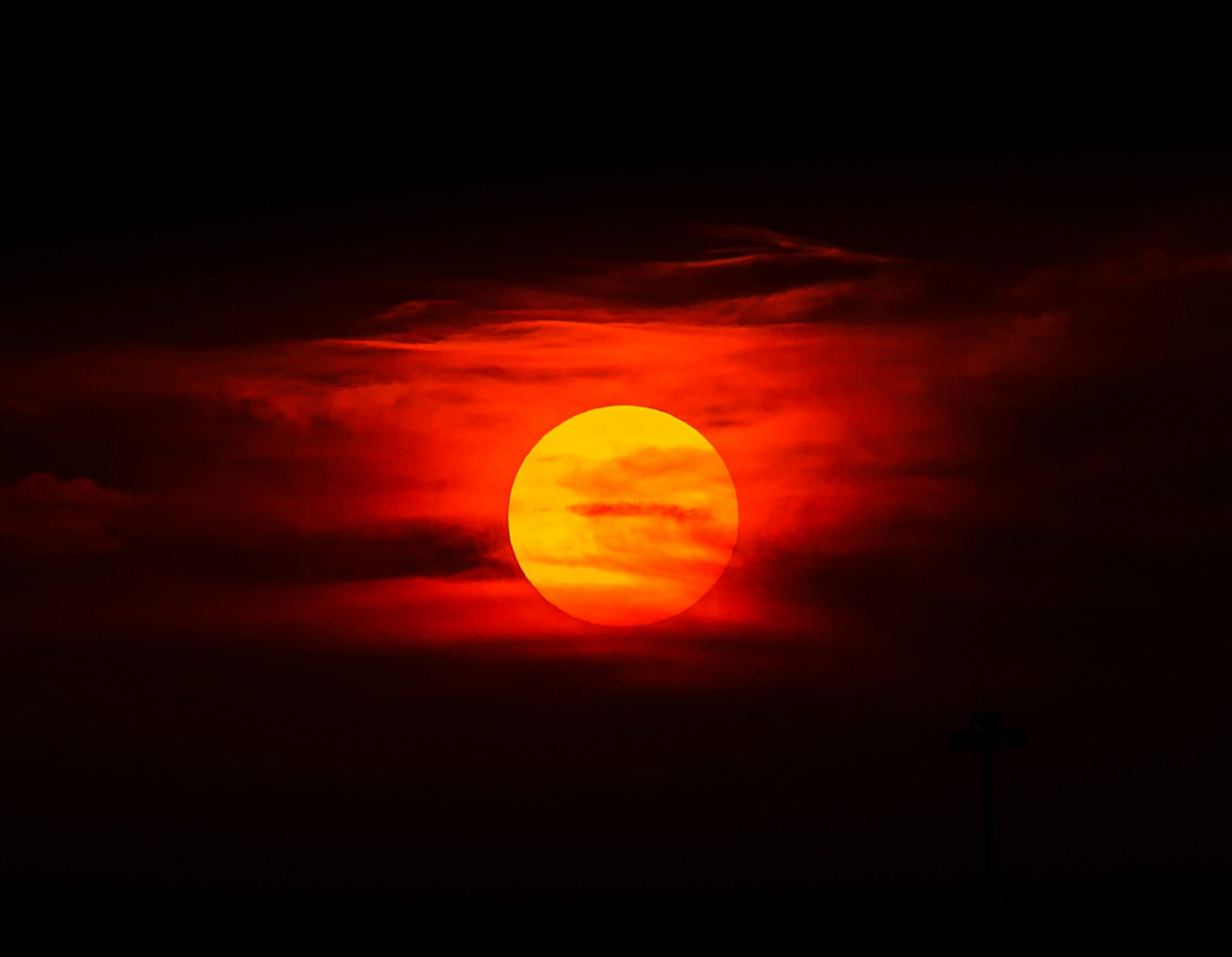
You burned the photograph of you smiling together outside the Chili’s near home. It was the cloudless night of a blood moon, almost a year since you had both spoken, and your roommate Zyaire told you the lunar eclipse symbolizes the destruction of love.
You sat on a cement patch in the backyard, the summer night air warm and humid. The moisture latched inside your throat, thick and convulsive, like a dewy cottonmouth. The mosquitoes readied their feast on your slick brown skin, nestling in between those thin black body hairs you wax for random suitors. The photograph kindled in your hand above a special metal popcorn bucket.
You bought it during the exclusive showing of Doctor Strange: Multiverse of Madness. The vessel had grooved geometric amber sorcery arts like fire, its falling embers frozen around the Grecian-like pail. You held it that night, alone, studying the fictional characters—Doctor Strange & The Scarlet Witch. They faced each other, readying their magicks, aiming palms and fingers and incantations, stuck in time.
Your friend told you he preferred seeing Marvel movies with his family. You told yourself you did not care for his exclusion, but you lied to yourself, as you always did, and hoped to see him there at the theater you would go together to watch countless movies as teenagers.
You thought the photograph would combust easily, melt and fold inward, the black molting ash curling, the sharp glossy corner turning into a picturesque fire, all to disappear inside the bucket into something for fuel for your dead sunflower plant outside the shaded front door or to float above into the still wet air.
But the flame just shrugged off. You kept clicking your candle lighter, hoping it would burn through the resin-coated plasticized paper in an instant, but to no avail.
“According to who?” you asked Zyaire an hour before your pyromancy as the blood moon slowly rose.
“The Natives, I believe,” Zyaire said, his chubby black fingers sorting through his tarot decks.
“Does it apply to everyone?”
“Sorry?”
“Does it destroy everyone’s love?”
“I think you misunderstood me,” Zyaire said and then told you to shuffle the cards as a means to absorb your energy.
“It’s a destruction of some type of strong emotion, like love,” Zyaire said. “Like, for you and your friend, or a mother and a son, or an artist and their passion.”
“I still care for him, though. Still love him, I guess,” you said.
“Oh.” A frown pulled his blemishes down, and his dry, textured skin crinkled. “Maybe give it a try tonight.”
Zyaire pulled three cards at random and placed them before you. The first showed Death, the second was a Kings card, and the third you cannot remember.
“This is good,” Zyaire said. “You can finally move on.”
He said it with confidence, an unrequited certainty, as if he held the all-seeing eye of the blood moon itself.
You did not think too highly of your roommate. You saw many of your flaws in him. He was something to hurt, to relinquish feeling into. You emptied words not meant for him when he asked if you would like to eat dinner at Chili’s with him the night before after you told him about your friend.
“I think I have a crush on you,” your roommate told you when you first moved in, just weeks before your tarot reading. “I feel like I know you.”
You felt as if eyes were on you that night. Instead of politely telling him you had just met weeks ago through a mutual queer friend, prefer to keep to yourself at home, only know that he’s really into astrology, and still feel mooted grief from no longer having your friend in your life after a mistake from nearly a year ago, you told him you are disgusted by the thought.
He told you a card reversed changed its meaning. Which one it was, you did not know, could not remember. You did not care too much to listen to the cards. You feared their truth. You thought your old friend would speak to you again, by some other divine chance.
The photograph still did not burn. It only got hotter and blistered. Your old friend’s smile turned to a frown, and your softer face crinkled by the small magmatic flame you bore onto your image. You feared you would forget him, forget what you had from before.
You met as prepubescent twelve-year-olds when only your worlds mattered and adulthood seemed as fantastical as the cards bending your fate. You shared friends and dives at the pool. You met his family and felt as one of their own. They invited you to a Thanksgiving dinner one year because he knew you and your mother refused to sit in the same room. You would not stop fighting. She wanted you to have a girlfriend, and you liked boys.
“You’re a man. Act like one,” she told you.
You grew older and graduated high school together. A hug with him was rare, but you cherished it when your older brother died.
“I’m sorry. I’m here for you,” he told you.
You would stare into those eyes, eyes like yours. They looked of warm wet soil on a dewy morning, surrounded by a bushel of cumulus clouds or cotton, and his hands were soft and veiny. Yours soft and supple, wishing to be held. He brought you Chili’s and watermelon Sour Patch Kids. You cried on his shoulder, the second man in your life to see you in tears. Your brother was the first when you told him twelve years ago—the molting age of the 10-year-old boy—you were called a girl because of your long black wavy hair and soft voice, and it made you smile.
“Am I a monster?” you asked your overprotective brother, your fatherly regent.
“Never,” he told you. Oh, the tears you had. The hot flush into your cheeks, as if you were a babe again from your mother’s womb, her tender touch bathing you in radiance, and you felt whole in that moment, new, with him holding you.
In college, you realized things weren’t as traditional and repressive as they were at home. Men did not have to be so stoic and coldhearted, and women were not objects and tools for the trade. Your old friend went upstate to Gainesville, and you stayed near home in Tampa. You kept in contact daily, and it never felt as if you were apart. You met people like you, people you thought did not exist, as if they were once mythos. You told them you felt like a freak for liking men, for wanting to singe your facial hair, to wear a heeled shoe or long skirt, and they told you you’re not.
You can’t explain love, your people said. Love is complex. Love is everywhere and in everyone.
You texted your old friend you were gay. You told him you felt love for him, and he said, I love you, too, but not how you’d like me to. You wished you were different. You wished you could be attracted to women and accept what you were told to be. You still felt like a freak, regardless of what your people said to you.
The next time you saw your old friend, it was uneasy. He avoided you, and you avoided yourself. You were together in the same living room from that past Thanksgiving with him and your mutual friends, yet as unforeseen strangers. His eyes avoided yours, his hands stayed in his pockets, and when you tried to talk with him, he said fewer words with each reply.
“I’m sorry about what I said.”
He wouldn’t even turn to look at you.
Don’t be, he said.
“Can we just forget that happened?”
Sure, you heard him say.
The blood moon was something to marvel at. It was a divine presence like Death by your brother’s casket. A monarch butterfly flapped its wings by you, and you dropped the photograph into its final resting place. The insect flew as if floating on the waves, the rise and fall of the salt air and water ebbing the amber-winged creature towards its sanguine rose in the sky to pollinate.
You remember the third card. You smell a bitter smoke, make an aggressive sniff, and cough beside the bucket. You feel your senses lapse. Sweat trickles down your forehead, and strands of long black hair stick to your hairless cheeks. You face the blood moon, this self-serving, cosmic singularity. You wish to scream at it for what you think it’s revealed, to ready your mouth for a drawn-out scream.
Why can’t I hate you? you try to ask, but your words stick to the sides of your throat.
The photo’s edges quietly sear, the flame slowly reaching its heart between your friend and yourself. The photograph is all you have of him, its twin gifted to him as a token of your friendship a year ago, the digital ones trashed and shot into the online nebulous void. You quickly reach into the bucket, the inner metal warm and snug, and pick at the slow-burning photograph. The edges crackle and glow as you raise it from its den, your index finger and thumb clinging to its untouched center, and you blow onto the ashen geometry. The ash flies behind the monarch’s trail and falls shortly after. All that is clear in this poor dilapidated still are your bosom and his torso close to each other, as one, your orange zip-up hoodie and his tailored blue dress shirt and maroon tie.
Dewy drops of sweat crawl into your mouth, and you swallow the sweet salt.
“You fool,” I say aloud. And I cry.

