

It’s a golden time of August day at the lake, 4:00, an hour over which the sun hangs penitent and merciful for inflicting the heat of the day on us and, as if to make amends, slides like butter in a skillet toward the horizon and makes of the water and the sand and the grass a near perfect moment between afternoon and night, what in our American language is called “evening,” and makes me think both of a gradual journey through the hours of the later day and recompense, “getting even,” “even-ing,” a voice of God that says—this is not in the Bible—“I will make things fair, heat of day and cool of night, they shall be eventual.” It’s an hour at which some people are thinking of pulling out—I’m thinking of it myself, for me and my sun-drenched kids—and at which some are just entering the life of the lake. Witness: here comes eight or a dozen kids and a handful of adults, dark haired or brown, brown likewise the skin and the attitude of the children, here they come, I was just thinking of pulling my kids away but now I pause because here comes a lot more kids, ages—I don’t know, eight to—I don’t know—twelve? An invasion of sand and water and mind, a squad of kids and their grown-ups. I am a grown-up.
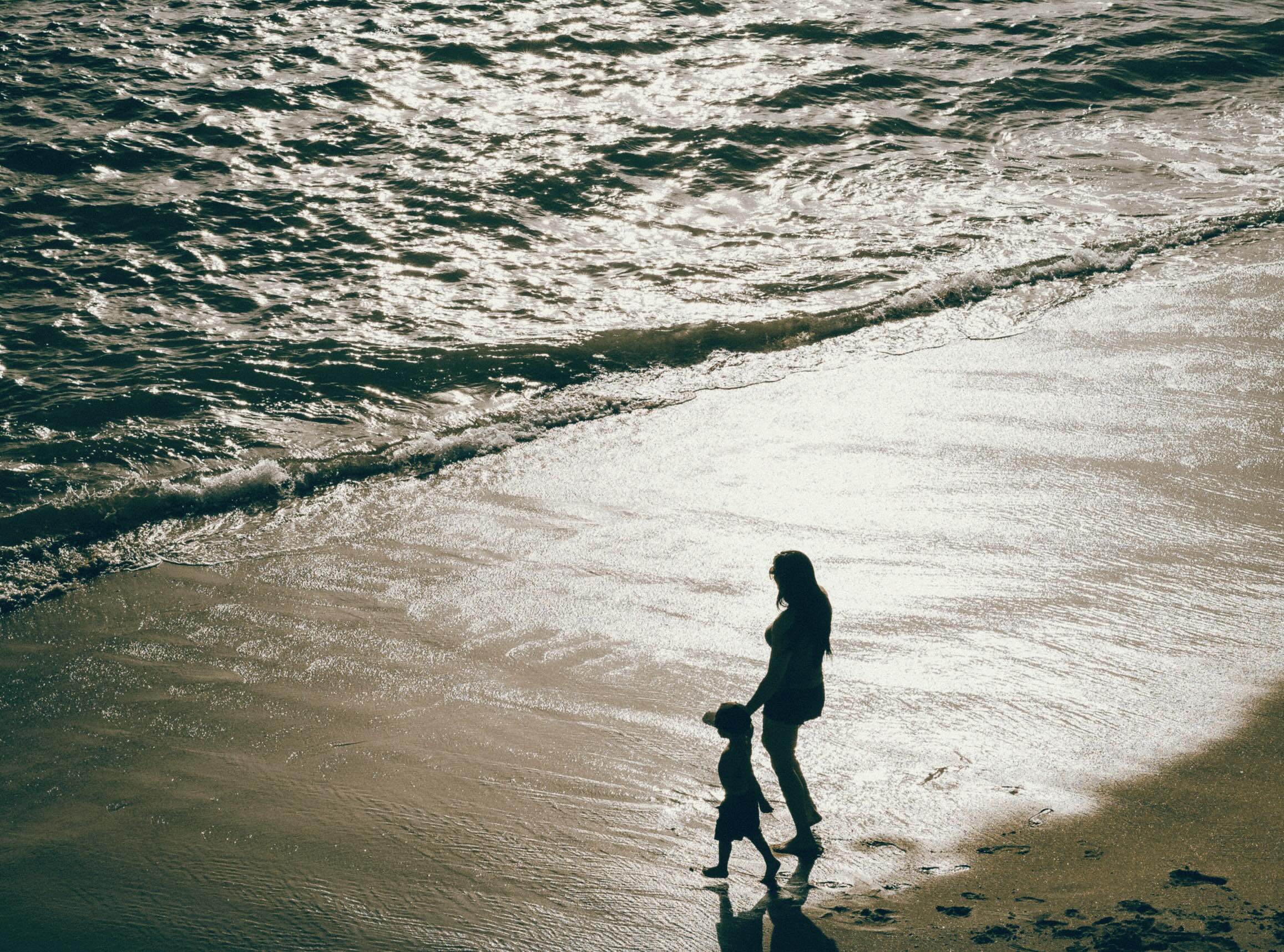
In ragged phalanx they charge the lake. At least some of them do; even the most eager of them flinch when they’re in over the waist, and the water, refreshing on pummeling legs, is bracing on the stomach and chest. Soon, by degrees, most of them are in up to their necks, some diving for smooth stones, others tossing a football. I’m not sure how any of the kids are related to one another. Certainly, too many to be siblings, so probably cousins? Uncertain, also, is the relationship of the adults scattered among them to the kids and each other. Who is a father? Who is an uncle? What catches my eye, though, from where I sit on a towel in the sand, is an old woman who walks confidently in a one-piece bathing suit through the wave of the kids and enters the water. She is shapeless, like an onion bulb, and she does not flinch or pause as she goes into the water and it becomes evident she is holding a smaller child by the hand, a boy with a head of sun-dappled light-brown hair and a blue swim jersey. This boy is more reluctant than his cousins or siblings to swim, and grandma without fuss or regard for her own body, in which she glides comfortably in a way I never will—there’s something incomprehensively powerful about an old woman in a swimsuit, unconcerned—drags the boy into the school of swimmers and drops him into their midst.
She’s only in the water for a minute, urging the boy on, before she returns to the beach and a lawn chair where she takes up a phone and resumes—I think?—a conversation with another old person—a friend? A sibling?—about some medical condition and the attendant treatment. The boy she instructs from the beach: “Dominic! Go play!” And little Dominic, led this far by grandma and now abandoned to his fate, looks around uncertainly for the comfort of a companion.
I lose sight of Dominic for a while to watch my own kids, to see if they’re straying into the traffic of the newcomers, and also to celebrate my wisdom in bringing them to the beach today. They seem to be having a great time, even my youngest who was hesitant to leave the sand and is now swimming happily back and forth along the shore. Too, I am drawn to the composition of the moment, the sweeping line of the yellow sand, the welcoming womb of the amniotic water from which, it seems, my species crawled and to which we can return for rejuvenation repeatedly, and the trees that surround us in full green flower and whose leaves dance with the slightest breeze as if conversing. Know what they are saying? “Now? Now?” and “Not yet, not yet.” When I catch sight of Dominic again, he has glommed onto another child, a girl, after beckoning pleadingly to grandma but being shooed away with a wave of her hand. This girl, whose thick brown hair is like Dominic’s, like all of these kids, and is long, is not much older than Dominic, but holds onto him like a child as he shyly clings to her. Gradually, she introduces Dominic to deeper water, so that he’s in it up to his chin now, which seems to discomfort him further so that he clings to her shoulders more tenaciously, and I am left to wonder again about the relationship between them. If not siblings, cousins surely, almost the same age and, I imagine, veterans of dozens of skirmishes in that riot of family as grandma and uncles and aunts and parents herd them into cars or around tables or onto the couches and floors of rumpus rooms in front of televisions or board games, feeding them, ignoring them, while the grown-ups drink beer—I am a grown-up; I am drinking beer—pausing to acknowledge them or interrogate them as the different levels of play unfold around them, the older boys with their footballs and their wrestling moves, the girls dancing and trading clothes, the littler ones using toys or begging the older ones for attention. In this arrangement, I wonder, is this often what happens? Does this girl usually get stuck, by instruction or inclination, duty or sympathy, minding Dominic?
My attention is riveted, and I can’t keep my heart from swelling with admiration for her. Also, I can’t help imagining what the future will be like for them. Let’s say they are cousins. Let’s imagine the girl’s name is… Veronica. If this incident is a rare thing, will they even remember it, years from now, as I suspect I surely will because here I am, writing something about it? Will they speak of it like this: remember that time we all went swimming at the lake and Dominic wouldn’t go in until grandma dragged him in—remember how fearless grandma was in her swimsuit? She didn’t give a shit! Wrinkles and everything. And then grandma dropped Dominic in, and Veronica got stuck holding him like a baby, remember that?
Or, if this is a common thing, will this pattern continue throughout the years so that whenever Dominic is in trouble—Dominic, the big man? Dominic, the small man?—whenever something concerns Dominic and he needs a hug or correction, will the wisdom be, go get Veronica. Dominic’s at it again, go get Veronica. He climbed a tree and won’t come down. He’s built a fort out of couch cushions, and he won’t come out. He won’t eat. He won’t sleep. He’s wet the bed. He’s joined the Air Force. He’s on heroin. He’s had his heart broken. He wants to buy this car. He’s afraid to go out for track. He’s gay. He’s knocked his girlfriend up. He wants to be a priest. Go get Veronica. She’ll know what to do about Dominic.
I don’t know. All I know is little Dominic is now splashing around cautiously with the other kids in the direction of his sister-cousin, and I am quite in love with Veronica. I don’t mean the child in front of me, you pervert, I mean I’m in love with the idea of a Veronica, of a holy connectedness that could exist between people and the divine source of it, of all the human experience in microcosm. Is this autofiction? Is this the male gaze? Out beyond where the children play in the deeper water unrippled by froth there is a gentle lake movement and the sun is captured in darts that, once witnessed, are instantly gone until a new one appears somewhere else. This is like that.

