

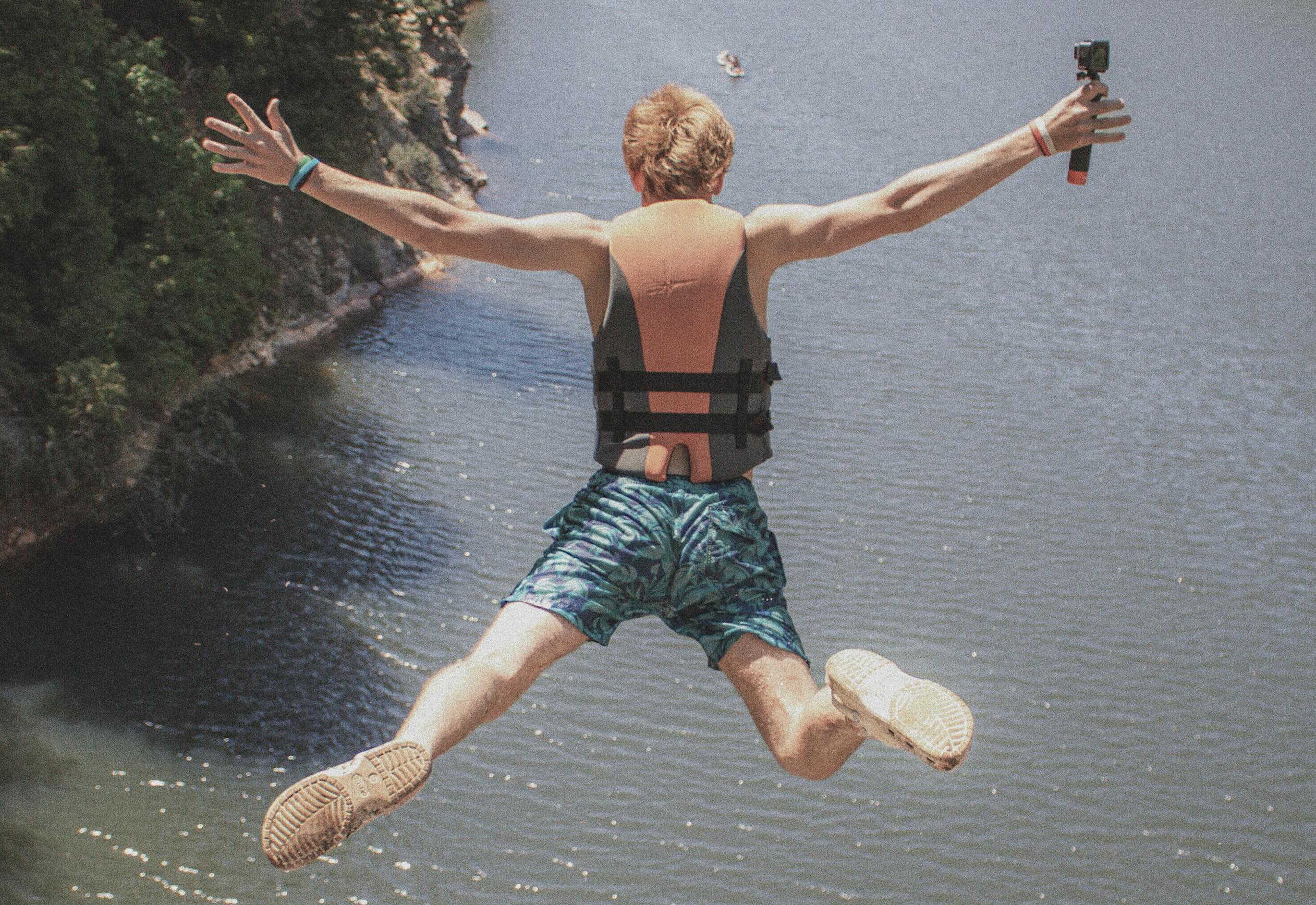
I’m twenty feet above the water, standing in the cradle of an old oak tree perched along the bank of Goat Rock Lake. My bare feet press into the bark of the tree. My crooked big toe seems to stare back at me. On the ground below, Damion shouts words of encouragement upward.
“Go on, Cam. Climb up to the top like you said you would.”
He reminds me of my arrogance, my own boastful assessment of this jump from the rickety wooden platform that I can see is much higher than I originally thought. It’s scantily built and another ten, maybe fifteen, feet above me. The only way to get there is by climbing the sixteen penny nails driven into the tree’s trunk. I wrap my fingers around a tree limb and lift myself up. My toes curl around the first rusty nail, then another. As I climb, I remember all the times I’ve gotten ear infections from lake water that looked just like the green, muddy water below. I look down again and see the sign on the bank next to Damion. NO SWIMMING, it says. I keep climbing. Damion keeps shouting.
When I get to the top, I try to work up the courage (or is it stupidity?) to jump off the platform. I imagine what this jump will be like. I can see myself flying out above the water, then slapping my feet together, and pressing my palms against my thighs, forming the shape of a pencil at the last possible second. In my mind, the grimy green lake water slaps closed around my head. Dirty water rushes into my ear canals. I can see myself, for the next few days after this jump, riddled with pain from the bacteria that are living and thriving in the lake. I imagine that they take up residence in my ear canals. With antibiotics though, I’d eventually heal.
I can see myself sitting with Damion and our other friends at the high school cafeteria, months after jumping. I imagine that I would show them my newly pierced ear, a sign that my ear infection is over. As soon as I’m sixteen, Mom said she’d sign the piece of paper allowing me to do it. It’s going to be a gold hoop instead of a diamond stud.
That day in the cafeteria, Channing will probably walk up to the table and make fun of me. He’d say something like, “That’s not an earring. It’s a queer ring.” The table would laugh. Channing would laugh. But I would probably say nothing.
I can see myself eventually leaving this small town with its green lake, but I think Channing will stay. He’ll become a preacher and be on the city council. His name will be familiar to everyone who lives here. Many of them will happily poke Channing’s campaign signs into their front lawns to support their favorite candidate. CHANNING IS OUR MANNING, the signs will say. From the pulpit, Channing will point his finger at those in the pews, people he deems sinners, like me and my queer ring. In city council meetings he’ll point his fingers at government officials he deems sinners. A vein in his neck will bulge during some of his sermons, and maybe a few of his prayers. At the age of thirty-four, the FBI will raid Channing’s house and seize his computer. His wife, probably Allison from Calculus, will hold her hand over her mouth as they take him away in handcuffs. LOCAL PREACHER ARRESTED, the headlines might say.
I’ll probably hear the news from a coworker at the restaurant I will work at in Chicago. “Aren’t you from this town in South Carolina?” my coworker will ask. He’ll hold up his phone while I prep scallops. I’ll remember Channing. By then I’ll have gauges in my earlobes, and as I remember him, I’ll touch my left ear lobe, pull out my gauge, and pop it back in.
“Doesn’t surprise me,” I’ll say.
“Dude, Cam,” my coworker will say, “wash your hands.”
I’ll smell the gauge and remember that those things are foul.
I imagine that I’ll get fewer ear infections as I grow older, but I’ll also swim in fewer lakes. In the Chicago summers, I’ll drive a motorcycle. It will be too loud to ride without earplugs. I’ll probably grow tired of constantly changing them out. Eventually I’ll resort to reusing a pair of dirty earplugs. Another ear infection will unfold.
I’ll spend my nights in Chicago, going out with coworkers who will become friends. All of us will go to music shows and drag shows. I’ll stand at the front of the crowd and feel the music rattle my chest. The sound waves will press and pulse against my ear drums.
By that time, maybe I won’t wear earplugs. They might make me look old or worse, they could give me another ear infection. I think I’ll drink mostly Sazeracs. But I’ll never go to New Orleans. I’ll inevitably be sad when I reach fifty and New Orleans floods beyond repair. All those above-ground tombs scattering throughout the city, a throng of flooded coffins, rattling bones, and festering bodies barreling through the streets.
I’ll eventually leave the restaurant industry. I won’t be able to go to shows anymore because the doctor will tell me that I have damaged my hearing beyond repair. Ironically, I’ll spend the next decade working at a call center, handling insurance claims. Each year it will be a little harder to hear customers on the other end of the line. Eventually, on my sixtieth birthday, I’ll travel to Mexico and meet a woman named Corrina there. We’ll be five years apart, Corrina the older of the two of us. Her father will be Sudanese, and her mother, French. I never really thought that I could find love. I plan on trying with nearly everyone I will ever know. I imagine none of those attempts at love will ever work though.
But, Corinna, I’ll fall for her, and she, for me. I’ll send a letter of resignation to the call center postmarked from San Cristóbal de las Casas. I’ll move to Paris with Corrina to be with her, to help her take care of her dying mother.
Once we’re in France, I’ll grow fond of the restaurant around the corner from Corrina’s family’s flat. Later, with Corrina’s mother’s death, I’ll speak at the funeral. I’ll try to speak French, but Corrina will gesture to me that I should just stop and continue in English. A few months after the funeral, I’ll lose my hearing entirely. Corrina’s small inheritance would allow me to invest in new hearing aid technology. The hearing aid battery will tuck nicely into my old gauge holes in my earlobe. The world will then become loud.
One day, after having a meal at the restaurant around the corner, while standing on that quiet cobblestone street in the middle of Paris, I’ll turn off my hearing aids. The world will then become silent.
I’ll see a woman with two shopping bags remove her sunglasses and accept the croque monsieur she ordered from the window of a small café. Another woman in the square will smoke a cigarette, while a man on the balcony above her will shake a rug outside his window. Even I, an American expat, will know that shaking rugs outside of a window is illegal in France, Corrina’s mother will have shaken her finger as she told me so. The man won’t seem to care though. A few construction workers will climb some scaffolding in front of a pizzeria. Their metal wrenches dangling from their beltloops will make what I will assume is a clanking sound as they knock against the aluminum posts. I’ll hear nothing though. A motorcycle will come rolling up and the driver will park next to the fountain in the square. I will wonder where the rumble of the engine that I cannot hear goes. Pigeons will flutter away as the driver dismounts. She’ll take off her helmet and wave at the man on his balcony. The woman smoking in the square will offer her a cigarette. Two teenagers—they’ll remind me of Damion and I—will be standing in the square, smiling, and photographing each other in the afternoon sunlight. I’ll look back toward my favorite restaurant and, in that silent moment of my old age, I’ll realize that the faded green paint of the restaurant’s shutters is the same color as the cloudy green water I will remember so well.
“Are you jumping or what?” Damion shouts from below.
My toes are curled over the edge of the highest platform. The water below becomes corporeal. The surface of the lake sways, almost in unison with the top of the oak tree. I bend my knees and look down at the murky water once more. I uncurl my toes and spring off the board. Just before I hit the water, I shove a finger into each ear.

