

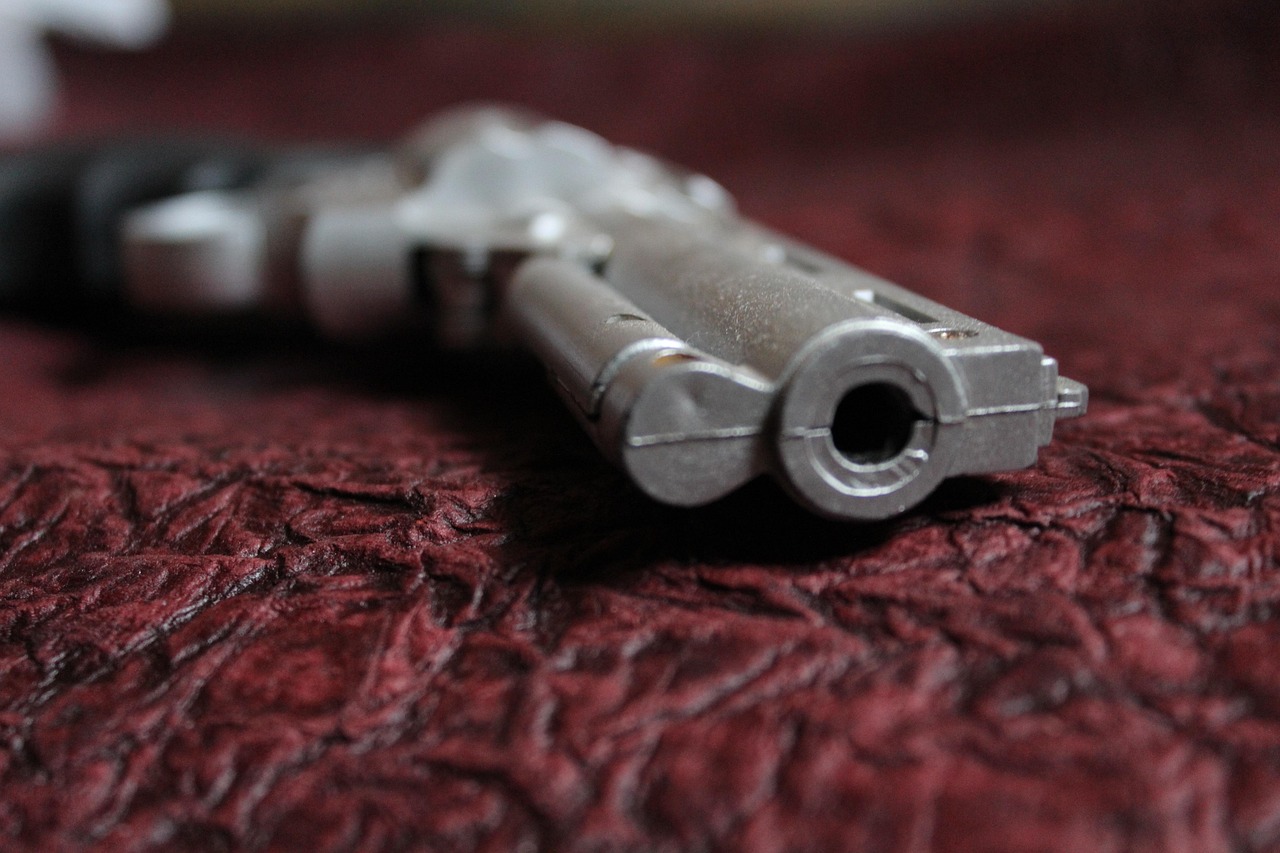
John sat beside the window of his seventh-story apartment holding the barrel of a snub-nosed .357 magnum revolver in his mouth, which hung open, not quivering as you might see in the movies, but relaxed like the open lid of a Zippo lighter flipped upside down. John wore a black suit jacket and navy-blue slacks, with a crimson collared shirt and blue and black striped tie, all horribly unmatched and perhaps one of the reasons he’d placed himself in this position. John felt unoriginal—an insurance company office worker offing himself in his cheap apartment. But this weapon had balls. His friends and family could take pride in knowing he’d killed himself in this way. John’s tie was half-unfastened, top two buttons undone, five o’clock shadow peeking through skin, sweating armpits, hair parted down the middle. The whole thing was a cliché. His whole life. Even his name was generic and he’d always hated it. Regardless, there John sat.
The only light in John’s apartment came from a single lightbulb: the lamp in the corner of the far side of his living room. His window was open, letting in the autumn breeze and revealing the fresh darkness. The rusted screen was barely attached at the top seam to the window frame. The screen could at any time break and fall seven stories and crack the windshield of Todd Peters’ white 2009 Audi S4. John kicked off his scuffed slip-on shoes, holding the revolver steady, which tasted less metallic than he’d hoped. He’d started to drool, but he made himself hold the gun there so he would follow through with the experiment.
John’s 1970 Chevrolet Nova was parked two blocks down because he hadn’t found parking the last time he’d driven it. Luckily, he lived close enough to work, the grocery store, and his gym that he walked most places. He’d rebuilt the Nova during high school with his uncle David. Uncle David had worked at an auto shop in John’s hometown and, as far as his parents were concerned, David wasn’t family. Despite David’s struggle with drugs—something he and John had never discussed, but John still knew—he was a genius when it came to restoring vehicles. In that moment by the window, John’s mind flashed to the Nova. He worried something might happen to it. Without being able to see it from his window, he imagined terrible things: the car left on jacks, custom twenty-inch rims long gone, windows bashed with glass littering the wet pavement, hood pried open and the engine taken, parts he and Uncle David had painstakingly installed, white ermine paint scratched and stripped off like the dull nail polish his mother reapplied twice a week.
John had been fired from United Life Insurance an hour earlier (58 minutes). Nice clothes—no matter John’s ability to match them—a somewhat expensive revolver, a once cubicle-monkey at an insurance office, and a rundown, shitty apartment—it didn’t add up, right? His mother had bought the clothes as one final push into the real world after he’d graduated at twenty-four from the University of Kansas. He’d lived with his parents during college: Oakaville, KS, a town of 1,200 where he never wanted to return. When he finally graduated—six years and $82,000 later—they sat him down in his clothes-strewn bedroom, where he’d never once gotten laid, and his mother told him bluntly: “You’re moving out, and you’re getting a job.” His father stood in the doorway, arms crossed, grizzled beard much thicker than John’s, a distant look in his eyes. This only reaffirmed what his mother had said: they were goddamned serious. As far as the gun, John had gotten a good deal on it but it still cost him a chunk of savings after college. Uncle David had committed suicide with nearly the same gun while John was a college freshman. And John admired the mechanics and craftsmanship of the weapon. He liked the weight of it, the metallic sheen, the moving parts, the compact size. Seven months after the talk with his parents, he now sat in the windowsill of his apartment in Kansas City with a gun in his mouth. He’d wanted to know what it felt like on his tongue. He felt connected to Uncle David, as if that not-metallic metallic taste was the same as he’d tasted, just before pulling the trigger.
Mindful of the loose screen, John leaned to look out the window and down to the dimly-lit street—revolver still propping his jaw open—and took in his familiar North Water Street for maybe one last time: he saw Todd Peters’ Audi S4 without questioning how he’d paid for it, the light reflecting off the wet street—light from the streetlights, light shining from the apartments across the street—the street that always seemed to be wet, but John knew that couldn’t be true.
Nice cars lined the other side of the street, and the other apartment building housed prettier, more well-to-do people than John’s own. He had often spent hours alone in his apartment, drinking beer and staring into the windows across the street, noticing the furniture: leather couches and recliners, dark-stained wooden coffee tables, brightly painted walls.
John spent much of his time, though, looking into the blonde’s apartment. He knew her name—Libby—but it felt wrong to use her name. John knew Libby from work. (That’s a lie. To know someone means to have talked to them more than a few times, which John hadn’t). Her office was at the far end of the second floor, while he labored away in his small, blank cubicle on the first floor.
Sometimes her curtains were drawn, but often they weren’t and he could see through a window into her life and even catch a glimpse of her if he was lucky. He wasn’t a pervert: if she’d walk by in lingerie or even naked—she hadn’t—he would look away. He’d contemplated this scenario.
He always noticed the bright art hanging on her apartment walls first. He assumed the paintings were expensive and foreign, painted by a Mozart or a Monet—those types. The only thing hanging on John’s chipping cream walls were a calendar set to July with a picture of a 1969 Shelby GT 500 as its background, even though it was October 18th.
As he scanned the building, John’s eyes caught movement and darted back to Libby’s apartment. John had never spoken to her, and had never stood by her office long enough to know what her full name was. He’d caught the name “Libby” on her name plate followed by a last name starting with an “S,” but he hadn’t stopped as he passed for fear of someone seeing him. He might have heard her name through gossip or coffee breaks, but John didn’t talk to many people and, unfortunately, he didn’t drink coffee. John began to fiddle with the safety switch of the gun, clicking it back and forth with his thumb and middle finger. He looked back to Libby’s apartment and found her standing at the window. He paused, revolver motionless in his mouth. To his pleasant surprise, the barrel finally tasted metallic. Libby stood at the window, looking out with her arms crossed, and John felt her looking right at him across the blank space separating them. He could feel it. (She was looking at him, though she couldn’t make out much in the dark; she thought she was looking at someone smoking a cigarette.) But John felt a connection—a feeling he couldn’t quite place, yet it felt warm in his chest and down to his feet.
John’s mind was full of thoughts, sporadic and juxtaposed, layered like a jawbreaker, an onion, dermis, epidermis. On top was the reassurance that he didn’t plan on pulling the trigger. His uncle David had killed himself this way, but he just wanted to know what it felt like with the gun in his mouth. Would it change him? Would he see things differently? Deeper: John’s subconscious. Dark. Fluid. A slew of spinning images—his manager firing him 72 minutes earlier with chapped lips and saliva collecting in the corners, graying hair showing at his temples, wiry hair jutting from nostrils, hands completely still as he gave the news. Next, the stack of clothes on the counter of Kohl’s his mom had bought him—slacks, turquoise and crimson and black and purple button-up dress shirts, ties he’d have to learn to tie somewhere—enough ties to hang everyone in the store with. A snapshot of the girl behind the counter ringing it all up, freckles on nose and cheeks, frizzy not-blonde not-brunette hair, judging him with her eyes. Next, a twenty-five second video loop on mute of his father’s face as he demanded John abandon his automotive dreams and go into business to get a job, enough fucking around—bags darkening beneath his bloodshot eyes, creases firmly set on his forehead and cheeks like the lines of a palm, thick beard that always made John jealous. Then a shaking image of his uncle David, what John imagined he’d looked like just before he pulled the trigger—long black hair disheveled, lips quivering—all while John was off at college, not there by his side. A newly-formed thought appeared: was the safety still on? Had he flipped it back? All this was a mosaic spinning and turning in on itself, all whispering up through a funnel: you can do it.
Libby continued to stand there and John unconsciously took the barrel of the .357 magnum out of his mouth, holding the gun in his hand, turning it away. Then Libby raised a hand and scratched her knuckles with the other, and turned from the window. He barely flinched, leaning forward and his breath cutting. The gun fired.
The 125-grain bullet left his .357 Magnum at 1,400 feet per second and first encountered John’s loosely attached screen. Hardly altering the trajectory of the bullet, like a piece of cloth, the screen gave and the bullet continued through the empty air that hung between John’s apartment building and Libby’s. The gap between John’s and Libby’s apartments was only 127 feet, so in real time the bullet left John’s gun, broke through his screen, traveled through the 127 feet of empty space, broke through Libby’s much nicer, sturdier screen, and ricocheted up to lodge itself in her ceiling in a matter of 0.091 seconds. But, relative to the bullet, it took its sweet time in getting there. The bullet took in the cool October breeze, the stars barely peeking above, and the reflections from the wet street below. Over the sound of the gunshot, which she’d never be able to place, Libby didn’t hear the bullet enter her apartment. She would notice the bullet hole in the screen two days later, spending many hours searching her apartment for signs that a bullet had come through the screen and she wasn’t just crazy, but would never think to look in her ceiling for evidence.
At the explosive sound from the gun firing, John fell back from the window sill and against his wobbly kitchen table a few feet away where his car keys sat. The gun flipped from his hand in an arc to the floor and slid in a graceful, spinning motion across the kitchen linoleum. A number of things entered John’s mind once the gun fired: “Holy fucking shit,” “what in God’s . . . did I shoot myself?” “you’ll shoot your eye out” from A Christmas Story, which he’d seen no less than fifty times growing up, and, “Jesus H. Christ! Why . . . what the hell . . . why would I try that? Fucking shit—fuck!” Shortly after falling back, John heard a second crash which signaled his window screen falling seven stories onto the windshield of Todd Peters’ Audi S4. John looked to his now-screenless window. He then tried to rationalize the bright light now shining through his window, as if it were high noon. The light had a strange quality only those having had a near-death experience could describe. The light seemed alive—it shimmered and sparkled as if John were inside the orange stripe of a rainbow. He blinked and blinked, but the bright light remained, and he continued staring out the window.
Instead of rushing to the window to see the damage his screen had caused and gauge the neighborhood reaction, John just sat there, heart thumping quickly, deep as a sub-woofer. He listened: the whine and crack of his heater kicking on, the faint whir of a car driving by on the street, the light whistle of October breeze now blowing freely through the window. Then he became aware of the loudness of his heartbeat. The rhythmic thump of his heart pounding in his chest, in his head, in the cells of his ears, all muting the erratic heaving of his lungs. But he heard nothing to indicate anyone was alarmed—no yelling or screaming outside, no police sirens, no sounds in the apartments on either side or across the hall, no doors opening. Nothing.
With a deep exhale of breath he couldn’t quite hear, John realized if he had shot himself instead of the window screen, nobody around would have cared—a moot point since he hadn’t shot himself and had since decided he couldn’t and wouldn’t. But the realization hit him hard all the same. John couldn’t know this, but the gunshot did in fact draw a small crowd out to the wet street—a single mother with her two children she’d told to stay inside but didn’t listen, a homeless man named Eugene Herbert eating a piece of pizza crust, and an elderly man with a broken cane held together with duct tape who’d been very close to completing his crossword puzzle before the gunshot. Meanwhile, John still sat by his kitchen table, hands on knees, listening to his heartbeat.
There came a knock at John’s door. He leaned over on his elbow and looked at the door as if he’d be able to see through it. The knocks sounded alien, unfamiliar. Were they coming from the ceiling? The floor? Inside his own head, maybe his brain trying to find an opening to get out? John rose to his hands and knees, and eyed the door. Who could it be? In his normal state of mind, John would have realized the knock most likely came from one of his neighbors, checking to see what had happened. But he’d just nearly killed himself—adrenaline raced through his body, his hormone levels spiked, insulin flooded his pancreas. Were the knocks real? Was the bright light coming through his window real? Maybe, if he kept quiet, the person would leave. But the same knock came again and John flinched at the surprise of the sound before standing up.
Near-death experiences were not unheard of in John’s neighborhood. Eugene Herbert had been nicked by a passing car three months earlier, ripping his newly dry-cleaned coat off and spinning him to the ground. Lying on the grimy pavement of North Water Street, Eugene had had a vision of his younger brother—whom he hadn’t seen in twelve years—standing over him, holding hands with a black Santa Claus. Eugene’s envisioned brother said only one word: “Stay.” Eugene took it as a sign from God. He quit his job, gathered his favorite possessions, left a vague note for his sister and parents, abandoned everything, and came to live in the alley beside John’s apartment building—where he’d also found the pizza crust. John saw no black Santa Claus, but the strange light filling his apartment from the October darkness outside affected him nonetheless.
John ran through a list of people who could be at the door. His parents, come to tell him he’d failed again, only to pick up the gun and finish the job for him? His weightlifting partner who worked in the United Life mailroom? Had they scheduled a workout? Had he ever paid back his cousin, Alex, that $12 his portion of a case of beer senior year of high school? Could he be coming to collect? The synapses in John’s brain fired rapidly and a list of people began to form in this fashion. These firing synapses also made the shimmering light from the window turn a bright shade of yellow. He stared at the light as his brain worked. Finally, John took a step toward the door as the firing synapses ceased and he’d decided who it must be: Libby. Verbatim, John thought, “The blonde, the blonde, holy shit, the blonde, Libby, Libby, that’s her name, Libby.” She’d seen him sitting there on the window sill, the gun in his mouth. He knew it, felt it in his bone marrow. He wasn’t sure if she’d cared because she walked away, but after the gunshot, surely she’d come to check on him.
If Libby were standing at the door, at his door, he’d have to take care of some things. He ran to his kitchen sink and organized his dirty dishes; he’d been washing them on a dish-by-dish basis. He’d almost forgotten about the gun lying on the linoleum. He snatched it up, flipped the safety back on, and shoved it into his pants pocket. He threw away some candy wrappers, put his automotive magazines on his only end-table, wiped the sweat from his forehead and found himself standing at his apartment door. John figured twelve inches separated him from Libby. Both in anticipation and because of his shaky nervousness, he yanked the door open without taking a second longer to think about it.
John’s manager at United Life Insurance, Ben Johanning, stood in the grimy hallway. Johanning’s arm was cocked, fist ready to knock again. John had been prepared to find Libby there, even his parents with a loaded gun pointed at him, but he’d in no way been prepared to see his boss again.
“Hi, John. You about to work out?” Johanning said, looking past John to the faded fabric of his couch. His blue athletic shorts, tank top, and black socks were folded and laid carefully on top of one another. His running shoes sat beside them. John, still shocked Johanning was standing at his door, looked over at the gym clothes.
“Oh. Maybe. Keeping my options open.” He looked past Johanning to the hallway to see if anyone else was out there. “So—what brings you here, Mr. Johanning?”
John’s ears still rang from the percussion of the gunshot. He was sweating again, too, first in anticipation of seeing the woman he’d never talked to, and now in a mixture of fear and anxiety, seeing his former boss at his door, dressed in an expensive Versace suit. John had a strange feeling Johanning had known about the gun and had heard the gunshot.
“Listen, I’m sorry about what happened at the office today,” Johanning said.
“You firing me?”
“Yeah, that. Look, it was a group decision and, frankly, it had to happen. But still, I am sorry. You’re just a kid trying to make it. I want to make it up to you.” He pulled out a sticky note with an address on it and handed it over. “I know it’s not the same, but a buddy of mine owns a landscaping company over on 75th and Santa Fe and he’s looking for a couple guys to crunch numbers. I know your job title here wasn’t exactly accounting, but you’re qualified for the job. And he owes me a favor.”
John just stood there. He still hadn’t fully recovered from the shock of seeing Johanning instead of Libby at his door. He looked to his feet and found the yellow light from the window seeming to waver on the floor.
“What I’m saying is, you’d be guaranteed a job there,” he said, motioning toward the note with his hand.
The small crowd outside on North Water Street had since dispersed. The elderly man had finished his crossword puzzle and gone to bed earlier than he’d planned—a successful day if he’d ever seen one. The two children had also gone to bed, and their mother had propped her feet on the coffee table, holding a large glass of wine and enjoying the silence. Eugene Herbert had finished the pizza crust and, falling asleep on a down pillow he’d found, thought about the image of his brother and the black Santa Claus burned into memory.
Back at the door. John wasn’t sure what to say. He’d left the insurance office in a frenzy earlier that evening, one-third in relief and two-thirds in anger at his unemployment—just one more reason his parents could ridicule him. Hell, he might even have to sell parts from his Nova to scrape by—a thought he couldn’t bear. He’d vividly imagined burning the office to the ground, but then even his fantasy was ruined when he thought of Libby losing her job too, or gruesomely burning alive in the fire. Now that Johanning was there, offering him this chance, he knew he should take it. He licked the metallic aftertaste from the roof of his mouth. He looked over his shoulder and nodded slightly when he saw the bright, shimmering light still tumbling in from the night outside. But the light had shifted to a greenish hue. He turned back to Johanning, stuck his hand in his pocket and fingered the cool, heavy metal of the snub-nosed gun.
“Think I’ll pass,” John said. His heart raced, pounding in his ears again. The gun felt good against his fingers. Johanning looked at John’s pocket briefly. John’s breath caught—did he know John had a gun nestled there?
“I see. Well, if you reconsider, you know where to find me. But that job won’t be there forever. Good luck in the future.” He looked at John’s tie as he backed away from the door. “Ugly knot you’ve got there. Try a Double Windsor. Look it up on YouTube.”
“Oh.” John looked down at his tie. “Thanks—I’ll do that.” John knew he wouldn’t do that. He let go of the gun and exhaled.
John closed his apartment door and leaned against it. His eyes were again drawn to the strange light dancing in through the window. He walked to the window sill, picking up the keys to his Nova on the way. He sat on the sill again—now in danger of falling out of it, with no screen to stop him—and looked out across the empty night air, tinted a seafoam-green, working its way back to the natural mauve-black it should have been. He scanned North Water Street and the apartments 127 feet across from him. Finally, he saw Libby move across the bright square of her still-open window, and pass from view.

