

1.
Momentum drives collisions. Things already set in motion have the energy to careen into each other regardless of intent.
2.
The Moon was created through a massive collision. A Mars-sized object smashed into the Earth, launching immense amounts of debris into space. Trapped in Earth’s gravitational pull, that debris initially settled into a ring, similar to the rings of Saturn. Over time, the debris gathered together and formed a sphere that we call the Moon. Two planets came together to make The Moon.
3.
My bike chain made a weird clicking sound when I was twelve. While riding, I watched the crankshaft to discern the cause of the catching teeth. I went as slow as I could to watch each gear tooth catch each link of chain. My front wheel went into the rear of a parked car. I flew over the handlebars and headbutted the spare tire mounted on the hatchback. A perfect hexagonal dent in the center of my helmet marked where the wheel touched my head.
4.
My mom forbade me from getting a motorcycle because it was too dangerous. My father got in one accident and that was enough. It happened at a red light, he wasn’t even moving but he got hit and the bike crushed his foot.
5.
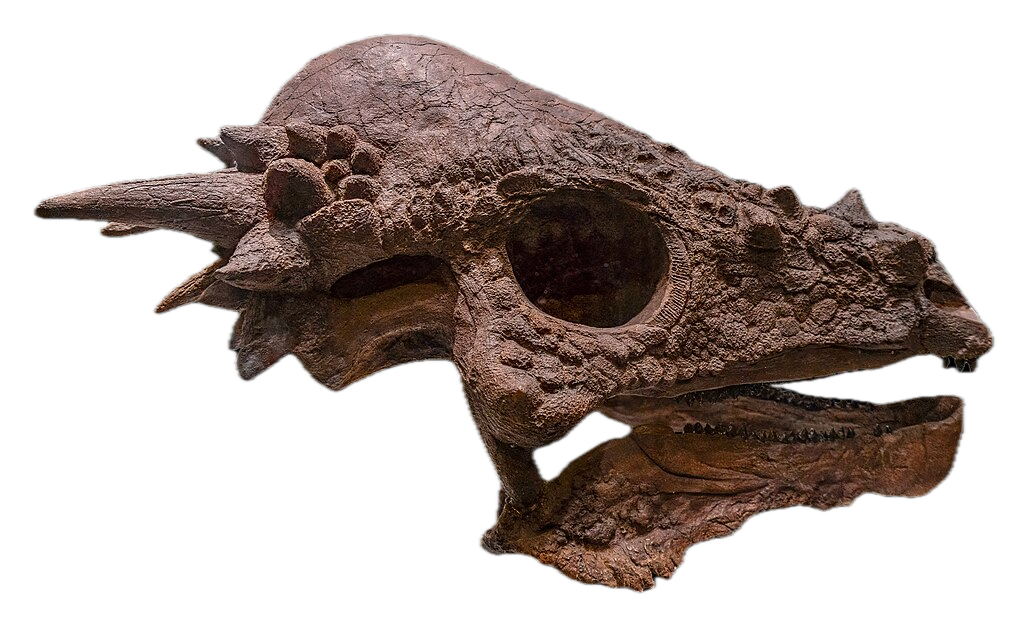
In the late Cretaceous period, a dinosaur, known as Pachycephalosaurus, lived in what is now the northwestern portion of North America. Unlike most other dinosaurs, the dome of Pachycephalosaurus’ skull was nine inches thick. Initial research into skull fragments found mainly in Wyoming led scientists to believe the thick skulls were used to ram each other for dominance. Today, male Bighorn Sheep and Muskoxen ram heads in a display of dominance in order to win mates and claim collision rights. Male Pachycephalosaurus would charge, heads lowered like battering rams and try to knock each other into last week.
6.
However, recent discoveries have led to a theory that Pachycephalosaurus was rather spineless. Key spinal fragments revealed inadequate bone structure to withstand the massive forces from dino ramming and the lack of necessary neck muscles to stabilize the head. When Bighorn sheep lower their horns, their entire spine comes into alignment to withstand the colossal collision forces. The vertebrae of Pachycephalosaurus would buckle under the massive blunt trauma of a head-on smack, twisting and breaking their necks and crushing their brains.
7.
My mother was raised in Minnesota by way of Saint Louis Park and my father was raised in Paris by way of Algiers. Their coming together lasted fourteen years before the kinetic energy ricocheted them back to their roots. The debris from the impact coalesced into a dual citizen. A person with two passports, two languages, and, like the moon, two faces.
8.
Nobody told our wisdom teeth that our jaws have shrunk and we don’t need them anymore. They used to play a crucial role in the molar team, dealing massive damage to our tough, fibrous food. An extra set of molars at the apex of our masseter muscles were just what we needed to deliver huge amounts of crunching force. But over time our diet has changed. Our food is softer, easier to break down. It is less essential for our teeth to have so much power with each chew. But no one told the wisdom teeth. They still try to make an entrance, but there’s never any room. Instead they become impacted, colliding with the teeth next to them. All four of mine were removed before I was in any danger, but they were all on track to be impacted.
9.
Deep Impact came out the same year as Armageddon making them “Twin Films” from 1998. Like the 2021 film Don’t Look Up, both are about an apocalyptic asteroid on a collision course with Earth. The asteroids are of such magnitude as to end all life on Earth, much like what happened to the dinosaurs. Rugged, blue-collar American men in both films bravely sacrifice themselves to detonate massive explosives inside the asteroids to break them into smaller pieces that will burn up in Earth’s atmosphere. We believed we could use our nuclear bombs for good. We could save the world through destruction. In Don’t Look Up, though nobody shoots the asteroid with a nuclear bomb or an IBM missile or a MIRV, instead it seemed best for us to just be together and embrace the collision.
10.
My wife, Annie and I, name our cars. We got married during COVID so for our honeymoon we took a 3-month road trip around the country in our car Lucy to see all of our friends who couldn’t make it to the wedding. Lucy did the entire 12,000 miles without a single incident. But the day before we left for the trip Lucy got rear-ended while parked. A hailstorm totaled her last summer just outside our house. We now drive Luna.
11.
Annie’s parent planets honeymooned in France. As a result, they named their first daughter after someone they met. Annie’s not French but her name is. Maybe her name and my nationality were the big bang that sparked the mystifying gravity that pulled us into each other.
12.
The latest theory on Pachycephalosaurus doubles down on the male dominance theory but shifts in approach. Instead of head-to-head collisions, the males with weak necks and unstacked vertebrae, it is theorized, would stand alongside one another facing in opposite directions and swing their heads into the flank of their adversary, literally head-butting until one of them got bored or lost a hip. No hip fragments have been discovered so this theory cannot be confirmed.
13.
I had a car accident two months ago. I backed Luna up into a parked semi. I guess I didn’t see it there. The hatchback needed to be fully replaced because it hit the semi so high up instead of lower down near the bumper. Our insurance premium went up.
14.
Our baby wasn’t in the car when I hit the semi but I cried anyway when I got home. I wept as I swept up the glass and pulled our belongings out. How do you not see a parked semi?
15.
The Chicxulub Crater off Mexico’s Yucatan peninsula is believed to be the scar from the asteroid impact that killed the dinosaurs. Scientists say the impact released the energy of 10,000 times the world’s entire nuclear arsenal.
16.
Got rear-ended last week in Luna but agreed with the other driver to not call insurance.
17.
Nice little particles of ice, she said. Broken bits of ice fusing with the freezing alcohol and juice in the cocktail shaker. A shaken cocktail is about destruction. It’s a violent act that imparts momentum on ice cubes that ram into one another and produce miniscule shards dropping the temperature of the drink and diluting the potency of the alcohol.
18.
I like to imagine the environment of absolute chaos inside a cocktail shaker.
19.
I like to imagine the universe as a cocktail shaker with planets and stars smashing into one another creating ever smaller and smaller particles in an extremely frigid environment.
20.
When atoms are hot they move more than when they’re cold. Hot atoms have a higher chance of bumping into one another. Chilling atoms reduces the amount of collisions. The thermodynamics of icing a cocktail is a reach towards stillness, brushing the asymptote of tranquility. It numbs us our collisions.
21.
Despite the planet warming, the universe is gradually cooling and slowing down.
22.
The first law of thermodynamics is energy cannot be created or destroyed.
23.
Annie and I can’t collide anymore. Not like we used to. The doctors say that in time she should make a full recovery, but the scar tissue from the birthing process of our Moon was so severe that even the slightest touch inside is painful. We try to collide in other ways.
24.
I try to imagine what transpired between 1998 and 2021 that caused the ontological shift from Deep Impact and Armageddon to Don’t Look Up. Two films came out just before the millennium that said we can avoid total destruction. By making our own divergent collision we can mitigate a larger, more devastating impact. A counter-collision. We can do this. We will find a way through.
25.
I don’t want to say that Don’t Look Up was entirely hopeless or that the characters were powerless. And maybe in the universe of the film, if all of humanity had gotten together they could have coordinated a counter-collision, but I think that’s just the point. In 1998 there was a singular focus, a shared mission. A collective. But in Don’t Look Up, humanity is divided. We are all so alone and as individuals we cannot stop a colossal asteroid. The best we can do is find togetherness, create collective, and embrace the collision. At the end of Don’t Look Up, some of the characters see the asteroid as the end it is and decide, together, this is the end.
26.
There’s a realness, a rawness, to that sentiment. It is a sort of omen, warning us all about the trajectory we’re on. And I don’t mean literally a trajectory with an asteroid, or the metaphor for climate change, I mean the trajectory pushing us farther and farther from genuine human connection. Pushing us until we don’t mix at all and we become immiscible liquids. If we collide less and less, eventually we will all float on, isolated until a massive collision blows up our spot.
27.
Our Moon waves her arms back and forth, imitating me as I clap. She likes when I clap but she has yet to be able to do it herself. She hasn’t been able to connect the palms of her hands with any kind of force.
28.
She clapped for the first time this week. They say that children raised in a bilingual household take longer to develop speech. The added complexity of two languages slows down processing. I frequently remind myself of this to assure myself she’s okay and that I am a good parent. Other children are developing consonant sounds but she is still vocalizing using vowels and a multitude of lip buzzes and raspberries. It’s adorable and I try not to get anxious. I tell myself soon she will be talking and it will be in two languages. In the meantime, her main form of communication is clapping so we clap. Everything deserves applause.
29.
Our Moon discovered her teeth, of which she has four. Two on top and two on bottom. She grinds them to know they’re there.
30.
Pachycephalosaurus was one of the last dinosaurs around, headbutting throughout the late Cretaceous. That is until an asteroid hit the planet. If the theories about male dominance and dinosaurs are true, it seems the asteroid was the ultimate alpha male.
31.
Liam, another car, once got hit by a deer. It was a fever dream but the damage was real. I was in bed with a fever of 102, sweating through my sheets in the August heat, when I noticed a doe in my backyard.
32.
The deer woke me up because it was caught up in our lawn furniture. Its leg tangled in the swirling wrought iron of a chair leg.
33.
I slipped out of bed both cold and hot and went to the backyard. Upon seeing me, a predator, an entity to avoid, it ran, dragging the lawn chair with it. The chair was heavy and pulled at the deer. I followed it around the house as it hop hobbled along. It ran towards, then fell into, the street but kept running. With every step, the chair clattered against the pavement, creating a noise that scared the animal more. This created an accelerating cycle until something was able to stop their momentum entirely. The doe meant to go left but the chair meant to go right. Together they went straight and collided with Liam.
34.
Animal control got to the scene before the insurance agent. They unhooked the deer from the car and the chair. Despite a few scrapes, the doe was more or less fine. It left me a mangled chair and a smashed driver door. The car looked like I had thrown the chair into the side of it myself. I had pictures of the deer otherwise the insurance agent would not have signed off on the coverage.
35.
For PT, Annie had to purchase lube. The damage from our Moon colliding with her pelvis during labor means that Annie has to do PT from the inside as well as from the outside. She’s training to have collisions again.
36.
As I write this I wonder if there’s anything that isn’t a collision. Confluence versus isolation. Without a coming together, without change, everything is the same. Forever.
37.
Collision is percussion. It is rhythm you can hear and feel.
38.
We are all the products of collision. A sperm collides with an egg and we’re created. Or rather two people collide and create a third.
39.
My dad was disappointed when I didn’t have my first collision by age 14.
40.
A friend of mine says she wants kids. She doesn’t need to say it because everything she does says it. But she’s single. She’s open to skipping the collision and going for IVF but worries what the repercussions of avoiding a collision with another person will do.
41.
How hard is solo parenting? she asks.
42.
I don’t know, but she could ask both my parents.
43.
When I was 16 I thought you had to be 18 to buy condoms. I didn’t have a fake ID and I couldn’t face the humiliation and complete emasculation of asking my mom to buy them for me. To get around this I asked my dad to send me a box of condoms, covertly via international mail. When I moved out to go to college I realized they had expired, I threw out a box of nearly 50 condoms stamped by U.S. Customs. It was the only time my dad ever mailed me a gift.
44.
Then it’s the bomb, the bomb… the bomb/ Will bring us together/ Coyness is nice, and coyness can stop you.
45.
An atomic bomb is the start of a chain reaction. Each link in the chain is a small separation, a tumbling of dominoes that breaks particles into smaller nuclei, releasing an incredible amount of energy in the process. The term critical mass originally comes from the atomic bomb program of the 1940s and refers to the necessary amount of starter material (plutonium and uranium) to ensure that when the fission occurs, enough particles will scatter to guarantee collisions with other nuclei.
46.
Just this week in the war in Ukraine, a new type of missile was revealed. The missile, nicknamed Oreshnik by its Russian creators, is a type of Intermediate Range Ballistic Missile, or IRM, that is incredibly hard to intercept. Another source I read called it a MIRV, a Multiple Independently-targetable Reentry Vehicle. I’m not sure which it is, or if it’s both, but what I do know is that it’s been designed to be extremely difficult to intercept. The warheads are nearly impossible to stop.
47.
Russia continues to lower the threshold for using nukes, and I don’t think they have them trained at any asteroids.
48.
In high school, we used to play Critical Mass. Enough of us on our bikes could block the entire street, pedaling slow. On the one lane road along the lake cars could not pass and it felt like we were the head of a parade. This was before Bluetooth speakers so I rode on the back of Hank’s tandem where I could bring a drum and give us a rhythm we could feel and hear.
49.
The Large Hadron Collider smacks protons into each other with such force that 100 billion antiparticles emerge every second.
50.
Hit me, c’mon, hit me, my father said to me. We stood in the hall to his apartment, my collar crumpled in his fists as he held me inches from his face. I’m four inches taller than him but he filled my face with his. I could smell the red wine and garlic from lunch on his breath beneath the smell of stale cigarettes that permeated the apartment. His watch, now my watch, jangled on his wrist as he shook my collar.
Hit me, Benjamin.
I don’t know what we were fighting about. Something had erupted at lunch and crescendoed. The silent motorcycle ride, a dance of balance, did nothing to quell the tension, if anything, it made it simmer and foam up. By the time we were home we were yelling. Helmets were tossed to the floor or the couch. I don’t remember what pushed it over the edge but he grabbed me and told me to hit him. He wanted to fight me.
I looked in his eyes and I saw the ferocity of a cornered animal. There was fear, but there was also fire. I wrenched his hands free and ran out the door. I returned that evening, after my grandparents talked me down from buying a plane ticket back to the states. That was the only time I ever saw him turn from fire to water.
51.
An antiparticle is a particle (despite the deceiving name) that has the same mass as a particle (pro-particle?) but the opposite electro-magnetic field. Every subatomic particle has a corresponding antiparticle. For every positron there is an electron.
52.
Tonight, our Moon swung her teething toy around while I held her. It was after the bath and I was trying to get her into her pajamas when Annie walked in. The toy flew through the air and hit Annie in the mouth. It chipped a tooth. The teething tool hit her front teeth and chipped one.
53.
The back of my father’s matte black motorcycle helmet is peppered with silver chips and scrapes. The remnants of our many headbutts from riding behind him and not paying attention. He slams on the brakes, my head flops forward, and our helmets collide. I’ve never seen another helmet speckled with so many scrapes and pock marks.
54.
When at a red light for too long I’d headbutt my father. Helmet to helmet, just to say hello.
55.
We pull the ripcord of avoidance to float away from collisions just as often as we plummet headfirst directly into them. Maybe a better theme than collisions is movement. Movement from the smallest subatomic particle to entire galaxies. Collisions are the result of all this movement. If any singular thing moved in complete isolation it would have nothing to collide with. Collisions are really just the result of all of us moving all the time.
56.
Annie and I collided for the first time in 2017. Since the arrival of our Moon eight months ago, we’ve collided only a handful of times. The shift of mass transformed our momentum. Our orbits are more oblong.
57.
Plumage theory prefers to focus on males that win mates through a show of extravagant decorative plumage rather than through show of force. There are birds that refrain from physical violence and win mates through displays of colorful feathers. Recent fossil discoveries have revealed that dinosaurs also had feathers. Maybe Pachycephalosaurus wasn’t so into bashing heads. Maybe they had elaborate crowns of gaudy feathers and the thick skulls acted as a sort of flowerpot for their beautiful bouquets.
58.
I used to make salad dressing by first mixing Dijon mustard with olive oil and then adding vinegar. I had to vigorously stir the mixture with a fork in a bowl tilted on its side until my arm cramped up just to incorporate all of the elements. But a few months ago, Annie told me to put the vinegar in before the oil. Mix the vinegar and mustard together before adding the oil. Mustard breaks down effortlessly in vinegar. Immiscible liquids are liquids that naturally resist blending or mixing. No matter how hard they are smashed into one another they never really come together as one.
59.
Our Moon’s momentum was stopped when it collided with Annie’s pelvis. An alternate route, through a Cesarean in Annie’s stomach intercepted her and brought her into this world safely.
60.
Two weeks later that same Moon propelled shit across the room, splattering my stomach and the rug. I was more upset about the rug.
61.
Now, she stands on her own.
62.
It’s the bomb, the bomb, the bomb…
63.
Our Moon doesn’t have her Y5 molars yet, but she will eventually, and it will cement her place as one of our species. Y5 molars are one of the attributes that set us apart from old world monkeys. Our 5-cusp rear teeth form a y-pattern, (hence the Y5 name). Our ancient ancestors like Australopithecus and Homo Habilis had larger molars than us but retained the iconic Y5 pattern. This special pattern helps ensure a successful chew with a variety of foods. Fruits to seeds to grains to meat can all be crushed and broken down by the powerful bite force of Y5 molars.
64.
Pete James, part of high school Critical Mass, always went by his full name. Maybe having a first name as a last name gave him that privilege. Pete James sounds way more intriguing than just Pete. His best friend actually has two first names, Dead Ray Olafson, so maybe he was just trying to fit in. Pete James accidentally smashed a juice glass into my face during a lively brunch at Dean Ray’s house late in junior year. The impact shattered the glass and severed a tooth. I don’t know where Pete James is today but I will have a fake canine for the rest of my life. Dean Ray Olafson has two kids now.
65.
A celestial body locked in synchronous orbit with a planet will never turn its back on that planet. The spin of the Moon on its axis fits nearly perfectly with its orbit around Earth. From here, we only ever see one side of it. It never turns its back to us. The dark side of the moon was first seen by humans aboard the Apollo 8 mission in 1968.
66.
But it’s only nearly perfect. The Moon is drifting away from the Earth. Every year it drifts 4 centimeters farther away from us. I got worried and looked up how long it will take for it to completely leave. 4 centimeters is only 0.0000000000056% of the distance between us. But still, it’s drifting. Until the sun explodes and swallows us all up, we’ll always be able to see the Moon, but every day it is a little farther than the day before.
67.
I’m going to stop here and go watch the Moon before it drifts away.

