

1.
Black is dead.
That’s what came to mind when the band started playing “Wonderful Life.”
I took a big gulp of my gin and tonic.
I shivered as the ice clicked against my teeth. I felt the same cold on my gums as in my soul.
It was a balmy night.
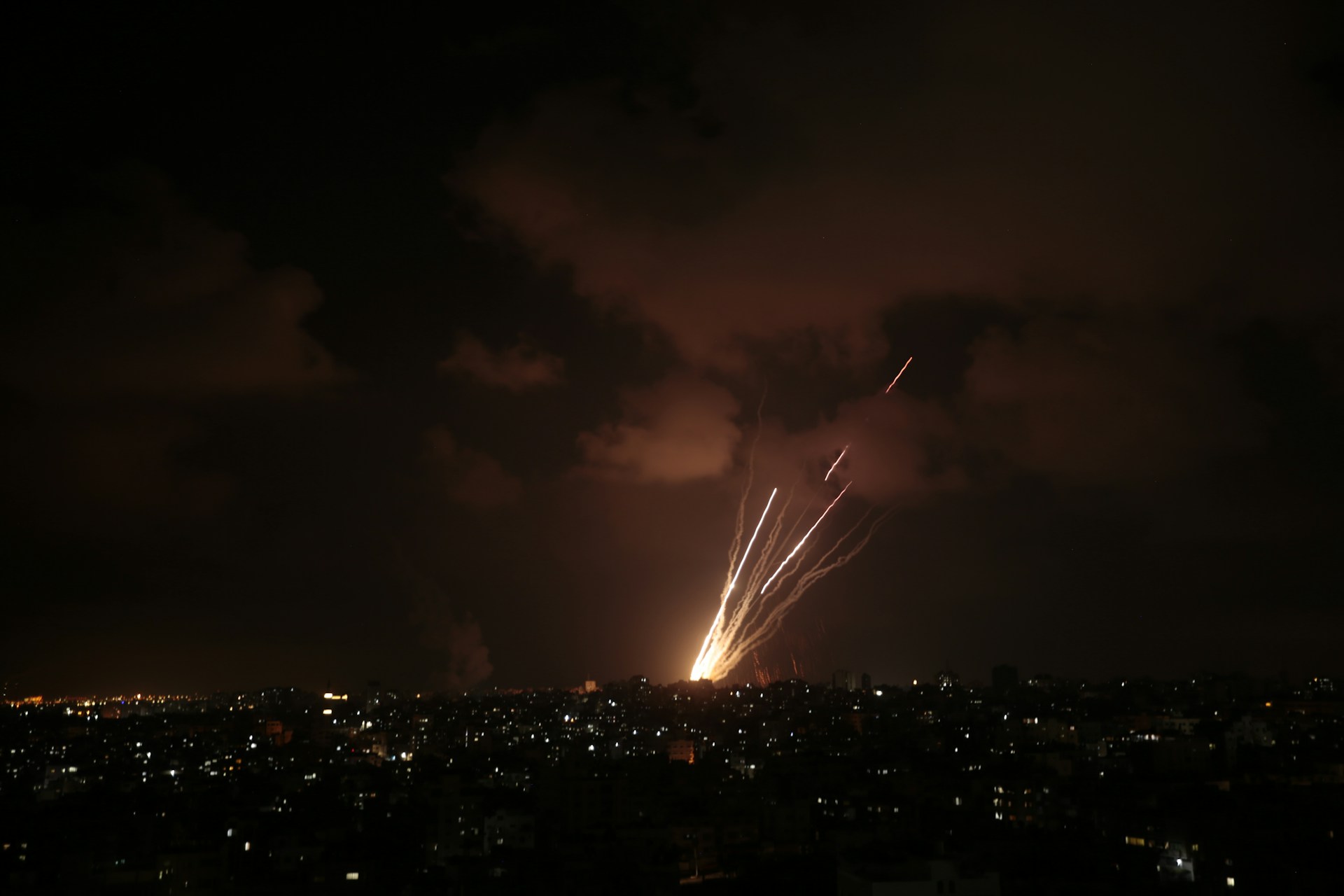
You couldn’t see the stars because of the city lights, but the rockets launched from Iran lit up the sky.
“It’s a wonderful, wonderful life,” the guests sang in chorus with the frontman on the dance floor.
A few people snapped photos, but nobody made much of it.
They weren’t shooting Lebanon.
It was a balmy late-summer night in Beirut, and I was standing at my host’s reception on a rooftop terrace in Hamra.
I didn’t feel like it, but it would have been terribly rude to say no. Everyone from the international press was there, and the Lebanese elite too.
I felt old and tired as I leaned on the terrace railing and finished off my fourth drink.
I’d had a long day.
I arrived in the country at eight in the morning.
I checked into my place.
Hezbollah questioned me and processed my credentials.
I covered the funeral of Fuad Shukr, who had been killed by the Israelis, start to finish.
I wrote a piece about the mass demonstration.
Henrik was impressed that I pulled all that off in less than twelve hours.
I wanted to sleep.
Henrik insisted on my presence.
By the time I staggered back to his apartment from Dahíja, the party had already been going on for two hours.
The ten-story building had been built sometime in the sixties. The two-hundred-square-meter apartment Henrik rented had an armored door. It might have been an office of the Palestine Liberation Organization before—at least my host joked that I shouldn’t be surprised if I saw the ghost of Yasser Arafat circling in the living room at midnight.
I wrestled with it for fifteen minutes before I managed to lock the door. I didn’t remember anything from Henrik’s morning demonstration—what button to hold down while turning the key. On the umpteenth try it worked.
There were a lot of people at the reception. By the door that opened onto the terrace, plastic tables sat on star-patterned cement tiles, lively conversation going on around them. A four-piece Lebanese band played old standards in the corner.
I started out to mix myself a drink, and meanwhile I took in the crowd. There were maybe thirty of them, mostly Westerners, a few Lebanese.
A young woman stood at the center of the group. She was in her early twenties, shoulder-length blond hair. She wore jeans and a T-shirt, and subtle lipstick on her lips. There was nothing provocative about her, and yet every man’s eyes glittered as he listened to her.
She was like the sun at the center of a galaxy: everyone orbited the light that radiated from her.
The flames burning in her were fed by youth and conviction. I could feel her warmth from the other side of the terrace.
“What the colonialist Nazi Israel is doing is genocide,” the woman said.
The people nodded.
“The world sees it now. The working class is already out in the streets. Truth will win. From the river to the sea, Palestine will be free.”
Henrik spotted me. He got up from the table and came over.
“There you are.”
“Sorry. I couldn’t get the door locked.”
“That’s exactly why we need to support the Palestinian resistance. In the name of social justice,” the woman said at the table.
A few people clapped.
“That’s Kat,” Henrik said. “Communist activist, from Hamburg. She was with the Kurds in Syria.”
“A younger Red Army Faction?”
“Something like that. The darling of the Palestinian Communist Party. She sold her apartment and wired the money to them. She lives for the cause. She has no money at all. She sleeps in the PFN office in Shatilla. The Palestinians feed her.”
“She seems crazy.”
“Crazy and wild.”
“Like an early Lana Del Rey song.”
“Or young Leila Khalid.”
“So, she’s going to hijack airplanes?”
“I can see it in her. Want me to introduce you?”
“Absolutely.”
We went over to the table and sat down.
“If the Israeli colonization ends and the Palestinian people win self-determination,” Kat said, “the same kind of revolution will happen as with the Rojava Kurds. Differences between the sexes will disappear, and social justice will arrive.”
She must have seen my expression, because she stopped talking and looked at me.
Her eyes flared like a solar flare.
“You disagree?” she said. “You don’t think Israel should end the genocide right now?”
“I do. On that, yes,” I said.
“So?”
“I’m skeptical about the social-justice part. I don’t really see jihadists campaigning for women’s equality.”
“That’s Zionist propaganda.”
Henrik cut in.
“You can call Daniel a lot of things, but you can’t call him an Israeli propagandist. Hezbollah cleared him in a day; he could go to Fuad Shukr’s funeral. I know colleagues who’ve lived in Beirut for years and couldn’t pull that off.”
“So, he’s not a propagandist?”
“No,” I said. “I just don’t believe in people.”
“Then what do you believe in?”
I didn’t answer.
“He believes in nothing. It’s because of cynics like you that the world is where it is, watching a people being wiped out live.”
“Especially since I’m the one broadcasting it.”
A bitter taste rose in my mouth.
“If you’ll excuse me,” I said, “I’m going to get myself a drink. In the meantime, please don’t redeem the world.”
I stood up and dragged myself, wrecked, to the drinks table.
2.
“She’s right,” I thought. “I really don’t believe in anything.”
I can’t get excited about anything. My first question about anyone is what they want from me. I’m cold and calculating. Cold sweat ran down my spine when I realized my twenty-year-old self would probably be just as disgusted by me as this twenty-year-old woman.
You don’t notice you harden after thirty. You don’t notice you’ve betrayed the passionate, noble, brave young person you once were. You barely remember him anymore, except when someone reminds you.
That put me in a worse mood.
I knew exactly that the Palestinians were going to lose. The survivors would be pushed into Egypt, Israel would move into the Gaza Strip and build a resort zone on the bones of the dead, and the world would watch in silence.
And still, I would have given anything to be able to believe the opposite.
Where did my idealism go, my faith in humanity?
What happened to me?
Time.
That’s what.
If you assume the worst about people, you can predict almost anything with decent accuracy. That’s true in politics, but also in the most basic social relationships.
By the time you’re forty-five you give up all hope.
It’s self-defense.
If you don’t hope, you don’t get disappointed.
If you live long enough, you will inevitably burn out.
The life cycle of the human soul can be mapped onto that of the stars. You’re born, fusion starts inside you. Hydrogen turns into helium, and it comes with a terrifying heat and light. You illuminate the universe. You warm the planets orbiting you.
But after a while the hydrogen starts to run out. The inner core contracts, the outer layers expand—you turn into a red giant.
You build walls around yourself to protect what’s left.
In the end the fuel runs out completely. You become a white-hot dwarf, the memory of fusion.
Then not even that.
Stars need billions of years for this.
A human can do it in twenty, twenty-five.
It doesn’t even occur to you unless someone else’s burning reminds you.
I looked around at the guests and decided one, at most two people might be older than me. And there at the center of the group shone this twenty-something communist sun named Kat.
I would have given anything to feel again the warmth of that fire.
Then the band started playing “Wonderful Life.”
“Look at me standing here on my own again,” it went.
By the end of the first verse, I almost burst into tears.
3.
At two in the morning, I gave up trying to sleep and went out to piss.
When I opened the bathroom door, I found myself face to face with Kat.
She stood completely naked in front of the mirror, toweling her hair.
“Sorry—I didn’t know someone was in here.”
“Come on in,” she said. “I don’t mind.”
“It’s not that urgent,” I said, and shut the door.
I pissed in the kitchen sink.
Then I went out onto the terrace to smoke among the plants.
I had it in my head that I was a cold rock drifting in space. There’s nothing alive in me. Nobody will ever know it was there, because I hardly remember it myself.
Soon I’ll leave the galaxy.
I couldn’t pity myself for long.
“Let’s start over,” her voice yanked me out of my head.
She stood by the table with two beers in her hands. She set one down in front of me. She wasn’t completely naked anymore; at some point she’d put on panties.
Her breasts glowed white in the half-dark.
“Kat,” she said.
“Daniel.”
She smiled as she sat down. Her brown eyes burned my skin. I tried not to stare at her nakedness, but I couldn’t. In my head I heard my twenty-year-old self: “The old shit is drooling over a girl who could be his kid. I can’t think of many things more disgusting than this.”
An Arabic tattoo ran along her side. I could read it when we clinked beers.
WE ARE THE REVOLUTION
“Kanafani?” I asked.
I hadn’t read much of Ghassan Kanafani, but I knew this line of his. You can read it on some wall in every Palestinian refugee camp.
Mossad killed him. They hid a bomb in his car in Beirut.
“Yes,” Kat said. “It changed my life when I read him.”
We were quiet.
“Honestly,” I said, “I expected to run into Arafat’s ghost more than I expected to run into you.”
“Henrik said I should sleep here. It’s late, and I’d have to wake up the office manager in Shatilla to let me in.”
“You and Henrik?”
“As if. Henrik isn’t interested in women. And even if he were—so what?”
“Nothing. I don’t know why I asked.”
“I do. Your instincts kicked in. Your lizard brain wants a woman to belong to somebody.”
“I’m sorry.”
“It’s hard for women too, not just men. We’re wired to give ourselves to persons, not ideas. I belong to the revolution.”
“That has to be lonely.”
“I haven’t been lonely for a second in my life.”
“Good for you.”
We were quiet.
“You left very early. When I looked for you, you were gone.”
“I was tired.”
“But here you are.”
“I couldn’t sleep.”
“Neither could I. Tomorrow we’re going down to the border, to the camp.”
“You should rest,” I said. “They’re shooting the border. Be sharp down there.”
“I don’t think I could sleep.”
“It’s enough if you lie down and close your eyes. It usually works for me.”
“I don’t feel like lying there with my eyes closed until nine.”
“Then what do you want to do?”
Kat stood up from the chair, put her palm on the table, and leaned so close to me I could feel her breath.
“I was thinking we could fuck until morning.”
The beer bottles clattered off the table as I crashed into the sun.
4.
Kat’s skin smelled like soap. She clamped her mouth on mine, and it was not a kiss, it was a hold, and her legs locked around me until my breath went thin. I went for her neck and her hips to turn her and take it back, but she caught my wrists and pinned them to the mattress and kept me there. I strained up anyway and she made a low sound into my mouth—approval, not mercy—and pressed down harder until the fight went out of me. She watched me the whole time, calm and bright, and then she shuddered once and exploded in my hands
It was getting light when we took a break. We lay sweaty beside each other in bed as the sun lifted its head out of the Mediterranean.
Every cell in me was screaming that I was alive.
My body burned. My soul sparked. I gasped for air.
Now I understood why middle-aged men chase young women so hopelessly. They think if they get them, they’ll partake of their youth and idealism.
I felt like a stone thrown into fire, now glowing white from the flames.
It felt great, even if I knew it would pass the moment we separated.
Ashes shouldn’t daydream about fire.
I got out of bed, pulled two cigarettes from the pocket of the jeans on the floor, lit them, gave one to Kat, and lay back down beside her. I stared at the cracks in the ceiling as I smoked.
“I could be your father.”
“Good thing you’re not,” Kat said, and put her hand on my chest.
“I feel like an old goat.”
“I fucked you—not the other way around.”
“But why me? You could’ve fucked anybody.”
“I like older guys.”
“Why?”
“Because they know how to fuck.”
She smiled; light and warmth poured from her big brown eyes through my whole body. She stubbed out the butt in the ashtray on the nightstand.
“Cigarette break is over,” she said, then climbed on top of me.
“You really want to join the resistance?” I asked afterward.
“I do.”
“You know there’s a good chance you’ll die?”
“I know.”
“And it doesn’t bother you?”
“Sooner or later, everyone dies.”
“Yeah, but not everyone gets shot or hit by a rocket.”
“At least my death will mean something.”
“Death doesn’t mean anything.”
“It doesn’t if you don’t die for something. Most people just die.”
We sat in silence.
“Henrik thinks very highly of you,” Kat said.
“Yeah?”
“He told me you’ve been in every conflict in the Middle East in the last twenty years.”
“That’s true.”
“Did you ever feel like you had to take a side? That just writing it down isn’t enough?”
“Yeah. Plenty of times.”
“So why didn’t you?”
“Because I was a coward.”
“At least you don’t preach about journalistic independence.”
“I don’t.”
“And anyway, it’s obvious they accept you, and your relationship with the resistance is good.”
“What makes you think that?”
“Hezbollah cleared you in a day.”
“I got lucky.”
“And you have connections.”
“My ass,” I said. “You know what happened? I got into a taxi and went to the mosque where they were holding the funeral. Armed men blocked the entrance to the square on both sides. Since I wasn’t accredited, they stopped me immediately.”
“And what did you do?”
“Nothing. I told them who I was and that I’d arrived that day. I told the guards that if it wasn’t possible for me to go in and cover the funeral, I’d leave, but if they could help, they should help.”
“And?”
“I waited. A guy on a motorcycle came, I had to get on behind him. He took me to Hezbollah’s press office, where they questioned me and then issued my accreditation. The Hezbollah press officer gave me his number and said next time I should call him.”
“That’s it?”
“Yes. That’s what everyone’s amazed by.”
Kat laughed.
“Who’s the Hezbollah press officer now?”
“A guy around thirty. Perfect English.”
I couldn’t remember his name, so I got up and pulled my notebook from my pants and read it out.
“Okay,” Kat said, and took the notebook out of my hand. She picked up a ballpoint pen from the nightstand, wrote the spokesman’s phone number on her palm, then wrote in my notebook:
REVOLUTIONARY
Kat2001@protonmail.com
“If you need me,” she said.
I went out to the kitchen and made coffee. She was dressed by the time I got back. She stood in front of the mirror, putting on lipstick. She smiled when she saw me staring.
“It’d be a shame if you died,” I said finally.
“My body will break down either way.”
“Anybody can fuck,” I said. “There aren’t many who believe in something.”
“You’re cute. But I think you believe in something too.”
“In what?”
“You wouldn’t do this job if you didn’t believe in something.”
“I’m not good at anything else. I don’t have time to start over.”
Kat’s phone rang.
“They’re here for me. Will I see you again?”
“Tomorrow I’m going back to Cairo.”
“Then we won’t see each other in Beirut.”
I took my business card out of my wallet and pressed it into her hand.
“Write me if you ever come to Egypt.”
“We’ll meet again,” she said.
“Promise?”
“I promise.”
She kissed me on the mouth, took her backpack.
I sat in the half-dark for a long time after she left.
I stared at the ruins of the night: the beer bottles on the floor, the crumpled, sweat-soaked sheet on the bed.
Then I cleaned up.
Summer sparkled outside. The air trembled over the concrete.
I scrolled my emails while listening to “Wonderful Life” on repeat.
I was cold.
“The sun has left Beirut,” I thought. “And you’re heading for the cooling.”
More than once it occurred to me, but I stopped myself from writing her an email.
What could a forty-five-year-old old man write to a twenty-four-year-old woman?
Nothing.
Just as he can’t hope for anything.
5.
Two months later I wrote to her, from Cairo.
Mossad killed Hassan Nasrallah, the leader of Hezbollah, in a targeted airstrike.
Around the same time, they planted bombs in the pagers of key Hezbollah figures—pagers that blew up in their faces.
There were a lot of dead.
I had a very bad feeling. I scrolled the news looking for word of Kat’s death, but nobody wrote about a young German victim.
I wrote to her only that I hoped she was well, and that I thought of her often.
She didn’t answer, which didn’t mean anything.
That’s how ash remembers fire.
My life returned to its usual rut.
I was a dead, cold rock again in space.
I often caught myself—especially when I was alone—thinking about that Beirut night.
It would have been better if it never happened. Then at least I wouldn’t know how cold I live.
Time worked for me, and against humanity.
After Hezbollah was decapitated, Israel, with the Americans and the Turks, brought down the Assad regime in Syria.
Then they bombarded Iran with rockets.
Photos of starving Palestinian children with bones sticking out, from the Gaza Strip, flooded the international media.
I went down to the Egyptian border crossing at Rafah more than once.
A twenty-kilometer line of aid trucks rotted on the roadside.
Israel denied sabotaging the aid and protested fiercely when we called its Palestinian policy genocide.
The official position was that they acted in full compliance with international law.
They didn’t let the press into the strip to report.
The whole crisis landed on me; I was the only correspondent posted in Cairo.
I hated it all.
Israeli propaganda was the most aggressive in Central Europe.
You’d get called an antisemite just for stating facts.
6.
August came again, dead Cairo heat.
The war in the Gaza Strip had been going on for two years.
I was sitting in my apartment in Dokki when the phone rang.
It was the government press office.
“There will be a press conference about the peace talks. Would you like us to accredit you to the Ministry of Foreign Affairs?” the woman said into the phone.
“Did they agree on a ceasefire?” I asked.
Since the war broke out, Israel had been negotiating with Hamas through Egypt, Qatar, and the Emirates.
Aside from one brief truce, they hadn’t managed to agree on anything.
Israel wasn’t very interested in the hostages.
It looked like they wanted to get rid of the Palestinians in Gaza for good, one way or another.
All of us were waiting to see when they’d push them into Egypt.
Like hell I wanted to go to New Cairo to listen to Israel’s latest lie about why they can’t stop starving and slaughtering civilians.
Hamas may be a jihadist organization, but they hadn’t had any cards left to play for a long time.
What happened in the Strip was solely up to Israel.
“Of course,” I said.
It’s better not to say no to anything when the Egyptian government press office calls.
Especially if you want to keep your residency permit.
“When will the press conference be?”
“At five.”
“Okay. I’ll be there.”
I looked at my watch. It was two.
I got up from the computer and started getting ready.
In the shower I kept thinking: nobody cared. So why did the press office have to call us one by one?
I sat in a taxi for an hour.
By the time I reached New Cairo, my shirt was soaked through.
There was heightened security at the Ministry of Foreign Affairs.
They searched everyone at the entrance.
Then on the fourth floor, where the press conference was held, they patted us down again.
Egyptian flags were on the wall, chairs facing a podium.
I sat in the very back row.
By the time it started, the room was full.
I was staring at my phone when the members of the delegation arrived.
I looked up only when the Israeli envoy began to speak.
He was the only one surrounded by soldiers.
A man and a woman stood beside him in Israel Defense Forces uniforms.
They scanned the crowd.
I stared at the woman.
She reminded me of collapsed stars whose gravity is so strong they swallow even light.
In 2022, NASA released an image of one fifty-three million light-years from Earth.
You can’t photograph a black hole.
You can photograph the event horizon—where nothing gets back out.
A bright ring around a dark center.
And then it’s gone.
The woman’s hair was black now, but the first letter of the Arabic tattoo on her chest flashed between the buttons of her blouse.
She shone beside the diplomat like the accretion disk at the event horizon.

