

It’s been three weeks since I turned into a ghost. It was weird at first, but I’ve grown into it. The biggest lesson so far? Ghosts are severely misunderstood. Like we are all evil out to terrify humans. As if humans don’t terrify humans. As if we can haunt humans better than other humans can.
I grew up reading ghost stories. I wasn’t always a ghost, you know? I died, then became a ghost. As one does. Now, I have one goal and one goal only: to inhabit the house I grew up in. Not to scare anyone. Just watch over my two siblings—twelve-old-year Rup and nine-year-old Puk. I don’t trust my parents, never did, more so now that I can’t use my body as a violence repellent. I do enjoy the occasional prank—playing with the burner flame on Sunday afternoons when mother makes her favorite poita bhat or turning the knob to on after father has turned it off and watch them fight, looking for answers like I did all my life. From the small opening of their bedroom door upstairs, Puk and Rup’s heads would stick out like baby giraffes, giggling and squeaking as mother and father hurled profanities and furniture at each other.
In case you are wondering what I look like, I have no good answers. I have tried and tried but I couldn’t tell you what my body resembles. When I look at the mirror, I see a genderless blob instead of how I remember myself. Long, oval face, two protruding black sockets for eyes, no ears, arms so frail you could hear it crack every time they move, and legs so bloated and heavy I can’t walk faster than a child crawling for the first time. It’s not that I don’t know what I look like. I am disgusted at what I have become.
Still, I try and make myself useful. When mother locks up Puk’s Tinkle comics (which I passed down to her) or Rup’s acoustic guitar (which I stole from this rich asshole who bullied me in high school) or when father keeps the jar of Bourbon biscuits or soan papdi on the top shelf of the kitchen cupboard, I magically make them appear next to their beds. You might say I am enabling them, but if you see the scars on their fragile little arms, you will wonder what harm a little sweetness does.
The first time I went up into their bedrooms as a ghost with two jars of their favorite cookies, they were asleep—Rup’s mouth wide open letting out soft snores and Puk lying face down, arms outstretched. Just like I remember them. Despite my best efforts, the glass jars hit the wooden bedside table louder than I wanted, waking them both. I was scared. What would they think of me? Will they scream out of fear? Will they run away? Will they even recognize their brother underneath this despicable body he has inherited? Until I realized they couldn’t see me. Since that day, I have assumed my invisibility.
While they gorged on the cookies, leaving crumbs all over their bed, I sat down on the cold floor beside the bed that used to be mine, looking at them for a long time, relishing the joy they radiated, soaking in the light emanating from their smiles. We grew up learning that food is a luxury—you earn it by being Mommy and Daddy’s good little puppies. If you aren’t on your best behavior, if you talk back, if you let out a single groan from your daily punishments—forget about dinner. I learnt how to steal food from the kitchen cabinets long before I knew most parents don’t starve their kids for fun. We weren’t just treated like dogs, we were fully made to believe we were dogs.
Every day around midnight, an hour or so after bedtime, everyone snoozing away in their dreamlands, I let myself in the living room. Walk over to the kitchen, find my stash of snacks, sit on the creaky wooden rocking chair by the fireplace, gorge on some sour cream and onion chips dipped in mayo, and get some reading done. Catch up on everything I have missed. It’s a welcome change to not be fat shamed. Or called lazy. Or a disappointment. Or a giant stain on the family. Or a dead body in living skin.
Around three on the night before Magh Bihu, as I devour the last pages of a psychological horror novel under a candle—I hear footsteps in the distance. This is weird. No one comes down this time of the night. So, I get up, lick my fingers dry, wash my hands and wait at the end of the curved stairway that separates the living room and kitchen from the bedrooms and bathrooms upstairs. The steps get louder and faster, my heartbeat matches the speed. Warm light emanates, a shadow taking form, then another. Rup and Puk appear, groggy-eyed, rubbing their faces. Tiptoeing on their feet, Rup holding one of our old kerosene lamps for light, they pass through me into the kitchen, opening the doors to all the cupboards and aiming for the plastic jar of til pitha and laroo perched at the end of the top shelf. Inventive ways to reach for the elusive jar prove unsuccessful, so I walk to them and in a flash, move the jar to the counter. It takes them a few seconds to notice, but when they do, they don’t seem surprised.
Puk grabs a Tupperware with leftover chicken curry from the refrigerator and dumps it into a pan as Rup turns the burner knob. He clicks the rusty igniter that should have been dumped years back—once, twice, again and again. No sparks. I hold his hand, point the igniter to the burner, press against it with all the force I can conjure. An orange flame lights up their faces. Puk claps in joy, Rup grabbing her hands and shushing her. I forgot they haven’t eaten all day.
Mother and father would often hide lighters and matches and anything that could make light. They stopped paying electricity bills, choosing to keep the house in perpetual darkness. Unlike the neighbor’s houses, the lights in ours went out more than they stayed on. What do they care? They would be out living in their farmhouse while we sweated sleepless nights away. I taught Rup and Puk to use the gas stove. If you need to light a candle to study or the kerosene lamp to get around the house or a cigarette when you are stressed—you have a way. Of course, I kept the last one to myself. Someday, when they are all grown up, I’ll tell them.
I taught them the risks too. Tell them what leaving the burner knob on or not turning the cylinder all the way through or a faulty pipe can create, what it can destroy. They might be kids, but this is no child’s play. Hell, it’s not even adult’s play. Just don’t fucking play with fire.
“Do you think there’s a ghost in our house?” Puk says.
“Why would you say that?” Rup asks.
“Do you think it’s our Sunny da? I heard Ma saying to Pa that people who die come back to live with their family and talk to them.”
“I—I don’t know what you are talking about.” Rup’s eyes wander around the kitchen, neck turning slowly, landing on me. He doesn’t say anything, but stares at me for a little too long.
Our parents never let us out of the house. Like at all. In my twenty-two years as a human (you might say I died too young, but boy did it feel like a long life), the only view I had of the outside world was through the tiny hole I secretly poked on the edge of one of the thick, black plastic sheets covering every inch of our bedroom windows. It was the only way light sneaked in. When Rup and Puk were born, I was glad I wasn’t alone anymore. The four walls closed on us, pushing us together.
But now that I get to walk the streets every morning as the sun glistens, follow the shadows the moon casts late at night, breathe in the chilly air that makes my nose burn, touch the gently dancing leaves of the fig trees, lie down on grass and talk to daffodils and dandelions, let my skin soak in the pouring rain, listen to the music humans make in parks and restaurants and movie theaters and libraries—I know we didn’t live a normal life. The world outside wasn’t out to harm us, our parents were.
They have been slacking off on the daily punishments of late, though. Or maybe they have changed. The untimely death of their oldest kid might have hit them harder than their hands hit our bodies. So, when a thud rings around the storage room, where I’ve been sleeping every night, it wakes me up immediately. Can’t a ghost even sleep in peace? No one’s been down here since mother broke my arms and father broke my trust and lied to the police that I fell down the stairs a year ago.
Ducked inside the only empty space among hordes of files and childhood toys and holiday decorations and sports equipment and knives and whips—rows and rows of whips—bullwhip, snake whip, signal whip, stock whip, hunting whip, show cane—names ingrained in not just my mind but every inch of my once human body. I can’t see the scars anymore, but when I press against them, they hurt just the same.
Imagine my shock when I see the entire family gathered in the space between the two metal rows, bathed in a dim orange glow from the solitary bulb hanging above. If it wasn’t for Rup and Puk tied to their chairs, I would have assumed this was a normal family meeting. Although I don’t exactly know what normal is, so don’t quote me on that. Mother and father tower over the two, forcing dainty little arms around their backs with thick cotton ropes, the kind sailors use to moor a ship. Except the captain of this ship wants to drown it. Rup and Puk’s high-pitched screams cry for help, but unfortunately, the farthest they will reach are mother and father’s ears. The entire space is soundproof.
I don’t know if ghosts have déjà vu but I swear I am sitting on that chair, father covering my mouth and mother smashing my arms with my old cricket bat. Toughening up, mother called it. I never got up again. No complaints, my life’s a lot better now that they can’t see me. Who am I kidding? They never did. Mother lashes at Rup with a hunting whip as I jump in between them and snatch it away from her wrinkled fingers. The whip is still in her hands. I get up and push her. She remains rooted to the ground. As she swings at Rup again, I scream. No sound comes out. Father does the same to Puk with a snake whip. I fell to the floor in front of Puk, letting my body shield her, but the whip passed through me like I’m fog. I beg father to stop. Nothing changes. I try and try and cry and cry until I give up. I have been fooling myself—I am as useless as I used to be when human. I am a ghost after all. All I am good at is ghosting. So, I run through the door out of the house into the streets out of the neighborhood into the woods, deep, deep into the woods.
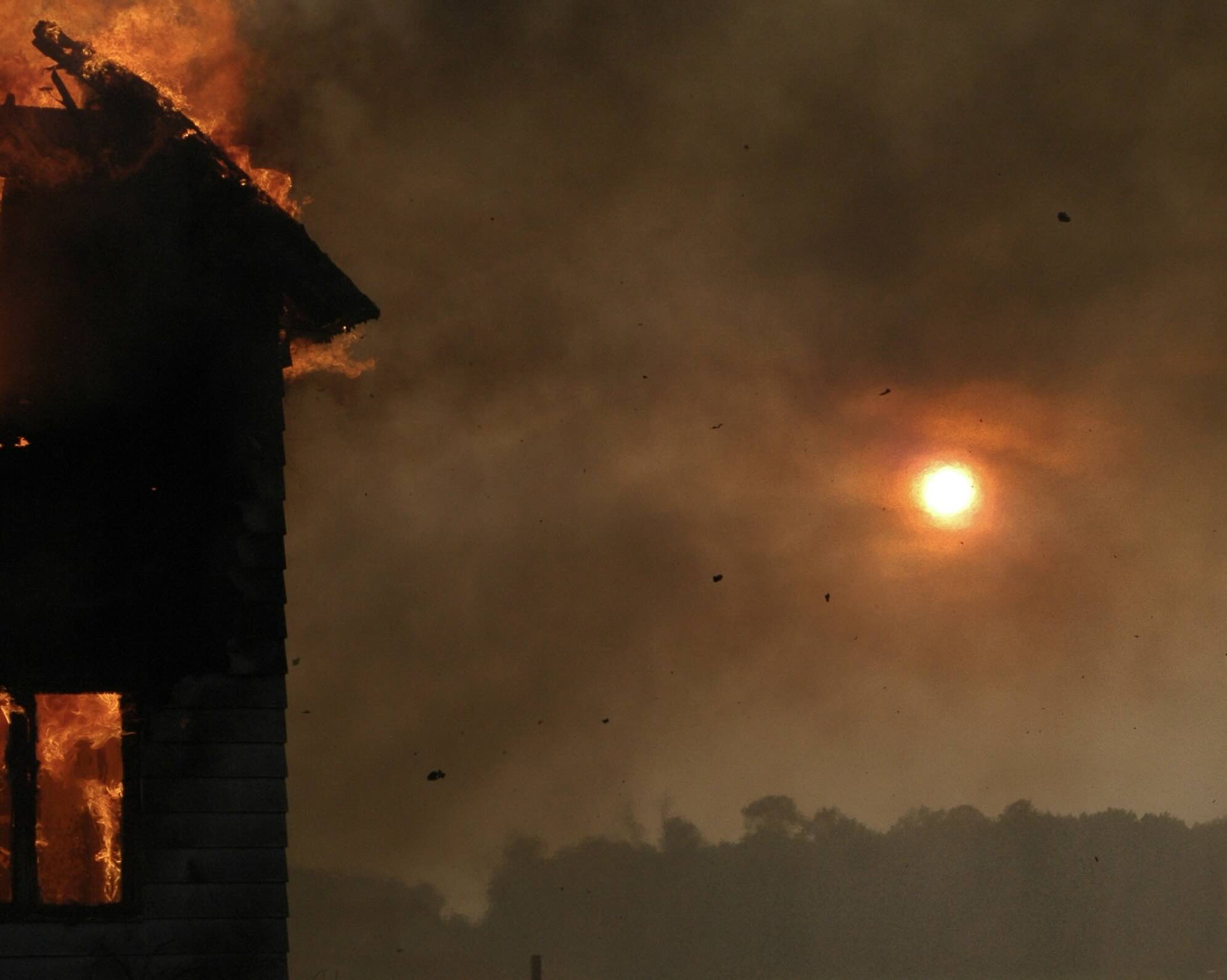
On a gloomy Sunday a week later, I gather enough courage to go back and check in on Rup and Puk. Plus, living in the woods, sleeping on mud as insects make my body home, returning to the city every other day to steal food through the window of unassuming strangers cooking dinner doesn’t quite work for me. Almost a mile before I reach the house, I smell something in the air, something smoky and wrong. Imagine my shock when I see the house going up in flames. Alarms reverberating, tanker trucks lining the streets, firefighters running around like madmen, some climbing up ladders into the house, some discharging water through fire hoses. Two bodies recovered… third-degree burns… emergency…, the paramedics announce, dragging mother and father’s charred bodies out on stretchers. Unidentifiable, lifeless, inhuman. Just like I remember them. I push through the crowd that has formed to soak in this Sunday spectacle, sticking out my neck and letting it grow and grow until it’s the size of a giraffe, giving me a bird’s eye view of the neighborhood. Another benefit of being a ghost—your body listens to you, not the other way round. Rup and Puk are nowhere to be seen. As I watch fragments of my childhood home dissolve in the air, as the grey, foggy smoke envelopes me, I can’t help but take a deep breath. And smile. Seems like a gas leak. Someone must have left it on by mistake. Traces of burnt rice on the stovetop, a fireman says. I sit on the ground, my mind traveling to Rup and Puk—their gleeful faces brimming with sweet laughter as they watched mother and father inflict violence on each other for a change. No matter where they are, I know they are smiling too. Sure, they don’t have a house anymore. But at least they don’t live in a haunted house now.

