

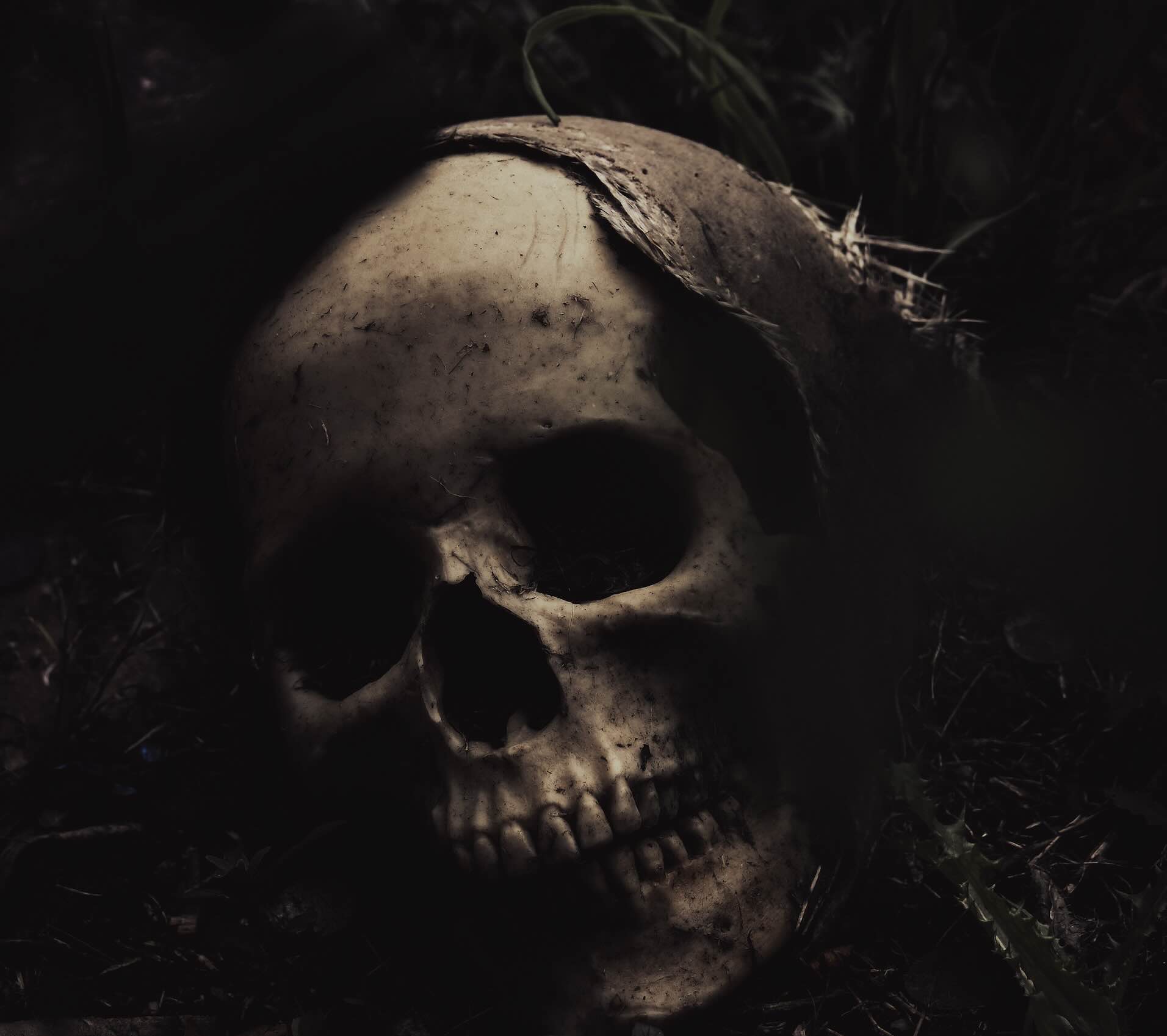
In the spring of 1995, Chuck O’Malley scoured the woods behind his house in search of his older brothers’ stash of nudie mags, fireworks, and liquor when Chuck spotted it: a human skull protruding from the earth. He knew exactly what it was right away. He’d only seen skulls in pictures, of course, and Indiana Jones movies, but the cavernous eyeholes and the bone tinted red from clay were undeniable. Someone had died here.
He found it down in a gully. A lazy hill sloped to the west, and to the east piled high was a sandstone bluff. Atop it sprouted a grove of pine trees, and snaking between them was the eroded ravine of where a river had once flowed but now ran dry. Moon, Chuck’s black-haired mutt, sat next to him with ears folded back, and whined in the direction of the skull. Less than a mile away was a cemetery. Chuck wondered if the bones of a man long dead had trekked its way to this gully. Despite how crazy it sounded, he couldn’t rule it out. His mom had always told him the dead visited her at night after everyone else had gone to bed.
The skull looked adult size. That didn’t mean much. The victim could’ve been anywhere from sixteen to sixty. A couple teeth were chipped, the left incisor and one of the molars. He found a femur not far away. More teeth that had been knocked loose. A clavicle. Two ribs snapped in half. They were lodged into the dirt and suffered post-mortem teeth marks where wild animals had gotten to the carcass. Coyotes more than likely. Maybe stray dogs. Moon didn’t mess with them, though. She whined and hid behind Chuck’s legs while he pieced the sun-bleached skeleton back together bone by bone.
His mother didn’t do much other than drink coffee and smoke cigarettes most days since Virgil, Chuck’s older brother, had gone missing. Well, Chuck and his parents called him missing. The cops called him a fugitive after he’d held up Foster’s Convenience Store on the edge of town and shot Marty Ballinger in the thigh during his getaway.
“Where you been?” she asked.
It wasn’t even real coffee. She mixed French vanilla powdered creamer, sugar, and a dash of cinnamon with heated milk. Sometimes water if Chuck’s father hadn’t made it by the grocery store after work.
“Nowhere,” Chuck said. Fridge was empty. No ham. No cheese. Didn’t even have any jelly.
“Let me look at you.” Smoke trickled from her lips as she beckoned him with spotted hands. Chuck stood before her. She did this often, appraising him. Sizing him up as if he were a rival rather than her son. “You look just like him,” she said, meaning Virgil.
They were about the same height, but Virgil’s hair was darker, greasier, and he was bulkier than Chuck. Skinny arms attached to a pudgy torso. After a few beers, you could get him to dance the truffle shuffle from The Goonies.
“He’s not coming back, you know.” She took a drag of her cigarette and exhaled the smoke in Chuck’s face. “I dreamt he floated in water.”
Her ghost sightings had grown more frequent. The night before, she claimed she’d caught the door handle to the storm door lifting on its own, a young girl whispering in the background, stealing tobacco and biscuits.
“Even the dead,” she warned, “are hungry.”
At school the next day Chuck was pulled out of second period and sent to the principal’s office. The building was old and full of water-damaged ceiling tiles and scuffed linoleum floors and chipped cinderblocks in desperate need of new paint. A sophomore, Chuck only had two years left before his sentence was up, and he’d been counting the days like a grunt awaiting leave.
The principal had a horseshoe-shaped bald head and glasses that made his eyes look too small for his head, but he wasn’t a nerd like some might imagine. He’d been a national champion wrestler back in the seventies and was built like a super diesel with cauliflower ears.
“Sit,” he said when Chuck entered.
Though intimidating, Chuck had always viewed Mr. Johnson as a fair arbiter of justice. Last year, when Chuck had broken a junior’s nose after a freshman hazing incident, he’d only given Chuck a couple days of detention rather than suspending him or, worse yet, turning him over to the cops.
“Mr. Preston tells me he’s missing some equipment from the geology lab. A spade, sifter, and some other things. You wouldn’t know anything about that. Would you?”
Chuck already knew he’d been caught. He’d stolen some archaeological tools—a brush, spade, and sifter, not much, really, if he thought about it—to help exhume the bones.
Mr. Johnson touched his fingertips together and stretched his hands and wrists. It was rumored that thirty years before, he’d strangled a man in Mexico for the crime of drinking the last drop of water they shared.
“I know you’ve had a rough few months, Chuck. But my hands are tied here. Stealing school property is a big deal. I have to suspend you.”
Chuck couldn’t picture Mr. Johnson killing anyone, though. The breach was too cavernous for him to cross. Chuck, on the other hand, he’d slip his hands over a man’s throat and press until he heard something go pop. He wouldn’t even think twice about it, as simple as crossing from one side of the river to the next.
The detectives arrived not long after Chuck returned home from school. They stank of stale coffee and cigarette smoke and scratched their goatees with jagged fingernails. Chuck had met them before: Wozniak and Stone. The same detectives assigned to investigate Virgil’s disappearance. Or, as they put it, to bring a fugitive to justice. They reminded Chuck of the detectives in old procedural shows his grandfather had watched while nursing his nightly bourbon.
“We have evidence Virgil is back in town,” Wozniak said. Remnants of his lunch were still stuck in his mustache.
“That’s impossible,” Chuck’s mom said.
“Why do you say that?”
Chuck’s mom pulled a cigarette from her leather case and lit it without breaking eye contact with Wozniak.
“What’s this evidence you have?” she asked.
Wozniak cleared his throat, glanced at his partner, Stone, who sat with upturned hands limp in his lap.
“Has he contacted you, Mrs. O’Malley?”
She took a drag from her cigarette, squinting her eyes from the smoke. “Sure,” she said, voice raspy. “All the time.”
“What’s that supposed to mean?”
She shrugged. “Make of it what you will.”
“He’s called you? Stopped by? Do you know where we can find him?”
“He visits me in my dreams.”
“In your dreams?”
She smiled and blew smoke in their direction.
“There’s been purchases, Mrs. O’Malley,” Stone said, finally speaking for the first time. “Virgil used his credit card at the mall, Blockbuster, Sonic, Randy’s M&M’s.” He lay photographs of receipts on the coffee table. Receipts Chuck had different copies of stuffed away in his dirty jeans pocket, alongside Virgil’s credit card. “He’s here somewhere.”
“Of course he is, detective.” Chuck’s mom patted him on his knee. “You’d know that, too, if you only had the eyes to see.”
The earth was cracked and difficult to dig. For years the landscape had suffered from drought. Storms were rare, the ones that did hit, typically in the spring, were severe but fleeting. For half an hour, rainwater soaked the plains in torrents, but by midday the following afternoon, the harsh sun would’ve desiccated the dirt back into dust. He had no clue how long the bones had been there, but by how deep he found some of them, he guessed at least a few months. He ruled out a shallow grave for they were scattered about the gully and the dried-up riverbank, but he supposed a coyote could have dug them up and strewn them across the ravine.
Growing up, Virgil had spent countless hours in these woods, hiding from homework, from Mom, from the cops, but deep-down Chuck didn’t believe it could be him. Virgil had always told Chuck when they were little that he would live forever. They’d been hanging out not far from where Chuck now exhumed bones, burrowing a maze out of the underbrush and laying booby traps for the neighborhood kids when he explained Francisco Vasquez de Coronado had discovered a river in central Oklahoma in the year 1541, right in these very woods. He’d shown Virgil how to follow the wind down to the riverbank to drink waters of eternal life. Virgil even claimed Coronado still lived out here as a hermit, stealing copper wire to survive. At the time, Chuck figured it was a tall tale, things older brothers liked to convince their younger siblings of, but no matter how much he told himself it was impossible, Chuck wanted to believe it. For years, long into his adulthood, he drank water from every river he encountered.
He found his mother naked in the garden aiming a shotgun toward the sky. His father wasn’t home from work yet and the neighbors didn’t do anything to stop her, too afraid, it seemed, she’d train the barrel on them and blast a slug through their torso. Chuck didn’t blame them for this. When it came right down to it, everyone was afraid to die.
“Mom?”
She looked wild. Hair unkempt and tangled. Eyes bugged and red-streaked.
“Do you see him?” she asked.
“Who?”
Her head jerked to the right like she heard footsteps in the distance. “Your brother.”
She stalked around the corner of the house and stopped in the garden before wobbling in a circle. A woodpecker chipped away at a tree trunk to their right, and she swung the barrel in its direction, finger trembling near the trigger guard.
“Mom? What happened? Tell me what you saw.”
“He was here,” she said. “Covered in blood.”
She stumbled through the garden bed and tripped over a stone when Chuck first heard the sirens a few streets over. Someone had called the cops.
“Shit.” Chuck spat. “Let’s get you inside.”
She turned to the back of the house. They didn’t have a fence; the backyard opened to acres of woods and a small stream. Kids would slip beyond the tree line to smoke weed and drink their father’s beer back there. Virgil had. Chuck had. They all had, and now, two miles back, lay the pile of bones Chuck pieced back together.
“There,” she said, raising the shotgun to a firing position. “Do you see him?”
“There’s no one there, Mom.”
The shotgun shook in her hands. “Don’t come any closer,” she yelled at the dark tree line where the wind whipped fallen leaves. “Stop. Virgil, I’m begging you.”
The sirens wailed louder and louder as the cops pulled onto Chuck’s street. He watched them speed closer with lights flashing. Two cruisers pulled into their driveway, both filled with a couple uniformed officers: three men, two with mustaches and one baby-faced, and a woman with legs like Greek columns. They didn’t see Chuck’s mom at first. They approached him with hands near their weapons lest he made any rash movements.
“Please don’t hurt her,” he said. “She’s not right in the head.”
It didn’t take them long to find her; she still screamed at a Virgil only she could see, waving the shotgun barrel in the air, stark naked and raving mad. The cops ordered her to drop her weapon, to get down on the ground, but she didn’t have any idea what was going on. She turned toward the police, aimed, and fired. She hit the baby-faced kid. Shot blasted his right side, puncturing holes in his cheeks and eyeball. He raised his hand instinctually to the wound and fell to the ground screaming he’d been hit, he’d been hit, officer down. The other three didn’t hesitate; they unloaded their clips into Chuck’s mom, firing until he feared his ear drums might burst.
He found the last bone on a Tuesday evening, a vertebra embedded in eroded limestone. The dogwood had bloomed, and sweltering heat cast mirages on the horizon. He tied the bones together with fishing line and secured them with glue, careful to brush the dirt from the tiny, curved crevices. The dust caked his palms like powder, and as he fastened the last bone to the base of the skull, completing the full skeleton, he, for once, could tell which way the wind blew.

