

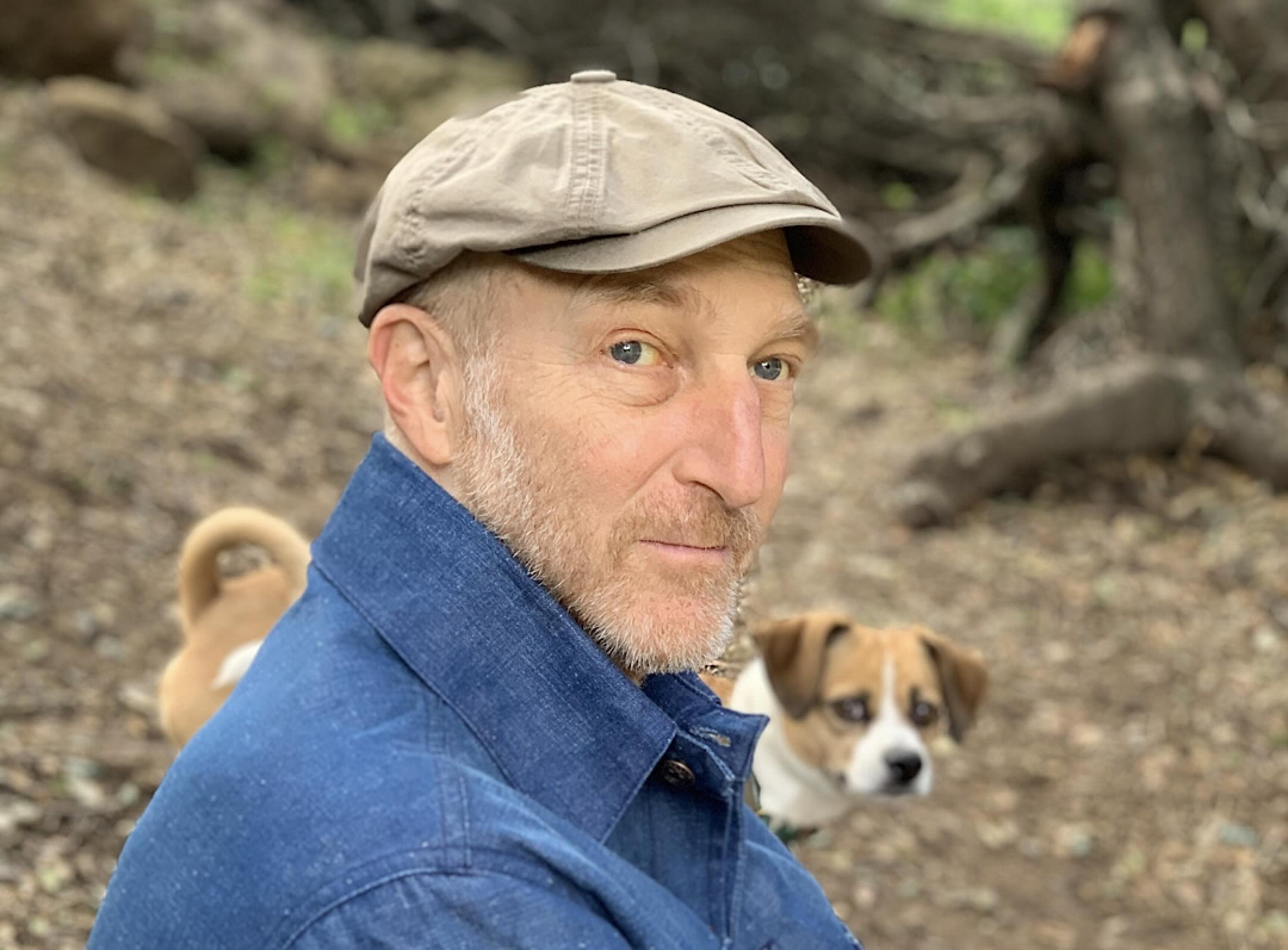
Jonathan Ames is the author of eleven books including WAKE UP, SIR!, THE EXTRA MAN, and YOU WERE NEVER REALLY HERE, all published by Pushkin Press. He also created the hit HBO comedy BORED TO DEATH, starring Ted Danson, Zach Galifianakis and Jason Schwartzman, as well as Blunt Talk, starring Patrick Stewart. His thriller YOU WERE NEVER REALLY HERE was adapted for a major Hollywood film by Lynne Ramsay, starring Joaquin Phoenix. KARMA DOLL is the second book in the series of Happy Doll thrillers that began with A MAN NAMED DOLL. Jonathan lives in Los Angeles with his dog Fezzik.
FR: I’m going to start with YOU WERE NEVER REALLY HERE. It’s the first book of yours I read. I love it! At the time I picked it up, I hadn’t seen many novellas out there, not like that one. It’s dark, brutal, gory, yet it’s human, too, Did the story require such a short take, rather than a bigger canvas due to what;s going on in the book?
JA: This is a case—as it were—where I wrote a story to fill a canvas of a specific size… When I first wrote the book in 2012, it was for an internet concern called Byliner. They were offering half-decent money for long-form fiction or non-fiction. I think the word count could be between ten and twenty thousand words, and so I set out to write something of that general length. Later, when the movie was coming out in 2018, an American paperback was going to be published, and I expanded the final section of the book by several thousand words, putting into action what had been told in an overview sort of way, which I had done because of the original word-count constraint. So there are two versions of the book floating about: the version that came out in 2018 and the version that appeared on the internet in 2012, which was also published in paperback in England, France, Italy and Spain… though the English publisher later put out the longer version… . So all this to say: it wasn’t the story that dictated the size, per se… but the original canvas I was given to paint on dictated the length…
FR: I’d like to talk about Joe. Where did he come from? Did you know a person or research a person that brought you to him? Maybe Joe is the closest thing to a “good guy” one can find in the grotesque world he inhabits. Although, saving children from sex trafficking is obviously admirable, he’s brutal, makes a point by having a hammer as his weapon of choice. He’s been doing it so long he’s mentally ill or perhaps dead inside. He operates like a machine at times. Tell us about Joe?
JA: Joe was born out of an apology I wanted to make to someone I loved, who most likely would never see that apology… I wanted to create a character—albeit quite different from me—who was broken… deeply broken… a character who wanted to disappear from the world and be very quiet so as not to hurt others… but who nevertheless brought pain where ever he went… so he was birthed out of my own inner melodrama… I also wanted to create a hero, my Jack Reacher, but someone more complex… And I wanted to write something that wasn’t funny. My tv show, BORED TO DEATH, had recently been canceled and for three years, I was told: “Make it funnier. Make it funnier. Make it funnier.” So this novella, YOU WERE NEVER REALLY HERE, was a chance not to have to be funny at all… Also, I was deeply inspired by the whole Parker series by Richard Stark (one of Donald Westlake’s pseudonymns) and wanted to write a page-turner like the Parker books… I was also inspired by some of the short, propulsive stories of David Goodis in a collection of his called Black Friday.
FR: I really enjoyed the show you created, BORED TO DEATH. For people who don’t know, what’s the difference between bringing a story to the screen Vs bringing a story to life on a keyboard for a novel? What do you prefer and why?
JA: Ultimately, I prefer prose-writing to screenplay-writing, mostly, I guess, because I began my writing career as a novelist and my great love is books. I love film and tv, also, but books are my lifeline and have been since I was a kid. That said, writing for television and film is a hell of lot of fun but also very stressful. You have constant deadlines, need to please tons of people, and you get a million notes… And with screenwriting, you have to be so quick and precise… each page equals a minute of screen time. Somehow it works that way. And each page costs a lot of money to film. So you have to be smart with it all and entertaining… it’s very gestural… in a very brief scene, you need to convey so much… with prose, you create the whole dream for the reader… with screenplays, you’re putting down enough details for a crew to assemble the dream, from the wardrobe to the location to the casting and so on… And you can’t—unless you use voice-over, which can be clunky—express what a character is privately thinking… you have to show everything—as in show rather than tell—which is fine, but books give you greater freedom… and it’s why so much great film and tv comes from books… it lays the groundwork and then the film-makers and showrunners can visually tell the story, usually by distilling it… just showing the action and the consequences of action…
I’ve been very fortunate to get to do both, prose-writing and screenwriting… being on set and witnessing what you wrote come to life three-dimensionally can be very gratifying… just as holding one’s finished book is also gratifying… something has been made… .we humans like to make things… we like to share our curiosity, our fears, our hopes… It’s like graffiti or carving one’s initials into a tree: a way to say, “I was here… ” But then we have to let it all go… We are here and then we’re not… It all rushes by so fast… Emily’s speech in “Our Town” sums it all up… to paraphrase, she asks: “Do humans ever realize how beautiful life is every single moment?”
And the ‘stage manager’ in the play says, “No. Well, a few saints and poets maybe.”
Well, that was a tangent.
But one thing about books vs filmed stories: each reader creates their own movie, their own version of the dream, whereas with the filmed story, everyone sees the same presentation of the story… for example, everyone who read the book YOU WERE NEVER REALLY HERE cast their own Joe, as it were, visualized their own Joe… but for the people who see the film, there’s only one Joe, which was a great Joe, by the way… but it’s kind of cool with books to collaborate with the reader, to give them enough details so that they can generate a dream in their mind as they read… that the reader is the film-crew and collaborator… as well as audience.
FR: The question I ask everyone. Obviously being an author, you grew up with a love of reading and I bet you still love to read now. I’m always fascinated by what authors people like reading, which is often different from the genres they write in. You write crime, memoir, comedy, etc. Who are three to five authors you loved to read growing up, and maybe three or four authors out there towing the line that you enjoy reading.
JA: In the seventh grade, my English teacher, Mr. Petersen, sensed that I loved to read, and he gave me two books to read on my own, separate from the class: Tarzan, by Edgar Rice Burroughs, and The Hobbit by Tolkien. Those two authors became my favorites in the middle school years, along with Isaac Asimov. I read like eighteen Tarzan books—I still have them—and I read everything by Tolkien, except for The Silmarillion, and I still have the editions of those Tolkien books, as well… I also read all of Asimov’s Foundation books, which I’m currently rereading and which hold up quite well, and I love the current television series… In high school, I discovered Kurt Vonnegut, Hunter Thompson (I was the editor of the school paper and modeled my reporting after him), and Jack Kerouac.
Current favorites of the last few years, who are still alive: Bernard Cornwell (his Arthur series and his Last Kingdom series) and Michael Connelly (Bosch, Ballard, Lincoln Lawyer).
When I was more of a ‘comedic’ novelist, my big role model was P.G. Wodehouse. My third novel, WAKE UP, SIR!, was an utter and complete homage to Wodehouse. My second novel, THE EXTRA MAN, was also comedic and its inspirations were wide-ranging: The Magic Mountain, A Confederacy of Dunces, Don Quixote….
When I was writing comedic essays in the late 90’s for a throw-away newspaper, which I collected into four books, my main inspiration was Bukowski’s non-fiction work.
FR: I loved your novel A MAN NAMED DOLL. Happy is a loner, outside his dog. He smokes dope, (which you know isn’t a big deal and never was to me but I still remember a time when it was considered a gateway into everything evil, which makes me laugh.) Happy is moody and dry, he doesn’t like being around other people so much, at least that’s how he made me feel. He’s in Los Angeles but I feel a lot of north east coast humor in the character. Tell the readers about Happy, what’s he like? Where is he going? What makes him work?
JA: DOLL, in many ways, is a synthesis between my two strains: the utter hardboiled approach of YOU WERE NEVER REALLY HERE and my earlier comedic, first-person fiction work. The Doll books are meant to be gripping page-turners, but there’s also humor. Unlike YOU WERE NEVER REALLY HERE, the Doll books are written in the first-person, and you really get to hear what Doll is thinking, which is often, I guess, somewhat amusing. He’s a flawed nut with a good heart, and he’s not bad in a fight. As he says, he’s easy to hit but hard to put down. He’s become my Reacher, rather than Joe from YWNRH… How he came about is sort of interesting. I was asked to write a short story for a Lee Child-edited anthology (speaking of Reacher!), The Nicotine Chronicles, where one was to write a crime story that involved, in some way, cigarettes. So I wrote ten pages about this guy Doll, a detective, and a friend of his asking for a kidney, because he’s smoked himself out of both kidneys and needs a transplant… And about ten, twelve pages in, the length of the assignment, I realized, I had something that could go longer than a short story, and so I put it aside and wrote a story called “Deathbed Vigil,” which a wonderful artist, Karl Stevens, is hoping to turn into a graphic novel….
After I finished “Vigil,” I picked Doll back up and wrote the first book in about five months, that was the summer of 2019 into the fall. Since then I’ve written two more, THE WHEEL OF DOLL and KARMA DOLL. I started a fourth one but put it aside for a number of reasons but want to continue the series soon. In the meantime, I have a new third-person, hardboiled novella coming out next year, A PAST WITHOUT PICTURES. It will be published by Mysterious Press, and I see it as a companion piece to YOU WERE NEVER REALLY HERE. It features a female protagonist, a LAPD homicide detective…
FR: The books of yours that I have read fall into the hardboiled, noir. Are you a fan of noir? Books and films? I think you use noir, hard boiled (whatever label the kids wanna use) as a vehicle to tell a bigger story. Sure, your books are page turners, fast paced, but they also say something underneath about society, which for me, sucks me into the stories. There’s both entertainment, but there’s also something larger going on in there. Elaborate?
JA: I’m a big fan of noir. Noir fiction, anyway. I’m not an aficionado of the films, but I have enjoyed many of them. My crime inspirations are (the usual suspects as it were): Hammett, Chandler, MacDonald, Thompson, Stark and Goodis. I’ve read others, of course, but those are the ones whose prose and stories, I am most inspired by. I like the shape that detective novels provide me, like the shape of a certain kind of vase or a poet writing a specific kind of poem, like a sestina or a villanelle or a sonnet or what-have-you… The detective vase is in the shape of the protagonist searching for a definitive answer to a mystery, if it was a poem you could call it a who-dun-it… like a haiku… But while working within that detective form, playing with the convention of the detective on a case (like Oedipus, one of the very first detectives in literature), I end up, like all authors, writing about life and the difficulties of the human condition, how confusing it all is… and those difficulties arise from internal conflicts as well as societal ills and structures… something like that…
FR: Short story writer and poet, Raymond Carver, talked about how after he finished a collection he’d stop writing for six months. He said that “it was as if he’d never been a writer at all.” How do you approach this? Are you like Carver in a sense? Or are there always stories in your head moving around? I often ignore plots when I’m reading a story even if I know they are there floating around in the novel. I’m far more invested in characters and what they bring to the page. Are your characters always in your head chatting up the night? Or do you get to the place where it shuts off?
JA: At the start of my writing life, there were long gaps between books, between novels… My first book, I PASS LIKE NIGHT, came out in 1989, but then I had a bad case of second novelitis and didn’t publish my second book, THE EXTRA MAN, until 1998, nine years later… I do remember when I finished I PASS LIKE NIGHT that there was a relief to no longer have to be with that narrator, but that also I would miss him… this other voice in my head…
And I think there was a similar experience after finishing, THE EXTRA MAN… that I would be saying good bye to this person who had been in my mind for years… This isn’t directly answering your question… but sort of… Also, after the first book, there was a total sense for years of not knowing how to write… I had produced that first book out of some feral instinct of what a novel could be but then had a total crisis of confidence, which lasted years and had to learn anew what it meant to write a book… and that happened after the second novel, as well, but to a slightly lesser degree, and after the third as well… In fact, after the third novel, I gave up writing novels for years… Now with the Doll books, writing a series, there’s less a feeling of starting from scratch… which is perhaps the benefit of the convention of the detective novel… I don’t have to reinvent the shape of the wheel each time… with my early works of fiction, each book had a completely novel shape, as it were, even though I was mimicking Wodehouse and others….
There was also a long phase in my writing life, between my second and third novels, where I was writing a lot of essays for the NY Press, a throw-away newspaper… And that form was so much easier than a novel: my word count for the essays was 1,200 words… that I could sustain…
So for many years, I wasn’t writing prolonged works of fiction and managed to put all those essays into four collections, which came out every two years or so, starting in 2000… but I stopped that sort of autobiographical writing in the early 2000’s… I began to repeat myself and the work grew shticky… .oh, well… on we go… then my third novel, WAKE UP, SIR!, came out in 2004 and after that I didn’t write another novel until YOU WERE NEVER REALLY HERE in 2012, but I filled those years writing a ton of television scripts, which were sort of like essays, in that they were short forms… bursts of amusement… not the long opera of a novel that has to be sustained…
Anyway, I’m all over the place with this answer, but what the hell… The Doll books, the first three, all flowed, one after the other… KARMA DOLL picks up twelve hours after the end of The WHEEL OF DOLL… but now I’m in a new cycle with Doll and need to find a new story for him… anyway… part of the writing process is never being quite sure if you are doing it ‘right’… but you have to manage that anxiety and soldier forward… and as I’ve gotten older, I do love to sit at my desk and play with sentences. When I was younger, I was more interested in life than writing and sitting down was harder… now I prefer to be alone at my desk, playing with my Doll, as it were….
FR: You’ve written comic memoirs. And although I see dry humor in HAPPY DOLL in abundance, that’s fiction. How does it differ from writing comedy from your own personal life? Personally, I find comedy the hardest thing to write. It’ll pop up on its own when I’m not thinking about it. Like if I’m using dialogue from Boston where I am originally from, it comes out funny, but to sit and try to write comedy to make others laugh is a whole different ball game. Tell the readers about your approach to writing comedy?
JA: I sort of answered this a little above… Oddly, I’ve never “intended” to be funny but when I’m “honest” it makes people laugh… the way we make each other laugh when we tell our friends are embarrassing stories… and I guess maybe that’s the key: back then I was sharing my embarrassing stories, my embarrassing takes on things… And I was the object of the humor, not others… but also a lot of it was what you would now call TMI… but that was what Bukowski was doing in the 60’s and 70’s, and in the 80’s and 90’s, when I was reading him, I loved his stuff…. He also had a column in a throw-way paper back in the late 60’s and early 70’s, like I did in the 90’s, and he created this fictional persona of Hank Chinaski, but sometimes it was just him, not Chinaski, and the two were so closely linked… and so I was telling my stories in a kind of brutally honest Chinaski/Bukowski style… also, in my comedic novels, I was very influenced by the comedic rhythms of Wodehouse’s dialogue and also the silliness of his stories and so that was a big influence as well, comedically… and A Confederacy of Dunces was very much about a larger than life character and I wanted to achieve that, somewhat, in my novel, THE EXTRA MAN… eccentrics make one laugh…
BONUS QUESTION:
FR: I read online you are a boxing fan. I, too, am a big fan of boxing. You go to a match, Hagler Vs Sugar Ray (Hagler won, ha!) and you bring along Happy Doll and Joe to the match. Drinks and treats are on you. What do you get for yourself, and what do you buy Happy and Joe?
JA: Since we’re all at a boxing match, I think we’d have some nice, cool beers, hopefully good-tasting ones, not thin-tasting-watery ballpark beers. Maybe afterwards, we’d get a decadent steak dinner, my treat, though I always feel a little guilty eating meat, but I do try to thank the cow who gave its life for sustaining me, helping me, and before we started the meal, as a kind of grace, I’d thank Joe and Doll for being good friends to me.
And before the meal, we’d enjoy the fight like crazy. Two of the greatest of all time and perfect foils for each other… .though, as I’ve gotten older, it’s harder to watch boxing matches knowing what we know now about brain injuries, which, actually, we knew back then… all those old boxers punch-drunk and slurring and dying early deaths… But Marvelous and Sugar Ray, I remember watching them on television… they were both so formidable… Sugar Ray with his speed and sneaky power, like chop, chop, chop, and then boom, and Hagler, with his ferocity and lefty stance… a juggernaut, like a smaller Tyson (young Tyson)…
I used to go to professional fights but haven’t for a long time now… I went to Memphis to see Tyson and Lewis and wrote about it for the NY Press, in an essay titled: “Everybody Dies in Memphis,” alluding to MLK and Elvis and, in a way, Tyson… that was his last big shot… I saw Joe Calzaghe in the Garden when he was at his peak… I saw Sergio Martinez knock out Paul Williams in Atlantic City with such a devastating blow; it was pretty scary to witness… it looked like Williams was dead… and later he got paralyzed in a motorcycle accident… I saw Pacquiao fight Timothy Bradley in Vegas and it was pretty disappointing fight… mediocre action and Pacquiao got ripped off… too many fights end in rip-offs… makes it hard on the fan…
I had two boxing matches, myself, stunt fights, fighting as “The Herring Wonder.” The first fight, I got my ass kicked in a four-round fight, three-minutes per round, against a guy, “The Impact Addict,” who was twenty-five pounds heavier than me. It was wild night, in 1999. There was a bunch of loony undercards—too much to go into—and the whole thing was called “Box Opera.” We fought in front of six-hundred people… I trained for three months at Gleasons to get ready… only to get the shit kicked out of me… I broke my nose training and then got it rebroken in the second round of the fight… In fact, I was fighting with a broken nose, but we couldn’t postpone the fight, we had sold tickets and only had the venue for that one night… My paper, NY Press, ran full-page ads for the fight and helped sponsor the evening, along with Pseudo.com, which was an early web company and it actually broadcast the fight on the internet—over telephone lines—and what you could see was a little bit larger than a postage stamp. The guy who started Pseudo, Josh Harris, a real eccentric, was the subject of the documentary, We Live in Public. The NY Times actually ran a picture of the fight the day after… it was quite the spectacle… I wrote about it in my column—actually several columns—and later collected the columns in my essay books…
My second fight was in 2007… and I “won” that one…. It was against a gentlemanly Canadian writer, Craig Davidson, who was looking to promote his novel, The Fighter. He also outweighed me by a good twenty pounds, but I had improved since my first fight, my defense was much better, and I was able to land more blows… though I didn’t enjoy hurting him… I saw him wince with pain when I jabbed him good and I felt bad… He was a gentleman, it wasn’t a vicious fight like the first one, though he, nevertheless, tried to get me good and at one point, he had my arms pinned and could have hit me with an illegal blow, but I saw him choose not to… My other opponent, in 1999, was looking to crush me the whole time; he pinned my arm and smacked my head like seven times in a row… my facial memory has never been the same, can’t retain people’s faces… To my opponent’s credit, in that first fight, he let me ride the last round, knowing that I was concussed and fucked up and we just sort of danced… I did get him good in the second round and this sheet of blood shot out of his nose… which was sort of wild to see…
Anyway, the second fight was a proper amateur fight: three two-minute rounds, and I didn’t get my nose broken… Well, I went on a ramble there… sorry!

