

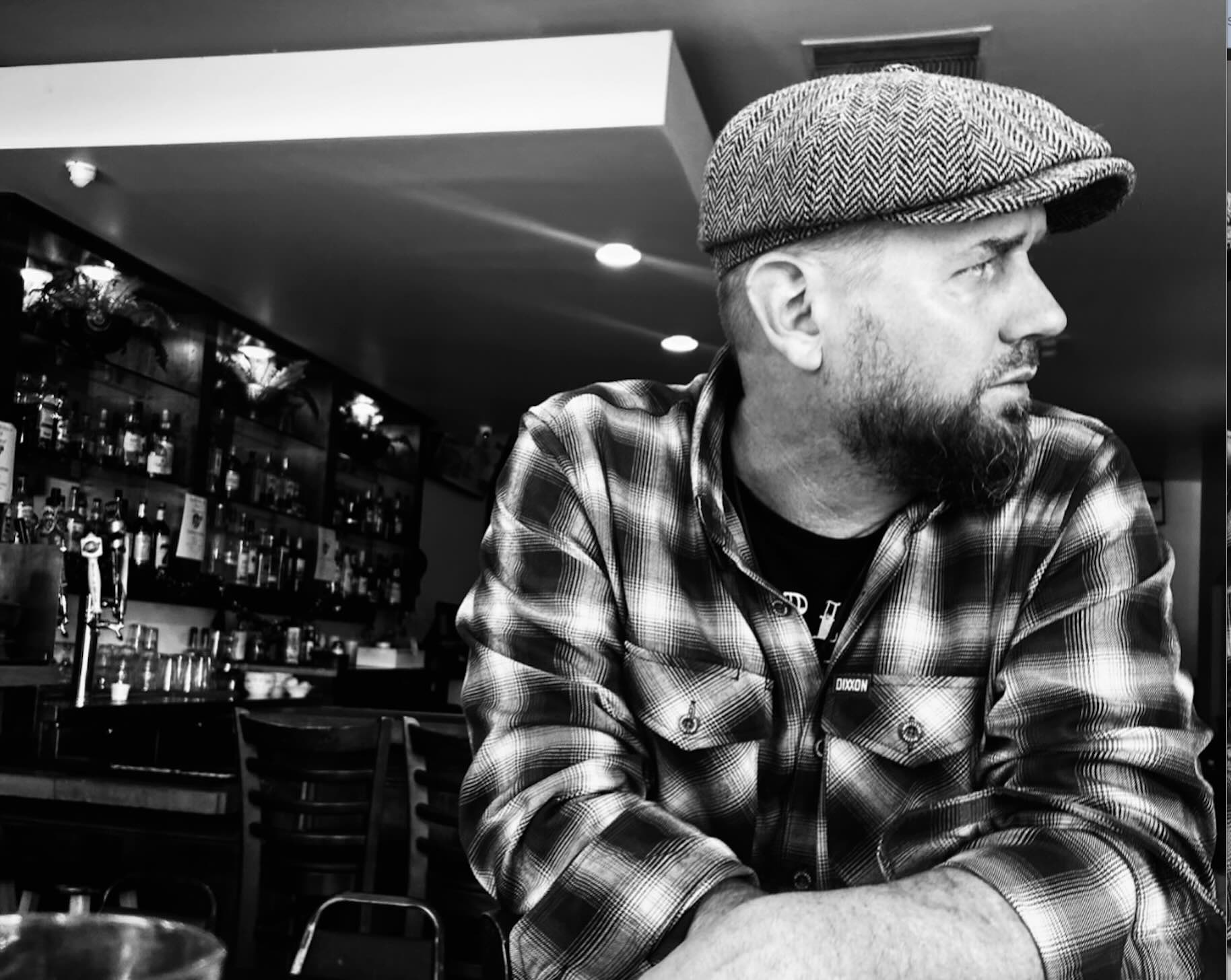
Brian Townsley is the author of three books of poetry, as well as the Sonny Haynes books A Trunk Full of Zeroes and Outlaw Ballads. He has won national awards for his writing, as well as had short stories and poems published in everything from Berkeley Poetry Review to Frontier Tales, from Black Mask and Mystery Tribune to Killpoet and Quarterly West, among many others. He also had a Sonny Haynes story make the Distinguished List in Best American Mystery Stories. He is a podcaster and executive editor for Starlite Pulp, as well as an alum of the mighty California Golden Bears and USC Trojans, and lives in Southern California. The next Sonny Haynes novel, UNDER A BLACK FLAG, will be released April 1 through Starlite Pulp.
FR: I’m going to get right into it. The character of Sonny Haynes, the guy jumps off the page. He has a checkered past, a rough and tumble life. He seeks revenge, but the way I read it is that Sonny has a code he lives by. Tell us Sonny’s backstory. How do you imagine it? A past that isn’t available to the reader.
BT: Sonny is a flawed dude, trying his damnedest to do something right, at the same time as being involved in an underworld that makes that difficult to do. But that’s the thing that I think we miss sometimes—people are complex. They do one thing that is spot on, get you into heaven kind of a deed, then turn around and get into a fight over a parking spot. Life is messy. And, to me at least, Sonny represents that. He is an absolute force when he needs to be, but sometimes he’ll fuck it up. He was a homicide detective in LA and was known for breaking bones before bothering to ask if it was the right guy. But then he goes home and he’s madly in love with his wife, Betty, and they take care of Katie, who is the daughter of an escort he has run in before. So, there are levels that aren’t always explained in the prose, but the backstory is always there. He’s no angel, make no mistake, but he certainly isn’t one to be on the wrong side of history, either.
FR: You bring Sonny to life both through a novel TRUNK FULL OF ZEROES and OUTLAW BALLADS, a short story collection, tell us why you decided to use both to bring this fantastic character to life? Did you think of smaller situations to put Sonny in?
BT: You know, Sonny is a combination of things. I grew up as a YA reading ENCYCLOPEDIA BROWN and then graduating into Chandler as a teen, and it changed my life. Straight up. All of it. The hats, the persona, the one-liners, the depth of knowledge of LA (I’m a native Angeleno), and I also read a ridiculous amount of Stephen King (still do), Dan Simmons, and Peter Straub at that age. But of all of the stuff that I was engaged in, it was always the Chandler work that made me go, “I can do that, maybe not yet, but I understand it.” So as much as I loved THE LONG WALK, or NIGHTMARES & DREAMSCAPES, or SONG OF KALI, there was such a resonance with a novel like THE LITTLE SISTER or THE LADY IN THE LAKE, that even when I started writing seriously, there was always a noir element to it. I’ve written, and published, a ton of poems, as have you. A LOT of them are noir/detective/blues/jazz related. It’s just what I grew up with, and, funny enough, it lends itself quite nicely to poetry.
Having said that, making a long story long, Sonny was originally created in a poem. It was simply my take on an Americana detective, but through the lens of my own influences. One of the first versions of him appear in a poem, “Notes on Still Frames from a Silent Noir Film” (published in Eclipse, at the time) in which these lines appear:
A trenchcoat, a black fedora removed
So often he wonders why he leaves
The house with them.
And
This man in our frame, the first
Existentialist perhaps,
Knew simplicity:
To watch the night burn
And offer witty commentary.
That was written sometime around 2000-2003, and even then, I knew I needed to expand the character, and that became A TRUNK FULL OF ZEROES. Sonny’s been there for a long time. He lives rent-free in my head, and there is so much more to say with him.
FR: Like myself you are a big fan of not only noir, but the western. There’s been a bit of a comeback for Westerns on the written page. Westerns with teeth. Long gone are the westerns of H.A. DeRosso, and Elmore Leonard. I first noticed their comeback more recently, with books such as WRAITHS OF THE BROKEN LAND by S. Craig Zahler, even a revival in movies and television shows, what intrigues you about them? I think a ton can be done with them, not only in the sense of an outlaw, but stories about people. How much research goes into your westerns? Do you see yourself writing more?
BT: So, yeah, I LOVE westerns. Grew up with them. My grandpa was a special effects guy, and was frequently on location with guys like John Wayne, Robert Mitchum, Kirk Douglas, and so many others. I’d hear little snippets when I was young about ‘this bar in Mexico…’ or what have you. MAN, let me tell you, I’d love to have access to those stories now. And my uncle also acted in westerns (my first pair of cowboy boots were a gift from him after a shoot), so it’s just kind of in the blood. Did I grow up around horses, or on a ranch? Nope, and nope. But trust me, it’s right there, all the time. And so YES, I will be writing more of them. To date, I’ve written the novella, DAYS OF BONE, NIGHTS OF ASH (pt. 1) in American Muse, that we put out in 2024. I’ve also published a handful of western shorts in various places, featuring a half-Pawnee/half-Irish tracker named Rye Lonehand, and the feedback on those has been pretty great. But next up will be writing part II of DAYS OF BONE…, as we’ve got another group of novellas slated for American Muse, part II either later this year or in ’27. We’ve got some stellar authors in that one—can’t divulge anything yet, but man. Anyways, westerns are, in many ways, a place of peace for me (regardless of what’s happening on the page). I let the language eat a little bit. Thing is, the West at that time was so open. You could leave a town and its customs and its mud and crowded environs and then not see a single soul for days, weeks, if the circumstances were right. So, I look at the language the same way: for as compact and claustrophobic as crime or noir can be at times, westerns provide something completely opposite. I love that.
FR: A question I ask everyone: Give me four dead authors you love. Four living authors you love to read, and one writer people wouldn’t think you read.
BT: a. Raymond Chandler; Jim Thompson; Cormac McCarthy; Jim Harrison
- Walter Mosley; Stephen King; Stephen Graham Jones; Larry McMurtry
- Phillip Levine—a poet who has perhaps 3-5 of the most amazing works I’ve ever read: “What Work Is, Soloing,” “The Simple Truth,” “My Father with Cigarette Twelve Years before the Nazi’s could Break his Heart,” and a few others, are just emotionally devastating. They were, and still are, something to aim for, in any kind of writing.
FR: You are the ringleader over there at Starlite Pulp. A magazine I adore. There are not many people doing what you are doing, which most importantly is giving voice to a ton of solid writers who don’t have many places to go with their stories. For me it feels like you guys will be the next Hardcase Crime, but you also cater to not only crime and noir, but western, horror, sci-fi, action, crossovers, etc. Tell the readers a bit about the history of Starlite, where it is now, and how do you imagine it in the future?
BT: We started Starlite in late 2022 with an idea, a website, and a logo. That was it. I was at a bit of a crossroads. Traditional publishing is very difficult, in any number of ways. At that point I had had three books of poems published, as well as the novel A Trunk Full of Zeroes, and had a full second book of short stories (featuring Sonny Haynes) ready to go. From publishers? Crickets. Talked to some agents, but at the end of the day, a short story collection just doesn’t pay the bills–for anyone (agents most importantly, as they are the one feeding off the advance). So, I knew these were good stories, regardless of the lack of interest. They had been published in BLACK MASK, MYSTERY TRIBUNE, DANSE MACABRE, etc., with one of them making the “distinguished list” in BEST AMERICAN MYSTERY & SUSPENSE. So, I started to take stock—I knew how to put together a literary magazine (3 years at Southern California Anthology), I knew how to publish books, I had an aesthetic I liked, but I had no idea if anybody else would. I’ve got two fantastic artists here (Ryan and Jesse), as well as an editor (Jake), so…how do I start my own label? It was literally that simple. Look, create what you want to see, right? Just do it. Build it and they will come. Blah blah. And you can laugh at the corniness of all that—I get that 100%–but the fact of the matter is, if you want to make something happen, make it happen. No bullshit. So, we started this tiny thing. We had a logo. We had a tee shirt. We started submissions—and in the first issue, Michael Bracken had a story make the ‘distinguished list’ in a Best American. Then we opened up submissions for the 2nd Review and more than doubled the amount of the first. Crazy. So, hey man. We’re just rolling with it right now.
With regards to the “giving voice to solid writers” you are sooooo correct. Literary magazines are everywhere, all trying to feed some literary fiction algorithm we don’t even see. I’ve never gotten it. Ever. You know what I like? Twilight Zone, Tales from the Crypt, Black Mirror, bad B movies, good B movies, Tarantino, PTA, John Carpenter, film noir, awesome terrible Sci Fi tales, and all kinds of Westerns. And you know what is gonna dominate your Prime or Netflix feed tonight, if it’s fiction? THOSE things. And yet, weirdly, when it comes to writers, we are all supposed to want to be Jonathan Frantzen or Hemingway or Richard Ford or whatever. It’s stupid. So, we said, let’s throw our own tiny hat into the ring.
As for us now, well, there are 5 of us. We all have our own little specialties, and are dedicated to moving this thing forward. It’s crazy, man. If you had told us we’d put out 11 books in 3 years, I’d have looked at you like you were smoking something. Or these amazing posters Ryan is putting out? And now in the coming months, we’ve got the Review we just dropped, MY CONFESSION: RECOLLECTIONS OF A ROGUE (the memoir that inspired BLOOD MERIDIAN) coming out in the next couple months, featuring essays by Stephanie Reents, Daniel Pyne, and Manny Torres, and then the new Sonny novel, UNDER A BLACK FLAG, which will be out in the spring. Then the next Review in the summer, possibly the next American Muse. Nuts. We’ll be at least 15 books in by the end of the year. I don’t know how my wife puts up with me. But man, we’re just along for the ride, and happy to do it.
One last thing on this: we’ve never looked at this as just a small press. I always refer to us as an indie label. YES, the books are, and will always be, most important, but I could see us putting on art shows, or pulp film festivals, and we put out merch (by our artists), and it’s all very emblematic of a punk rock/garage aesthetic that focuses on real art. We’ll never use AI—for anything. And we try not to think much about the “bottom line” or what have you—we’re just trying to bring our vision of what we want Starlite to be, in its most authentic form. The idea is, real recognizes real. Right?
FR: We share something in common. We both started out as poets and published tons of poetry. Like myself, you ended up writing stories. How did starting out as a poet turn you into a person who loves writing noir and crime, what was the path? Does being a poet help with writing the stories in any way?
BT: I feel like I covered some of the first part of this question earlier, but YES, writing poetry always helps. Poetry gets rid of the chaff. We’re taught, sometimes harshly, to not linger on the unnecessary. To hone something until it is bone on bone. And yes, that absolutely helps in writing fiction. Writing is about making choices—what to leave in, what to include that may not seem obvious, and what to take out (lots). So, yes, poetry helps regularly in that. I’m not sure I would have chosen this path if you had set it out before me in the beginning, but I’m quite happy with the road taken as I look back. I learned so much from the economy of language, and now I get to combine both. As a side note, and if anyone is interested, the authors that made me realize that you can do both—write tight, economical prose while also writing full stories, were Harrison (REVENGE, LEGENDS OF THE FALL), and McCarthy (BLOOD MERIDIAN, CHILD OF GOD, etc.).
FR: I really love the character of Sonny Haynes. When I read him, I’m instantly drawn back to the old pulp magazines from the 1950s that my grandparents had on their bookshelves. How did he come about as a creation? Did you know anyone with his personality? What sort of inspiration goes into your characters and the world of 1950s Los Angeles?
BT: Sonny came about simply: to pay homage to the influences I love, and to create something individual to the genre as well. I drew influences from all over—both grandfather’s, Johnny Cash, Mike Ness, Chandler, Mosley, and the idea was to create a character you immediately recognized, but then when you got into the work you realize he is actually unlike most other iconic figures you’ve read. His relationship with Katie, his (kinda) adopted daughter, 19 now in the newest book (as of 1953), is something that I really enjoy writing. And I’ve had both readers and booksellers express to me that it might be the best thing about the series. I don’t know about that, but it’s definitely something that I look forward to.
As for the 1950s LA references, I relied on family members at the time, a few of which have passed since. I chose Gilmore Field in Trunk because I hadn’t seen or read anybody use it in the past (it’s where the Hollywood Stars baseball team played, and where the Fairfax Farmer’s Market is now), I chose Central Avenue because it was a West Coast bastion of jazz and blues and, again, I don’t remember it being used much before. And I leaned on relatives (longtime Angeleno’s) for that. Funny story: when Trunk was published, the editors came to me and said, “this scene at the beginning of the book—it’s not realistic for LA.” They were talking about Sonny reflecting on the large back yard that led into a creek, and the frogs and crawdads that would be a part of the regular activity back there. I laughed when they called me on the phone with that. It was MY back yard! So many folks think LA is one thing: concrete and spread out. I used to short hop the ivy fence in the back and pick out crawdads and well, we’d even play baseball with them (yes, I’m aware, not nice—I’m in crawdad hell somewhere), but there’s nature everywhere. Los Angeles as well. Trust me.
FR: One thing I want to bring up, you do a few reviews for Starlite every year, with some of the most painstaking submission waits ever, which is great because it shows you guys over there put a lot of work into each one. The books are fantastic, crisp, and have excellent stories, but I want to touch on those covers. Wow, beautiful, each one of them. If people are looking at my book collection, a lot of times they are drawn to the amazing covers. Some with photography, others with original artwork. Tell us what goes into making those books, and about the art and artists that you choose? Do you have several pieces you pick from each issue?
BT: Our wait time is only about two months! Haha. Yeah, here’s the thing, and I’ll try to keep this concise, because I could talk about this for far too long, but most litmags you send to are well set-up nonprofits (Hitchcock, Mystery Trib, etc.) or AWP (Associated Writing Programs) set-ups in universities. I worked for one—the Southern California Anthology, through USC. Well, I shouldn’t say worked, per se, I volunteered, but I learned a ton, and I’m thankful for that. Thing is though—those examples I used above? They have volunteers, they have students, etc., that can help them at any time. Part of the reason they don’t charge for submissions is because they have free labor available a lot. We have two editors. Literally. Two of us. When I worked on SCA, we had at least 10 editors, with another 5-10 that kinda came in and helped whenever they could. We’ve got two. We’re not a non-profit, we’re an LLC, and there is no AWP army of volunteers to come through the door. So, we get to everything as quickly as we can, and we get issues out pretty quickly.
As for the covers—well, it is my firm belief that there is no cliché more overused than ‘don’t judge a book by its cover’. I grew up in bookstores and galleries (pops was a gallery artist and enormous bibliophile), so I’d often go to Westwood or some other spot in LA and have to kill two hours while dad was browsing. And you know what I learned? The books I picked up were the books with cool covers. Simple as that. Now, the book may still suck even with a cool cover, but man, that cover is what gets the interest. So yeah, we’re very aware of that. We have a couple of fantastic artists we’ve worked with—Danny Gallieote and Jens Ochlich, both of whom I found through Instagram. My pops was a gallery artist, and I’m certainly no f’ing artist whisperer here, but when I see stuff I spot as potential cover material for something we do, I just reach out. I’m honest about what we can and can’t afford, and what help the cover could provide their art. Some I never hear from again. Some are amazed I even reached out. So, you never know. Just gotta ask. The cover for Review 6 is a perfect example—it’s a favorite from fans of SP, and it was just a photo I found on IG. Reached out to the guy—he said that would be fantastic, still don’t know his name—goes by Sean Doe—and the rest is history. And we’ve got two artists here at Starlite that are pretty amazing (Ryan Snowden did the cover for TWENTYNINE PALMS, as well as all of our poster work), and so we’re very cognizant of the covers we put out. And we certainly hope other people dig them as well.
FR: What’s next on tap for Brian Townsley? Working on anything Sonny oriented? Westerns? Taking a break? Or strictly Starlite right now? Give the readers a bit of insight into what’s coming next from you?
BT: Ahhh, man, talk about timing. My new Sonny novel, UNDER A BLACK FLAG, will be out in April. I’m so stoked. Seriously. We’ve been formatting it for a while now, and we’ve gotten blurbs back, and well—as many of your readers know, anytime you put years of work into a book, when it comes out it is both terrifying and exhilarating. But yeah. Sonny Haynes (and Katie, and Mel, etc.) will be back soon. And I can’t wait for folks to check it out.
But yeah, I’m already onto the next thing, of course. I’ll be starting part 2 of the western Days of Bone, Nights of Ash in the next week. Really excited about that. I also will continue writing the western Rye Lonehand shorts (which tend to get into weird horror territory, by the way), and I’ll also be writing a few shorts that feature Katie with Sonny has a side character.
FR: What I truly like about your work is that you take from the ambiance of old L.A., the old pulps. I can see some of your influences: Jim Thompson, Chandler, Highsmith, Elmore, but the work is all you. Some of your work has touches of the cinematic involved, which I love because it’s literature, but I often feel like parts of your work could be a film. How much research do you do? Any kind of planning? Myself, I simply sit down and write with one character in mind, I guess they call it pants-ing, because I don’t use outlines. Do you? Do you have a set time that you write? Tell us about your influences in books, life, even film and music. What gets the creative juices flowing?
BT: The literature/film thing is interesting, because I’ve had people mention Sonny as a cinematic character in the past, and then 2 of the blurbs we received for the new novel mentioned writing a screenplay for it. Which I have no idea how to do (although I know people who do). Who knows.
I do quite a bit of research, but I only use some of it. I always want to be accurate—whether I’m writing about 1950s Palm Springs or 1870s Arizona, but I also don’t want to get stuck in the past. Fiction is fiction. This is not historical fiction, which often tries to be particularly accurate. I look up what I need to know, and I use it when I can.
As for outlines, yes, I use them for novels. And I allow a lot of freedom within that framework, but it is definitely there. But for shorts? Not so much. I probably have a few notes and ideas written down, but that’s it.
Influences? Maaaaan, don’t get me started. But for Starlite, we tend to focus more on jazz, blues, and blues-based rock (with a smidge of punk thrown in), because it tends to lend itself to our aesthetic. I grew up with jazz—Miles, Trane, Sonny Rollins, Art Pepper, Chet, Monk, Kenny Burrell, Sonny Stitt, and so many others (mom worked in the Jazz Dept at UCLA and later was an event coordinator with the California Jazz Foundation), so I tend to see things through that lens sometimes. But when I write, or edit for that matter, I tend to listen to jazz (no lyrics) or soundtracks. It helps me focus. I listen to a lot of Brad Mehldau (jazz pianist), or I’ll put on soundtracks (Farewell, My Lovely, Legends of the Fall, Wyatt Earp, American Primeval, etc.), which I find helps me lose time writing (and I mean that in the very best sense).
BONUS:
FR: You get in a time machine, snag Sonny from 1950s Los Angeles and drag him into 2026 Los Angeles. They guy is fucking lost. Where are you bringing him to feel at ease? What sort of booze do you give him? What movies do you show him? What food do you feed him? What music do you play him? Where do you set him up? How do you think he’d view the world today?
BT: Ohhhhh. Man. I’m not sure I’d want to see Sonny in this time. Yeah, he’d be lost. I’d probably get a broken nose explaining it to him. He drinks Four Roses bourbon (although he is often trying to be sober), but you can still find that. With films, he’d probably love Tarantino, and some of the darker westerns (BONE TOMAHAWK and the like). He’s a steak and eggs guy, so that’s still pretty doable. He likes jazz and the blues, so these days I’d probably stick with some Black Keys and White Stripes, ease him in a bit.
As for the world? He’d look at it the same way. Fucked up, but worth trying to save.

