

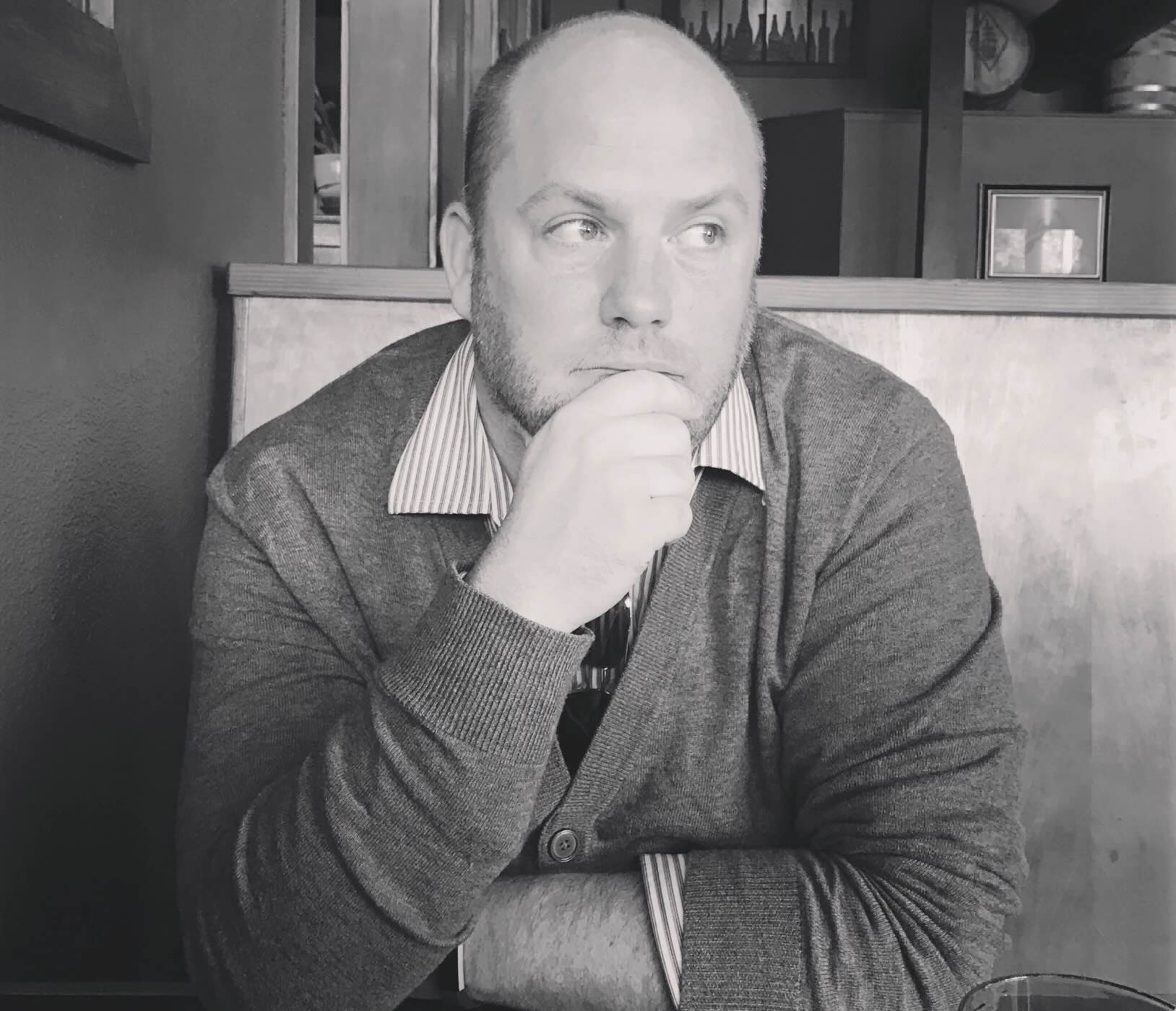
Since Peter Mountford exploded onto the literary scene with his award-winning novel A YOUNG MAN’S GUIDE TO LATE CAPITALISM (HMH, 2011). He’s become known for creating stories in which characters blow up their lives and his latest book DETONATOR (Four Way Books, September, 2025) is no exception. A chance encounter with her ex’s new girlfriend at a funeral in the Scottish Highlands spurs Sarah out of a ten-year isolation (“Love of Her Life”). An assiduous and reticent Vietnamese dry cleaner, Minh, discovers that one of his regulars is none other than former secretary of defense Robert MacNamara—an architect of U.S. violence in Vietnam; as Minh’s daughter looks on, he must decide how to proceed—maintain his role as unassuming proprietor or protest (“Mr. McNamara’s Suit”).
Even for those that make a seemingly more reasonable choice, there’s dissonance.
In “Pay Attention” homemaker Vivian’s lover, a BDSM dom, crosses a boundary, triggering her to reconsider his place in her life, fraught as it is with caregiving her children and her stroke-survivor brother. As Vivian is looking at her brother, who can no longer speak or go to the bathroom independently, Mountford writes, “The agony of his situation is so total it’s almost impossible to witness. If you stare at it, you’re cruel. But if you look away, you’re callous”.
Yet Mountford has no such concerns; he gazes unflinchingly at characters’ situations while he confidently employs story-telling strategies to keep his narratives moving—strategies he’s obliging to share with his students and fans alike.
– Shaun Anthony McMichael
SAM: The undergraduate bromide with writing is to “show, not tell”. But the more one writes, the more that maxim shifts to “tell but tell well”. For instance, early on in your story “One More Night Behind the Wall” the narrator comes out and says, “That was the party where Priscilla died. And nothing was really the same after that.” I notice other writers, Colson Whitehead comes to mind, showing a card like this early on. It creates suspense and draws a reader in. How much weaker would it be if it was “That was the party when something happened… (Dun, dun, dunnnnn!)” Is this one of the lessons you impart to students and clients?
PM: Absolutely. That’s a big thing I talk about a lot—showing and telling simultaneously and knowing what to show and knowing what to tell. “One More Night Behind the Wall” is inspired by Charles D’Ambrosio’s story, “The Point”, which has a death that’s described at the end. Yet he tells the reader very early on that this person has died. And so, the death, when it happens, doesn’t jump out of a box at you. I think that is the kind of thing that might have happened in older stories. But I think to a contemporary reader, it can feel a little manipulative while at the same time displaying the writer’s lack of narratorial control. If you don’t set a reader up, a big death has an impact when they get to the moment, but it feels more like you just thought it up in the moment.
SAM: Let’s talk about larger-than-life mother characters juxtaposed their impressionable sons. We’ve got numerous examples in your work: Gabriel’s mother and his love interest Lenka (A YOUNG MAN’S GUIDE TO LATE CAPITALISM); the mother in “One More Night Behind the Walls”; Vivian in “Pay Attention”; and Anne in “Horizon.” You lost your mother when you were in fourth grade to cancer. Describe the process of making your mother characters so strong: they are iconic and memorable— overbearing at times, but also realistic, and likable.
PM: When A YOUNG MAN’S GUIDE was published I was oblivious to the fact that I’d created this hapless male character, Gabriel, surrounded by these very strong, smart, dynamic women on all sides. It wasn’t just my mother who had that kind of presence in my family but also my sisters and the women who stepped in to help raise me after my mother died. I was always surrounded by these very assertive, complicated women—all formidable in their own way. And this is how I’ve seen the world and how I render it. I do think they’re all quite different from one another but I do find them mesmerizing as characters.
SAM: I admire your female characters. In this collection, they appear as more sexually dynamic than the men: two embracing lesbian relationships, one delving into BDSM. How do you ensure your women characters don’t come across as oversexed or as figments of male fantasy? You’ve had powerful women in your life, which I’m sure helps…
PM: I think it’s a lot of women I actually know and how they express and think about their sexuality. My fiction is definitely made up, but, like all fiction, it is also drawn, we have to admit, from things we know and what we observe with our own eyes and ears. I am interested in sexuality in general—the way it affects and plays with power dynamics between relationships. Also, from a writer’s standpoint, it’s a simple matter of sexuality drawing on serious emotional situations for people. In sexuality, there’s a lot of pain, desire, fear, and shame and all these powerful emotions, and it’s very difficult to talk about. So, from a dramaturgical standpoint, I find, when characters are in intense sexual situations, it makes for a fertile writing landscape.
SAM: The continuum of memory and forgetting is another topic of the collection. It comes up in “One More Night Behind the Wall”; “Out on the Cold Road”; “Mr. MacNamara’s Suit”. In “Detonator,” the narrator says, “I remember smiling, and it’s possible I had warm tears on my cheeks, or else that’s just my memory connecting with my imagination, as it often does, because they’re old friends and have been helping each other along ever since they met.” Is literature humanity’s limbic system, a center for memory and emotion? Compare this with the news, chasing headlines or the latest stupid thing the president has said or done. Is literature a way to reconcile with all the ways we remember wrongly?
PM: I think so. All fiction is very much about time. But we have awareness of only the things that have transpired in our own lives, and the things we’ve perceived. We only have our paths to really look at, and I do think our memories are deeply flawed. Certainly, mine is. So there is a kind of dream machine that’s taking place while you’re trying to explain what you’ve seen in the world and your imagination does get involved.
Life is also very painful for many of us in extremely serious ways, and sometimes people just don’t want to remember or think about something. And I feel like Minh, the protagonist in “Mr. McNamara’s Suit”, avoids delving into the wound of the Vietnam War, because the wound is just a great place of pain. And because he doesn’t want to think about his past, he doesn’t face reality. I’ve felt that way at times myself. Life is hard enough; I don’t need to go prodding the scar tissues of memory.
SAM: Speaking of how our brains work, accidents and medical complications also play out consistently in your work. The loss of Leonora’s leg in your second novel THE DISMAL SCIENCE (Tin House Books, 2014). Gabriel getting hit by the shrapnel and bone fragments of the dynamite blast. Priscila’s death. The speaker in Detonator’s hilarious and inopportune post-coital brain hemorrhages. Novelist Louis Erdrich has a long-standing friendship with a family doctor who helps her with nitty gritty specifics. Do you lean on such friendships or resources so that the medical mishaps read as detailed and realistic? In past interviews, you’ve mentioned how you’d been “aswim in tragedy” from a young age, which I’m sure inspires…
PM: I’ve had to do a lot of research, mostly just through the internet, and it is enormously complicated. My father had a stroke around 10 years ago, which is why I think there’s so many brain injuries in my stories. Nonetheless, the brain injury in the story “Detonator”—the post-coital brain hemorrhage—is very different from what my father experienced, and so that required an enormous amount of research. That was an incredibly difficult story to write. There was the emotionality in it of course, but also technically and logistically. I had to manage a time jump and all the character’s confusion and trying to reconcile that with what was actually happening. And then also trying to understand how this brain injury would make a person like him operate. So, it took a voluminous amount of research like watching interviews with people who have similar brain injuries and so on.
SAM: All that research and work paid off, because objectively, “Detonator” is an immaculate story! You mentioned in an earlier interview how you feel writers only have 1-2 perfect short stories in them. Yet DETONATOR contains several. What are the conditions required for these “perfect stories”, the forces of pressure needed for those diamonds?
PM: Karen Russell and I were talking about this the other day. She’s written a great many amazing stories. We were talking about our experience where sometimes your best story just kind of happens without an enormous amount of effort. It will just come out of you. You will stand up, look at it, and ask ‘did I write that? Because I don’t remember writing that!’. Even with stories like that—so good they seem to have been written by someone else—there’s a ton of labor involved. I remember the labor that went into the title story “Detonator”. But the strongest qualities of the story were already present.
Where do these things erupt from? It’s very hard to say. For me they often have some connection to something that is of extreme emotional potence for me. And often it’s something that I think is lurking out of view for me in my own mind.
Let’s take “Love of her Life”, set in Scotland. With that story, I was very preoccupied by the difficulty of making decisions as an adult, and how they often have very surprising outcomes for us. Even if you’re making well-informed decisions, it’s hard to predict how it’s going to shake out. So that kind of obsession of mine fueled the story.
SAM: In your work, the personal and the political intersect. There’s a new leader in Bolivia and there are new directions in the lives of protagonists Gabriel and Vincenzo. There’s a civil war in Sri Lanka and civil conflicts in the families of “One More Night Behind the Wall” and “Horizon”. A reliable customer of Minh’s dry-cleaning business turns out to be one of the architects of U.S. violence against the Vietnamese people. A historical event gives gravitas to the personal elements unfolding and vice versa. What’s your process for finding these connections?
PM: When somebody asked Milan Kundera about how he got all this wonderful political stuff into his fiction, he answered something like, “it’s not that difficult when there’s a tank gun barrel poking through the grocery store window.” And my life has been a bit like that. I’ve lived in South America during a lot of upheaval, in Sri Lanka during a lot of upheaval. I grew up in D.C., around a lot of power players. For instance, I saw Robert McNamara on the subway in his London fog coat, and what always struck me was that when you look at people living amidst situations with global ramifications, you’re looking at real people who are complicated and have rich emotional lives. And the fact of the political complexity that’s occurring proximate to them doesn’t really disrupt their humanity, regardless of where they are situated on a political spectrum. And so, I just am very interested in humans who are having difficult, complicated lives but who are also near a lot of political drama which is in conversation with their personal life.
There are people right now in Venezuela falling in love with each other, or breaking up, and there’s some kid who stubbed his toe, and another who’s mad at his brother. All of these things are happening simultaneously.
SAM: A human femur carried home and buried, a suckling pig’s spine broken, a downed fence, a newly cleaned freezer, a dead dog, a dry-cleaned suit—these are just a few of the memorable metaphors and symbolic gestures that emerge in your stories. How do you cultivate them, drawing them out to suggest but not force a reader into concluding what they mean?
PM: I don’t know where any of those came from. I think it’s just trying to imagine the characters’ life in a vivid and realistic way, and what would they be encountering in their day-to-day existence that would be realistic and normal. I was just talking to a student here about this. It’s a difficult thing to teach. Sometimes you close your eyes, and you just wander blindly into a scene or a situation with your character, and you just have to have a little faith that you will find something of value within that. And so it’s a little bit of a trust fall with your own intuition. You think about things that might actually happen and you improvise and you realize that something might have metaphorical value or resonance that’s much deeper than anticipated. So you can lean on it a little. All those metaphors you listed were found by accident. You mentioned earlier that scene when Gabriel from A YOUNG MAN’S GUIDE… gets shrapnel and bone from the hand of the mining protestor shot into his face from an explosion. And it’s like he’s got some of Bolivia and the Bolivian people embedded in him now. And I was like, oh, right! He’s been trying all along to kind of keep a safe distance from the Bolivian people for emotional reasons. He’s trying to stay up on the 8th floor, far away from them. And now these people are literally inside of him. I didn’t think about that until I saw it on the page and was like, oh, I see how that works!
SAM: The plot of literary fictions can swing on a connection/ disconnection paradigm. Vincenzo and Gabriel end up disconnected from their most meaningful relationships; through no fault of his own, so does the speaker in “One More Night Behind the Wall”. Conversely, protagonists Sarah (“Love of Her Life”) and Vivian (“Pay Attention”) are veering toward connection. When do you know in which direction a story will lean with its characters?
PM: It’s often the natural consequences of what the person wants and the choices they’re making; I’m just trying to be faithful to what they’re experiencing and why they would want to do what they’re doing, and what are the outcomes of that? I think in “Love of Her Life”, she’s deliberately making a choice to no longer be alone. Life’s too short for that. For the first time in 10 years, she’s aggressively pursuing connection. Being alone for her is no longer a good way to live. And so she lands where anyone would who makes such a strong choice in that direction.
SAM: Have you ever had an editor not buy the direction you’ve chosen for the ending?
PM: My story “Impact Play” in the anthology KINK (Simon & Schuster) went through a tremendous amount of editing. I had to rewrite the end a great many times to try to make it work in a way that was interesting and nuanced. But that’s really uncommon. I’ve not usually had that experience. However, with The Dismal Science, my second novel, I had an amazing editor at Tin House, Tony Perez—married to Karen Russell, interestingly enough— and he suggested I needed a new first chapter, that the beginning that I had written for the book, wasn’t the beginning. It was the most fun writing assignment I’ve ever had—an easy, delightful experience. And so, the first chapter in that book is something I wrote in the space of a week or two. I think it was so enjoyable, because I knew the character (Vincenzo) very well, and I’d written this whole book with him. I jumped back 6 months before the book starts, and took a moment in his life, a weekend or something, and examined it to prefigure the events of the book. I think it makes the book a thousand times better.
SAM: Minh, Vincenzo, and Gabriel are three great characters who appear in your work. These characters are of different races/ ethnicities from yours, yet you limn them effectively with sensitivity and realism without fetishizing or caricaturizing them; and their racial/ ethnic makeup is essential to how their stories unfold. Describe the importance of this effort for white-bodied writers as a mode of raising racial consciousness and maintaining high standards in fiction writing.
PM: You’ll notice that when I’m writing in first person, it’s from a white man’s perspective. I don’t write first-person from non-white characters or women’s point of view. I always do third limited. There’s a bigger difference so I don’t think I can get into first person there. When choosing POV, the question to ask is, can you successfully find empathy in a deep and real way for this person and their experience? I think I do with the characters in these stories. I’ve certainly tried with other characters who I’m very different from in any number of ways, and I’ve failed, and I can see it. I can feel it when I’m not able to pull it off. I tried to write a crime novel from the point of view of a detective—a white guy. But I couldn’t, for the life of me, figure out what it’s like to be a person who chooses to become a police officer, and then what it’s like to be in that milieu. I put in tons of research, and I still couldn’t figure it out. I spent all this time around these detectives. I went on ride-alongs. But I couldn’t bridge that gap. I couldn’t find my way into these people. So, I had to give up on that, and it’s not the only time I’ve had that experience.
I remember I had a negative review of A YOUNG MAN’S GUIDE in which somebody said something to the effect of, “I don’t like this book, I wish this book was about the experience of, Bolivian peasants”. But I couldn’t write that book. Ever. No amount of research would ever enable me to write that book.
I’m sure that’s a limitation of mine. I know there are amazing writers who can throw their voice really far, like Adam Johnson and Anthony Doerr. It’s incredible how they do it. They’re both such ambitious writers to such an extreme degree and they have a lot of time to focus on their writing. They can delve deep into characters with whom they have almost nothing in common. It’s very impressive.
SAM: Here’s an expat question. In “Boca Del Lobo”, you write from barkeep, Maria’s perspective, “…like other foreigners who remained, his loneliness had ripened and then fermented into a kind of spiritual sourness”. Do you think that this would happen to you if you decamped permanently from the U.S.?
PM: For a time, certainly. I might have recovered, too. But I think she’s also spending a lot of time with young, lost foreigners staying in Bolivia for a while. So, there’s a bit of a sample bias there.
Becoming an expat is understandable. I found quite a sense of relief in my experience living in South America and Mexico. Sure, capitalism is everywhere in the world. But places where capitalism isn’t going so well, people seem less transfixed by it. I found myself liberated from this thing that was grasping me by the shoulders and I didn’t even realize it. That’s one of the wonderful things about exploring the world is discovering how strange your own cultural viewpoint is.
SAM: Speaking of shifting perspectives, there’s this idea of reading fiction as a way of “getting an education”. I feel that way with your work. Whether it’s about Evo’s election in Bolivia, the world of hedge funds, and game theory (A YOUNG MAN’S GUIDE…); Machiavelli, Purgatorio, and Chess (THE DISMAL SCIENCE); the Sri Lankan civil war and the gay architect Geoffrey Bawa (“One More Night Behind the Wall”), I’m always learning when I read you. These are things you have researched; some are things you’ve experienced. What’s the feedback loop like for you of living, reading, and fiction writing?
PM: I’m very interested in fiction that does what straight-up fiction’s not supposed to do. I mentioned Milan Kundera earlier. But there are other writers who do this. You’ll be reading a work of fiction, a novel, or a short story, and they start doing something that reads a lot like an essay or a research paper. They’re talking about philosophy or science. Ben Lerner’s novel 10:04 that has an enormously long passage about Walt Whitman in it. And I love that! It gives the story the energy of an essay. I don’t understand exactly why they need to be so separate all the time. People get very nervous in the United States when you start talking about politics and real people like Robert McNamara in the middle of a short story, and you start talking about history and philosophy. But to me, those are the best parts of life, so why not just throw them into fiction. And there’s certainly precedence for this: the many pages in Moby Dick devoted to whales; the metafiction in the sequel to Don Quixote. I feel like older writers were more daring in some ways.
SAM: You’re closer to Vincenzo and Luce’s age now than when you wrote their stories. You wrote them so well, with such authority. When you re-read or think of how you wrote them, are there elements of cringe or confirmation in your feelings? Would you write them differently now?
PM: In THE DISMAL SCIENCE, Vincenzo’s in his mid-to-late 50s, and after the book came out, I was worried that maybe he reads more like he’s a decade older—retiring from his profession, exhausted, and wanting a simpler life away from the ambition and drama of his younger years. But I’ll be 50 this summer and, in a way, I’m relieved. Because I already feel geriatric and exhausted. Like I want to relax, slink off into the distance, and have a lie down. So, I’m very pleased and more confident now than upon publication, that I expressed his experience accurately.

