

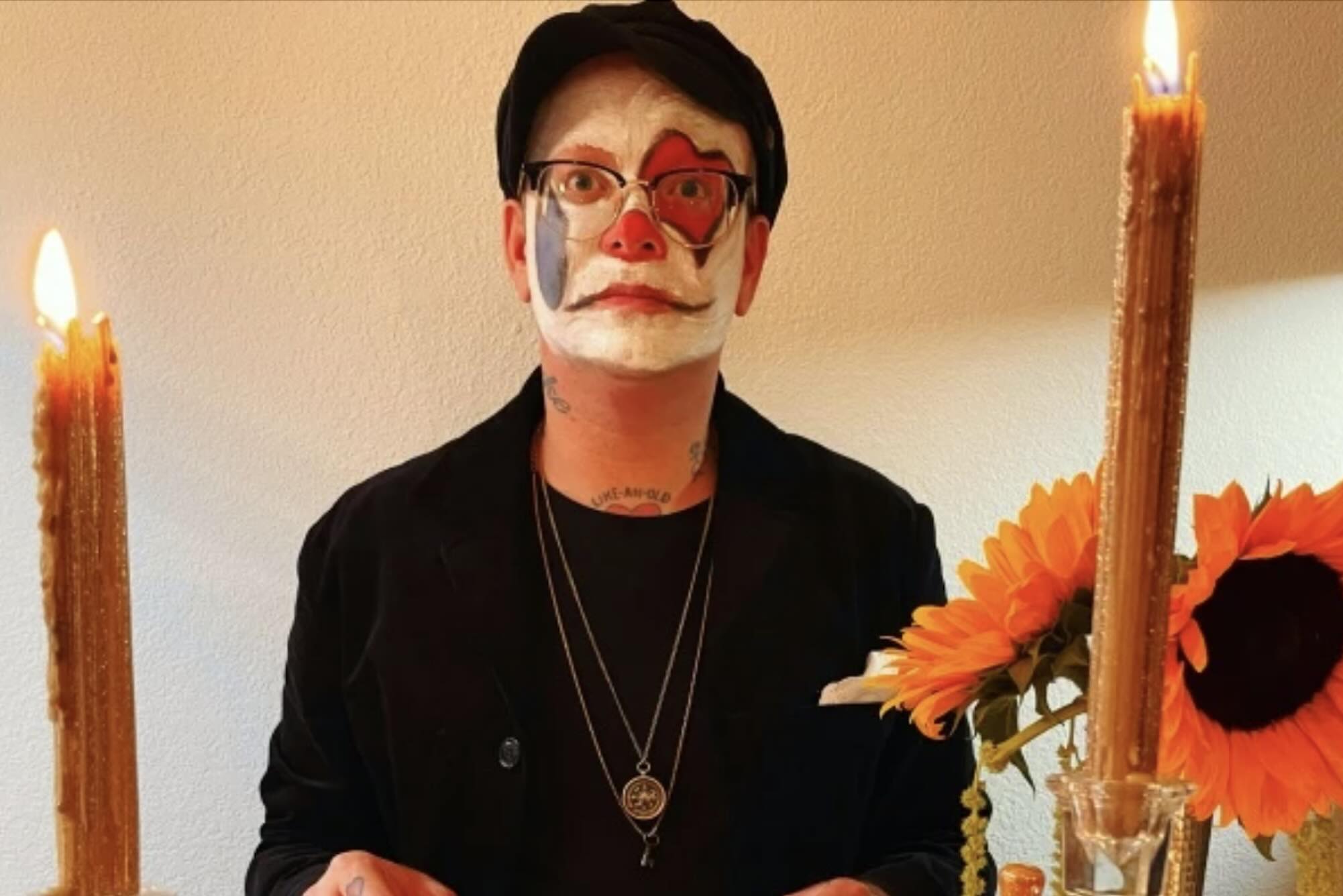
Micah Schnabel is the best singer-songwriter you’ve never heard of (unless you fucking rock some shit, then you have heard of him and know just how true it was what I just said).
As part of his bands Two Cow Garage and Call Me Rita as well as a solo artist, Schnabel writes with the heart of a punk anarchist and the soul of a folk troubadour. You will not find anyone better at telling the stories of the have-nots while also raging against the machine. But all along the way, his politics are always the politics of humanity and compassion. It’s not us against them, it’s us just trying to make it through the day without losing ourselves to the anger and depression this world seems to feed upon.
With his new book The Clown Watches the Clock, Schnabel has taken his song-writing talents and turned them into one the best books I’ve read in years. It’s got the mix of heart and sense of absurdity of George Saunders and Kurt Vonnegut. It’s got the gritty working-class ethos of Bud Smith, Sam Pink, and Scott McClanahan.
In a fair world, this book would be a best-seller or at least a huge cult hit on the indie circuit–a novel that perfectly captures the absurdity of our near future. A clown who can’t pay the bills bringing children joy to people resorts to doing roasts at funerals. Getting paid hard cash by dead people to tell their living loved ones just what they think of them, no holding back.
All the while the world around them is full of government roadblocks at every state line, checking papers and harassing anybody who might stand up for their rights. It’s one of those books set in the near future, but the near future seems like it’s a year or two away or maybe tomorrow (jesus fucking christ, this world).
But the brilliance of the book is that it’s not preaching to the choir. It’s looking at the decisions that good people have to make just to make it in this world. It’s damning social commentary that doesn’t get in the way of a great story; it’s political but never preachy. It’s funny without punching down. Like everything Schnabel does, it’s smart and all heart at the same time.
This is one of those books you read and you need to tell somebody else about and then that person tells somebody else about. If I didn’t know anything about how brilliant Schnabel is as a songwriter, I’d still tell you this is the book you need to read.
You need to read this book. Then you need to share this book. The world will be a little bit better for it.
In the meantime, you have to check Schnabel’s music. Because here’s the brilliance of having a genius novel written by a brilliant songwriter who fucking rocks:
You’ve also got a musical accompaniment that fucking rocks to go along with it.
I can’t tell you how happy I am to be able to introduce Micah Schnabel to those of y’all who don’t already know how brilliant he is.
BD: You mention on your BandCamp page that both your book The Clown Watches the Clock and the album of the same title were written at the same time while you were struggling with Covid. What was the creative process like between the two? Which idea came first? Do prose and song lyrics come from similar parts of your brain or do you have to shut one off to turn the other one on? Is this like Pink Floyd’s Dark Side and the Wizard of Oz?
MS: I’ve only written two books so far, but during the writing of both books, the songs tend to form by themselves. When I’m locked into a story that I’m working on every day, a songs start to feel like an accessory. When you’re making up an entire world, a lot of ideas that you wouldn’t necessarily think to write a song around start to pop up and the songs feel like play. Like the line “at the church inside the old Mexican restaurant that used to be a Pizza Hut…” (I love that line!) That comes from the main character from the book, PK, riding the bus to the dollar store. I don’t think I would be able to come up with that cold.
I think longer form writing lends itself to opening up the brain works for the song world.
BD: I believe The Clown is your second published novel after the great “Hello, My Name is Henry. What was different for this one versus Henry? Was Henry your first novel you’d written or just the first to get published? How has your approach to novel writing and your idea of what a novel should do evolved?
MS: Hello, My Name is Henry was my first attempt at a novel and it only came about because my friend Michael Baron at White Gorilla Press asked me if I’d ever thought about writing a book. At first I laughed, because I never thought someone of my educational level could write a book. But Michael was incredibly kind and patient. I started writing short stories and sending them to him and he would gently guide me in the right direction. That went on for a couple years before I finally hit on the idea for Henry. When it hit I could feel that it had enough emotional juice to be a full book. I told Michael and he agreed and I spent a year working on the first draft. I wrote the damn thing on a typewriter because I didn’t own a computer. I shipped it off to him and he was kind and patient enough to type it up and get into Google Docs.
From there, we spent another year editing before we got down to the final manuscript.
Henry is definitely a first novel. It has a lot of ideas getting thrown against the wall. My entire life up until that point found its way into the book.
What I’ve learned is that my writing tends to start too broad and get sidetracked, which is no fun for the reader. I’ve learned and am still learning to be more lean. To always be trimming the fat and to only give the bare necessities. When I’m using a microscope instead of telescope is when I think I’m working at my best.
BD: Having a clown for your narrator and protagonist was such a brilliant thing. And of course, the whole time I was reading it, I had all these different versions of “Why a clown” questions in my head, and then you go ahead and answer the question yourself in the fictional interview at the end.
Specifically, you wrote, “I thought a clown was an antidote to cynicism.” Is that what you as the author thinks too? Especially within the larger context of how cynically most people view clowns in general? The combination of the Clown getting paid to roast people at funerals was an extra brilliant touch.
Beyond the symbolism of the clown as protagonist, though, I also wondered–and maybe I’m just projecting here–but as a performer and an artist, I imagine that you’ve probably had a moment in your career where you’ve had some thought similar to “What am I–a fucking clown?”
How much of that cynical view of the clown’s art did you identify with as you were writing this?
MS: I think Clowns are very similar to musicians and are artists. The best ones expose their own vulnerabilities in an attempt to humanize all of us. But unfortunately, in the world that we live in, the easiest thing we can do is knock someone down when they’re vulnerable. To the point that it’s currently being fashioned into a point of nationalistic pride. The emotional sucker punch has only ever grown in popularity.
Framing a Clown in a real person rarely happens in our media landscape. A Clown’s only goal is to make other people happy at their own expense. But instead of celebrating that beautiful, selfless gift, we turn the Clown into a villain to project our worst ideas upon. It’s very sad and really shows our hand as a species.
Almost all of PK’s troubles are a rough remembering of tour horror stories. Probably too much so. I should have made more stuff up but I had so many incredibly dehumanizing moments to pull from the ol’ bag of tricks that has been my life.
BD: You picked quite a challenge for yourself writing speculative fiction/satire in the world we live in these days. I know this was written back in Covid, but especially the stuff with the military state demanding ID papers to go city to city, etc. felt like it wasn’t so much speculative fiction as it was what I’ll call “reality-adjacent.” Like maybe it’s the world today, but who knows about tomorrow?
What was your approach like to the elements of spec fiction and satire in this? Navigating willful suspense of disbelief while also turning up the volume enough so that it’s at least slightly more fucked up than the world would be by the time you published it?
MS: I was looking at what I thought was our most likely future. If we look at what’s happening in this country right now, these things were all already being proposed when I was working on the book back in 2020. And since the Trump administration has no enemy with any teeth, I was betting we would most likely see those ideas come to fruition one way or the other.
I hate that even the worst ideas in the book are turning into our reality. Not to sidetrack too far, but as the military is being sent into cities, I’m guessing it’s just a matter of time before his supporters in rural areas start to blockade freeway exits. I really hope I’m wrong about that one.
BD: One of my favorite parts of your writing is that the social criticism are always there–both in your songs and in your two novels, but it’s always grounded in character. You’re never preaching to the converted or patting yourself on the back for your big ideas. Your characters are never complete martyrs–they are always somewhat complicit in the world they live in.
Can you talk about maintaining that balance in your writing? Especially writing a book like The Clown Watches the Clock during a time where it’s increasingly difficult to not just write angry diatribes attacking the lunacy of this dumpster fire? Not completely giving in to the cynicism?
MS: Thank you for saying that. I definitely have to watch myself on being preachy. I don’t like when others do it and I don’t want to ever come off that way. My entire human and artistic existence is based on the fact that I don’t know shit.
I speak about the world from exactly who I am. A high school graduate from a small, impoverished rural American town. I grew up in the 80’s and 90’s and watched the town crumble and the factories shrink. I write about who I am and the people I know and I don’t punch down or pretend to have the magic beans to solve anyone’s problems. I think that keeps my work honest and hopefully far away from anything that could be considered condescending or preachy.
BD: As someone who is married to a poet and works with said poet/wife and gets most of his feedback from said poet/wife, I am always interested in the relationships of other artist partners. What’s your collaboration like with Vanessa? Especially now that you are in a band together? How do y’all negotiate the whole muse/bandmate/editor/life partner relationship?
MS: Vanessa and I are still figuring out our creative partnership after 14 years together. Items continued to grow and bind together and I think we’re starting to hit on something really exciting. As a white guy with an acoustic guitar in this day and age, I think it’s exciting for not only me, but also for the listener to hear another point of view. The back and forth in the songs is an exciting driving force right now.
There are definitely difficulties. We book ourselves, play the shows, do the drives and then drive home together, so it can be difficult for both of us. I think we’re both still learning how to take it a little easier on one another. That even when we do something that angers or frustrates the other person, it’s never done in malice.
Again, I would like to loudly point out that I don’t know shit, but I think like any good relationship, there’s always work to be done.
As for the creative side, because we live and tour together, we’re usually on the same or similar page and topics. So if I start a song Vanessa’s always right there to pull the story along. She knows where I’m coming from and most likely what specific situation I’m pulling from.
Likewise, when Vanessa starts an idea, I can jump right in and swim. Our latest single “No X-MAs Cards For Fascists” was Vanessa’s idea. She wrote her first verse and then I jumped in with mine. It feels like a Beastie Boys type of writing that neither of us have ever done before. It feels fresh and in the moment, and that’s where art always feels the best.
BD: It’s always funny to me how most writers are wannabe singer-songwriters and a lot of singer-songwriters seem to want to write novels or books of poetry. As a definite wannabe, I am always wondering what your day-to-day life is like when you’re not touring, writing, or recording music? Like what would your MTV Cribs be? What are your daily errands? Your chores? What makes you human and not just a rockstar?
MS: Errands, baby! Endless errands. Grocery store, dishes, all of that wretched human stuff. And since Vanessa and I live and tour together, when we get home it’s kind of like starting all over again. And we tour a lot, so nothing is ever really settled.
As for me, my normal day at home is coffee, booking emails, brainstorming the next 3-6 months.
Lunch. Then I usually sit down with the guitar. Start the laundry if it’s laundry day. More coffee. Pace around the front room with my guitar on and play through new songs I’m working on memorizing.
Grocery store. Dinner. A walk around the wealthy neighborhood a few blocks north of our apartment.
At night is when I can usually settle in on the creative side of things. Like, right now I’m writing this interview and when I’m done I’m going to pick up the guitar and work on a new song I’m excited about.
I usually get to bed by 3 or 4 am depending on recent time zone changes. We just got back from the west coast so I’m still a little hung up on Pacific time.
Wake up and try and do it all again.
BD: Okay, so now I’m kind of just asking fanboy questions, but I think the people of BULL deserve to know too: What’s the story of Two Cow Garage? The name? How did y’all meet? Are there plans to do any albums or touring in the near future? (Please don’t break my heart, or if you must, just sugarcoat it with words like “indefinite hiatus” and “always open to the future” and “never closing the window.”)
MS: The name Two Cow Garage came from our friend Jeff Fernengel. He’s a brilliant painter, artist, and all-around human. He was more connected to the punk rock scene here in Columbus, so when he heard our kind of country band, Two Cow Garage was what he dubbed us. He said it didn’t matter what name we chose, he was calling us Two Cow Garage. A few days later we picked up our first show super last minute (a 9/11 firefighter benefit) and we still couldn’t come up with a proper name. We used Two Cow Garage as a default and said it on stage. That was 24 years ago.
Shane Sweeney and I have been the faces and songwriters for Two Cow since the beginning. It’s our band and we’re still best friends after all these years. Right now, we’re doing local shows and the occasional out-of-town show that makes financial sense. It’s expensive for the band to travel and for folks to take time off of work and all of the tough stuff that comes with being in an active band. We have songs for a new record, but to be honest, there’s just not much demand from enough folks that it would make sense for us to be out right now. As adults in our 40’s and 50’s we just can’t go out and come home with nothing anymore. We were able to swing it for a long time, probably longer than we should have. But Shane and I hold the keys and TCG isn’t going anywhere. I think as some time passes and we put out a new record, an opportunity or two will come around that will allow us to go back out and play some shows.
BD: Who are your favorite storytelling songwriters out there? Who would you want to read a novel from?
MS: Willy Vlautin is my biggest inspiration as a writer (check out BULL’s interview with Willy here). He was the first person I ever knew personally that wrote a book. TCG toured with his band Richmond Fontaine way back when and I remember him showing us the illustrations for his first novel Motel Life at a party after the show. I couldn’t believe I knew someone who had written a book! His writing is something I strive towards. Simple, plain spoken and beautiful. And his songs are just as good as his books.
This isn’t ass kissing and I mean this with the upmost sincerity, two artists I would love to read novels from are Vanessa Jean Speckman and Shane Sweeney.
BD: And lastly, of course, the obligatory: What writers have had the biggest influence on you? Songwriters? Novelists? Any specific books that you took as inspiration for The Clown?
MS: Willy Vlautin is the writer that made me a reader. I’d say he’s had the biggest influence on me and my writing.
I think Hanif Abdurraqib is not only one of the best writers currently working, but one of the most important thinkers of my generation. He and bell hooks have taught me a lot about love. And not just romantic love, but showing love to your people around you. The people we share space with everyday. From a coffee shop to a stage, they taught me to pay attention.
I think Will Johnson and his work are a gift to this messed-up world.

