

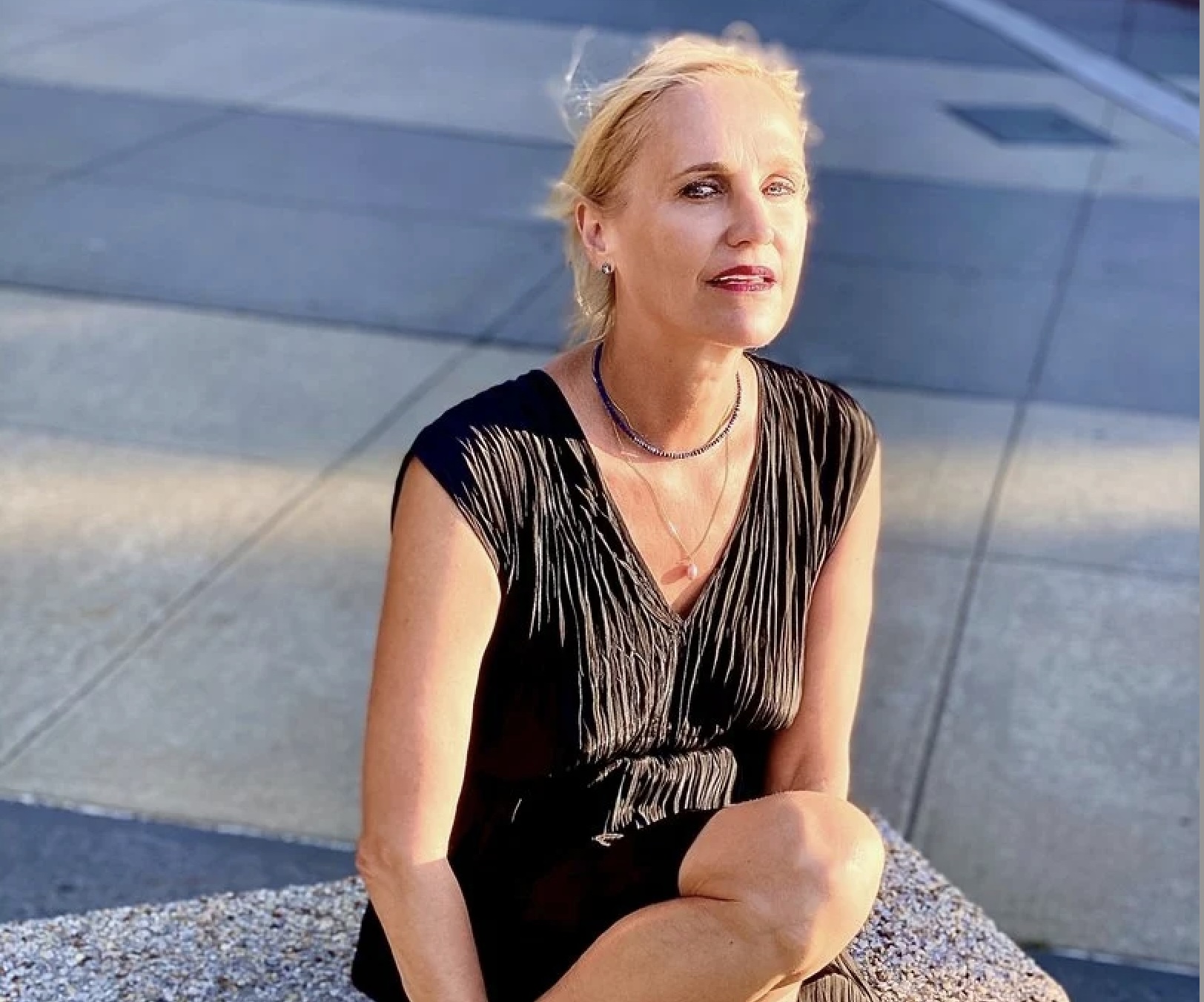
Paula Bomer is the author of The Stalker, which received a starred Publisher’s Weekly, calling it “dark and twisted fun.” She is also the author of Tante Eva and Nine Months, the story collections Inside Madeleine and Baby and other Stories, and the essay collection, Mystery and Mortality. Her work has appeared in Bomb Magazine, The Mississippi Review, Fiction Magazine, Los Angeles Review of Books, Green Mountain Review, The Cut, Volume 1 Brooklyn and elsewhere. Her novels have been translated in Germany, Argentina and Hungary. She grew up in South Bend, Indiana and has lived for over 30 years in Brooklyn.
FR: Congrats on The Stalker, I truly loved the book. It’s a dark book, but it’s pretty damn funny. I laughed a bunch. Tell us how you came around to the story? Maybe from your own experiences?
PB: I’m so honored that you loved this novel. Truly. And dark and funny was the aim, so I’m glad that’s one of your takeaways. I had been trying to write a novel called Gaslit for about 7 years, on and off, and it went nowhere. There’s no other way to explain it but a man’s voice came to me, and off I went. And Gaslit turned into The Stalker. The first draft was all-consuming and took about 3 or 4 months.
FR: Okay, Doughty, he really loves himself, HA! You came up with one hell of a memorable character. He thinks he’s God’s gift, the smartest man on earth, he’s really not. Tell us about Robert, is he a composite of people you once knew? Where did he come from?
PB: Yes, he loves himself. Unconditionally! He thinks he’s the best thing that ever walked the earth. There’s this dated theory about abusive behavior, that it stems from deep insecurity or trauma. I do discuss his background a little bit, but I don’t make it the thing that forms him entirely. He’s definitely inspired from real life experiences but he became his own creature. This is why fiction writing is way more my thing than non-fiction. You really bring to life a totally imaginary being.
FR: On the other end of the story, which is darkly funny, it makes my skin crawl, too. The delusional entitlement that lives in this man’s head. His ideas, cons, how he goes from the YMCA to living in some pretty swank places. How did he achieve this? Is he more invested in the game of torment or bettering his own life? Maybe both.
PB: I love “maybe both.” I would even argue maybe a lot of things are the reason why he is the way he is. Entitlement is a hugely problematic character flaw for not a small portion of humanity. His self-belief or identity comes from many things, but one key thing is his family’s ancestral “importance,” and maybe more importantly, a society that reinforces this belief that wealth comes from some inner greatness, rather than an accident of birth. “The game of torment”—what a great phrase, Frank. The writer Elziabeth Strout said, “It interests me how we find ways to feel superior to another person, another group of people. It happens everywhere, and all the time. Whatever we call it, I think it’s the lowest part of who we are, this need to find someone else to put down.” And there is science to this—chasing a dopamine high that can come with power over another person. When my sons were little, I would help out during lunchtime recess occasionally. I witnessed and would try to interfere or “make peace” all the bullying and it blew my mind. Bullying is about control. To hurt someone, a person feels like they have controlled that person and hurting them makes them feel powerful. I agree with Strout that it is “the lowest part of who we are.” As far as bettering his life, yes, he sees something worth taking, and off he goes. Who doesn’t want the nice stuff? It’s how we choose to pursue the good life that matters.
FR: Will there ever be enough, an endgame, for Doughty? I imagine it must be a tiring life being such an asshole, so tiring he needs crack to keep going. Where does his emptiness come from? Personally, I don’t think a person like him will ever be satisfied.
PB: Is anyone ever satisfied? One goal is reached, then another one is made. One problem is solved, then another appears. When I moved out of a house into an apartment, I was—and still am—so thrilled to not be my own landlord, to not hire plumbers, roofers, fix the sidewalk, etc… but I knew a new set of problems were ahead. I have far less privacy. Mostly, I miss my backyard and neighborhood of over 30 years. Was it the right thing to do? Absolutely. I am at peace with this choice, or life development. I don’t know if I believe there is a state of satisfaction, it’s more like a moment. Feelings, and “life goals,” by definition, are fleeting. But how we chase them, and to what end we will go to to satisfy our desires is fascinating.
FR: Switching it up, and a question I ask everyone. Being an author, you must’ve come up with a love of reading. I often like to ask this question because I find authors often read all over the spectrum. Growing up and in young adulthood, give us three or four authors you loved reading. Also, give us three or four writers out there right now that you enjoy.
PB: The Fire Cat by Esther Averill was an early childhood book that made me feel like I had a friend in the world, that I was not alone. I keep a copy of it on my office shelf. Reading is a balm of the loneliness of existence for me. In high school, I read Flannery O’Connor and that was life changing. In my twenties, when I began writing fiction regularly and trying to get published, the stories of Denis Johnson, Mary Gairtskill, and Tolstoy were key to the work.
Writers writing now—Megan Nolan’s novels Acts of Desperation and Ordinary Human Failings are mindblowingly great novels. I read Sam Lipsyte’s most recent novel—all of his novels and his story collections are brilliant—No One Left To Come Looking For You after I finished my draft of The Stalker. So fucking good, so funny, and also set in the early 90s of downtown New York, so that was really fun. I have such a big must read stack right now, but at the top of it are Lonely Crowds by Stephanie Wambugu, Perfume and Pain by Anna Dorn, How to Dodge a Cannonball by Dennard Dayle, and Saints of The Narrow Street by William Boyle.
FR: Tell us a bit about your publisher, SOHO, what’s it like working with them?
PB: The Stalker is my fourth book with them. I feel so lucky and grateful to be with them and to have Mark Doten as my editor. He is old school, he’s a modern-day Maxwell Perkins, in that he is a truly brilliant editor and makes my work the work it is. Being on a small press, owned by the daughter of the woman who founded it, is so wonderful too, in that the attention you get is genuine, and you feel that. They care. I have a theory about Doten and me—we both are Midwestern transplants to the big city. We get each other.
FR: We’ve been pals on socials for a while, and I have watched the release of The Stalker at your various events, readings, signings. How has all of that been going?
PB: I had so much fun despite my terrible social anxiety. I felt so supported. It was also exhausting and it’s slowing down now, so it’s time for me to focus elsewhere. It’s been a great ride, and I’m super grateful to my awesome support system. Also my last novel, Tante Eva, came out during Covid, so I walked around with a mask on signing books in bookstores where everyone was wearing a mask. That just totally sucked. So to be able to commune with others for this one felt like a huge gift.
FR: Like me, you are a fan of Jim Thompson. His characters were not funny for the most part. Everyone in his world is out to fuck everyone else over by any means necessary. He wrote dark stories. The Stalker is fucked up, dark, but also funny. Did you need elements of humor to be able to work your way through the story because it has epic moments of cringe? I use cringe in the best way possible.
PB: Reclaim the word cringe! Ha. I love it. Jim Thompson was a genius. I remember thinking some of his novels were slyly funny, but you nail it with the fact that everyone has an angle and everyone is out for themselves. The last one of his novels that I obsessed over—that phase also was in my 20s and early 30s—was A Swell Looking Babe, and I remember smiling darkly at parts of it. But no, he’s not “satire.” And this novel is a satire, albeit a particularly dark one. There’s this documentary series that isn’t very in-depth called The Dark Side of Comedy and—is there any other side? Humor and darkness are twins to me. You can have one without the other, but they are so great together, it’s like a sort of destiny. But as I mentioned, the serious, unfunny book about abuse and entitlement called Gaslit was inaccessible to me. I couldn’t bear it, but once I found a way to mock the perpetrator, things flowed. I definitely needed humor for this one. Helps the medicine go down, so to speak.
FR: Doughty gaslights. He believes he’s entitled, filled with misogynistic anger. He doesn’t give a shit about anyone. After reading the book, one could put Doughty up to a lot of politicians, the state of the world, what women deal with, was that the intent? Elaborate.
PB: It was not but I love that for once in my life, one of my books resonated with what’s going on in the world! That is sheer luck. And I will take it. When Baby and Nine Months came out, it was years before Bad Moms was a movie (and they weren’t that “bad”) and before the work of Elena Ferrante had made it to the USA, and before Miranda July wrote about a mom going on an aborted roadtrip to a hotel to have wacky sex. So I’m just saying Hallelujah to the timing of The Stalker. Not that these men haven’t been around forever, but it is a special time. I broke out with shingles when they overturned Roe v. Wade. I can’t believe Trump has only been in power for a year. My mother came from Austria, she knew fascism, and we are undoubtedly ruled by a fascist regime.
FR: So what’s up next for you? Working on anything new? Or taking a break?
PB: I’m always working on things but promoting the novel was exhausting albeit fun! The time is coming to read a lot and get back to work. Anne Tyler never promoted, and I think that is why she is so prolific. I read once she said something like, “I did an interview to promote [one of her novels] and I couldn’t write for six months.” I feel her on this. But I am not Anne Tyler, and I’m happy to get out and do things. But it’s not conducive to working on a large project.
BONUS
FR: You just took a baseball bat to Doughty’s head and killed him. You are covered in his blood, and you turn around and have a need to celebrate. Where are you going to celebrate, blood stains and all?
PB: Straight to my neighborhood bar, which is in the acknowledgments of The Stalker. I’d buy a round for the bar and I’d get all the love, covered in blood and howling with satisfaction.

