

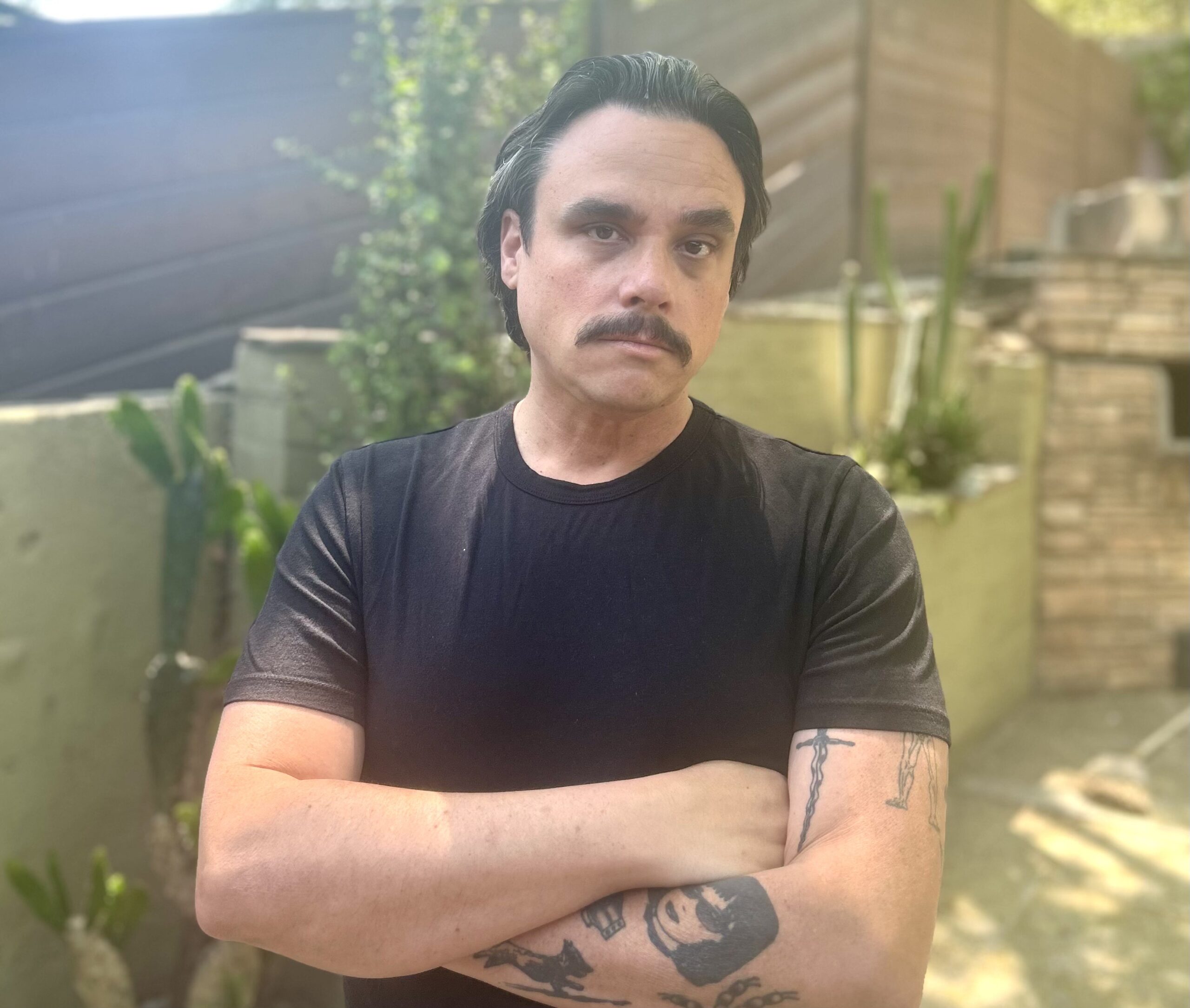
When I talked to Jordan Harper, he had just come back from a New York screening of SHE RIDES SHOTGUN, a film version of his electric debut novel from 2017. The movie seems destined to make a name for Ana Sophia Hager, the young actress who kills it in every scene she’s in, and hopefully will bring more readers to Harper, one of the vanguards of the Thuglit-era of crime fiction.
The story of a tough-guy robber Nate (Taron Egerton in the film) and his eleven-year-old daughter Polly (Hager) on the run from the Aryan brotherhood, SHE RIDES SHOTGUN has antecedents like PAPER MOON and SHOGUN ASSASSIN, but the book is totally unique in tone and the coagulating voices of his characters.
Like his two protagonists, there is a duality in Harper. He’s humble and generous, but also not afraid to stand on his work. “I would get in the ring with just about anybody” he tells me.
Tender enough to bring his childhood Teddy Bear to the film screening for photo ops but hardboiled enough to say “I don’t write action. I write violence.”
Comfortable in movies and TV—another film adaptation (of his L.A. noir novel EVERYBODY KNOWS) is in development—but at heart, a wordsmith. As his contemporary S.A. Cosby has said, “I personally don’t think there’s anybody thinking about the actual craft, the act of writing, as deeply as Jordan Harper.”
Harper is the author of five books and his latest novel A VIOLENT MASTERPIECE, has just been announced. We talked over Zoom from our respective locations in Los Angeles, interrupted only once by a strolling coyote.
BF: You started out as a music writer, but did you always want to write fiction?
JH: When I was a little kid I was very into writing short stories. Even before I could write I would dictate stories to my mom and have her write them down, and they would usually be stories about monsters fighting. I had a whole universe of comic book characters when I was nine years old, you know and as I got into high school and started taking drugs I started drifting over to Hunter S. Thompson, he became my main inspiration. In my teens and twenties, I really wanted just to be Hunter S Thompson…
BF: Yeah, I get it. When I was 18, I got my first tattoo and it was the dog from the cover of FEAR AND LOATHING, the Ralph Steadman dog.
JH: I’ve long resisted getting the Gonzo symbol tattoo, I kind of thought about changing the word “Gonzo” to something else, like “Pulp.” As in pulp fiction, but I was worried that people would think I was into Pulp, the band. I mean, they’re fine but…
BF: You don’t want people at your funeral to be like, “Oh, Jordan really liked that band Pulp that’s weird.”
JH: Exactly. I didn’t actually like music journalism very well, besides just the writing part and I could also see that that was sort of a dead end for me. While I was doing that, I used to run an anonymous True Crime blog, I was very into crime fiction and crime and crime movies and gangster rap. And so I would write something about Twin Peaks, and then I would write something about the West Memphis Three.
And then my grandfather died, and my grandfather was a prison guard who made knives in his spare time, a real Ozarks badass. And he was connected to this kind of violent history that my family has. My great-grand uncle was killed in a shootout in 1931 outside of my hometown (Springfield, MO), along with six other cops in this absolute massacre called the Young Brothers Massacre. This pulpy little book was published in 1932 about it and copies of it were always floating around my family. And so I had read it a lot, and I had this kind of connection to both the Old West and the Bonnie and Clyde era through my grandfather, who was a very Johnny Cash fan kind of guy. And then Johnny Cash died, and my grandfather died not too long after that. And I ended up writing this short story called “Johnny Cash is Dead” (in the collection Love and Other Wounds). And it kind of came out of nowhere. I just really wanted to capture my grandfather.
I ended up Googling “crime fiction,” I was not in any way plugged into the scene. And I wound up finding this website called Thuglit that had just published its first online issue. And I had also just moved to New York and I sent Todd Robinson, the guy who ran it, “Johnny Cash is Dead” and he published it. It showed up in Issue two of Thuglit. And he used to have a party at a bar every time an issue came out. And so I met Todd, and I met a lot of crime fiction writers and started finding this community. I started just writing more and more short fiction and a good chunk of it got published by Todd. And I’m not the only person who said this, you know, S.A. Cosby credits Todd with his discovery, Rob Hart was published in Thuglit. A lot of people will say this, that Todd Robinson is probably as responsible as anybody for the current generation of crime fiction that I guess I’m a part of
BF: Yeah, it’s just amazing how much talent came out of Thuglit and maybe—I want to hear your opinion—the reason it was special is because you guys were just doing it for the love of it.
JH: I think that’s accurate. We were a specific generation of writers who were heavily influenced not just by crime fiction, but by crime film. I love Jim Thompson. I learned about Jim Thompson through THE GRIFTERS, the movie. I learned about James Ellroy through the LA CONFIDENTIAL movie. And so I think that sometimes I get told I write cinematically, which isn’t a conscious choice, because I am as influenced by film as I am by books.
But you’re also right, it was just the love of the game. When I was living in New York. I was in a writer’s group with Todd, Justin Porter, a couple other guys, and my whole gig in those early short stories was blowing their minds. That’s all I wanted, was to make them go, “Holy shit, fuck you, I can’t believe you did that,” and I got a lot of joy out of that. I often speak to my therapist today about how to recapture that pure joy of creation, because once money and all the other stuff gets involved, even if you don’t lose it totally, it gets damaged.
BF: I’ve always loved classic crime novels but to be honest I wasn’t reading a lot of contemporary stuff until I recently discovered you and S.A. Crosby and was like, “Holy shit, I had I had no idea this was going on.”
JH: Somebody asked me the other day, Are we in a golden age of crime fiction? I don’t know, but you also have to remember that when we were in the time of Jim Thompson and David Goodis and all those guys, they didn’t know that was a golden age either. People figured it out much later.
BF: Even today, at lit magazines and the book culture—whatever that is these days—you kind of feel like, “Oh crime fiction—that’s a different thing.”
JH: This is me being totally honest with you, and maybe not, kind of stuff I should say in interviews, I get very frustrated with that, because I feel like I’m as good a writer as any of those people. And I think the tide is turning slowly, Shawn (S.A. Cosby) has done a lot to do that. And frankly, I think I’m on my way too. I just want to be judged by the same metrics as everybody else, because I think I can be, and I think there’s a lot of people who would like our books and aren’t getting them because of assumptions made about genre and who buys what books.
BF: You’re working in a classic genre, but you’re also giving the reader a fresh perspective, a contemporary POV.
JH: I try hard. I think I write about both men and women in crime fiction in a way that is unusual for authors of any genre, in part, as a reaction to what I thought was an overly macho thing. And also, I just write about what I like. And I actually like women, and so I want to write about them as much as I want to write about men. And, yeah, I kind of dream about the day that somebody outside of the tight circle takes a look at me, because I think I would do all right by a lot of people’s estimation.
BF: Sentence by sentence for sure.
JH: That’s kind of what I mean. Like, I would get in the ring with just about anybody when it comes to that.
And I’m also writing about America and the violence implicit in America in a way that I’m not seeing out of a lot of literary fiction right now. Now, I could be wrong about that. I’m not super well-read, but I do think that pulp is actually a really good way to describe America right now, because we live in a pulpy reality.
BF: Probably the same thing that James Ellroy would have said in the 1980’s, before he was ‘discovered’.
JH: It took him a really long time, and honestly, it took a movie coming out. Just like it took Cormac McCarthy having ALL THE PRETTY HORSES be a hit, and Oprah having THE ROAD, you know, nobody read BLOOD MERIDIAN.
BF: So let’s get to SHE RIDES SHOTGUN. Your first novel. You’ve talked about PAPER MOON, and SHOGUN ASSASSIN being influences, stories of dangerous men and kids on the road. So I started watching SHOGUN ASSASSIN I’m like, oh shit, it’s the “Liquid Swords” intro. The GZA song.
JH: It started with LIQUID SWORDS, really, yeah. Like, I love that album in high school. And then I can’t remember if I just happened to rent SHOGUN ASSASSIN or if somebody told me it was where it came from, but then that led me to watching SHOGUN ASSASSIN. And I love that movie. It’s a mash up of the first two LONE WOLF AND CUB movies, they jammed them together.
BF: And what made you think you could write in the voice of an 11-year-old girl? Polly is not just an accomplice to her ex-con father Nate, or a damsel in distress, she’s the major voice of the book.
JH: The first draft of SHE RIDES SHOTGUN had very little from Polly’s point of view. It was almost entirely from Nate’s point of view. And I did that thing that you do where you put the book aside for a while. I was working on a TV show at the time. And I printed it out and picked it up and sat down on my office floor and I started reading it, 20 pages in, and I just knew what I’d done wrong, why it wasn’t working. It felt “Macho.” It felt familiar, honestly. At the time, I was scared to write from the perspective of an 11-year-old girl, because I thought incorrectly that I had more in common with big, badass armed robber Nate McCluskey than I had with scared little Polly. And that’s not actually the case.
It was like a crime scene in my office. I just wouldn’t touch the printed-out book. It was just sitting on the floor for like, maybe two or three weeks because I was depressed, because I knew how much work was ahead of me if I wanted this book to be good. But then I sat down and I literally rewrote almost every page without really changing the plot at all when I was done, I had something pretty close to what you see now, and it was 100% the right choice.
BF: Right and… Sorry I’m distracted because there’s a coyote walking across my patio.
JH: Oh, for real. Okay, yeah, we get those. I had a fucking peacock land in our backyard the other day.
BF: Very LA thing to happen to an interview. Anyway, you were saying about the voice.
JH: You always think you think you know what you’re writing about when you write a book, and then you figure it out later. I don’t want to be dramatic here, but whatever my neuroatypical-ness is… Polly has a hard time dealing with the world, right? And it doesn’t make a lot of sense to her, and so she has this teddy bear which is not real, but she uses it to express herself to the world. The bear in the book is based on my childhood teddy bear, and the bear in the movie, I sent photos of my bear, so it’s loosely based on my bear. And I brought my teddy bear to the screening so that Ana Sophia, the actress who plays Polly, could pose for pictures with it, and I’m thinking “This is so weird.” And then I had this realization that the bear symbolizes fiction. I didn’t have this conscious thought, but subconsciously, it’s her way of relating to the world through a lie that tells the truth. And that’s what fiction is, and that’s what I need that as well to deal with the world.
BF: And how did you get into the mindset of an 11-year-old? Because some of the descriptions seem so true to a kid’s POV, at least my memory of being a kid.
JH: She is someone who I just invested with as much of my own emotional truth and… there’s a poetry to being a kid, because you haven’t said sentences a billion times, and so your language can be a little more open.
And LA was still pretty new to me, and there’s that thing where you come to LA, and see it, even today, as both an insider and outsider. I think being able to do that and go for a kind of kid wisdom, not an adult kind of wisdom,
I just tried to dig for a lot of that stuff, and kind of just get over the idea that just because she is a girl and I’m a boy, there’s some gulf between us. I am anxious the way she is. I had this kind of storm of feelings as a kid, and I just gave her all of that.
BF: Another thing that stands out in the book is the action and violence is very visceral. How do you write violence?
JH: A key term that you said, you said action, but then you changed it to violence. And that is a big thing for me. I use this in pitches. I always say, “I don’t do action. I do violence.” I want the violence to hit. I want it to matter. And the way I do that is I focus on making it as small as possible. To me, a machine gun isn’t as dramatic as a six-shooter, and a six-shooter isn’t as dramatic as a baseball bat. The more you can make it about one body trying to affect another body, change you, break you, really that’s the way to head, because we’ve all felt pain. Most of us have had at least one really intensely painful situation. So if you can take yourself to that place, that is actually going to move a reader way more than, like, the description of fifty guys getting their heads blown off.
It’s why I don’t respond to the John Wick movies, personally, I find them totally airless, and the deaths are just so meaningless. I love John Woo movies that’s a totally different thing. But like, for the most part, I favor ‘down to the bone’.
The other thing I would say, is tying violence to emotion, not just having it exist separately like ‘here’s the emotional scenes, here’s the action scenes’ is really important to me.
BF: And do you think about the rhythm of your action scenes as well?
JH: I really think about the poetry of language. I do think about rhythm a lot. I think about hard consonants versus soft consonants. I tend to favor words that have a lot of hard consonants, so it’ll have that kind of Anglo-Saxon rat-a-tat to it, so I take it really seriously. And try to reach for a selection of words that will produce an overtone that will hum, yeah, and that’s very, very important to me. And if I could be criticized on that level, it would probably be for overworking my prose. But I really try to not use received language in almost any sense. I work to try to never say anything in a way that’s been said before
BF: Do you usually overwrite and then cut down?
JH: Yeah my rough drafts are terrible.To be clear, if I was somebody who turned in my second draft, I would not be a successful crime writer. I really do believe in shitty first drafts. I do layer after layer like I do tone passes, I do dialog passes, I do character-focus passes so I can get locked into the rhythms and thought patterns of that particular character. And then I can go through and rewrite all of their stuff in one pass, and then I can go do the other ones. That way I can really work on having them be different.
BF: Tell me about the Park character, the cop who is chasing down Polly and Nate, he’s very unique.
JH: I was doing cop ride-alongs back then, which is something I wouldn’t do now—I got too grossed out by bad police—but so I had not seen a car flip over, which is described by Park in the book, but I saw the aftermath, like the immediate aftermath of something like that happening while I was in a cop car that was going really fast through red lights. And I immediately understood the appeal of being a cop. And I tried very hard to not give the cop the “I want to save this little girl trope”, I wanted to give him frankly selfish personal reasons for chasing this as hard as he does. And for me, it was like, He’s just doing it because it’s fun, like, this is what gets him off.
BF: Which was the hardest scene to write and which was the easiest?
[BF NOTE: SPOILER ALERT, skip this graph if you don’t want to know a key scene in book]
JH: The easiest scene for me, because it was the first thing I wrote, was Polly choking out the dog. To me, that’s the heart of the book. I love it so much and it was also very, very important to me. This is true in all of my books. I never want one of my books to end where the big tough good guy beats up the big tough bad guy and the story ends because isn’t it great that the good guy is a better shot or throws a better punch than the big, strong bad guy? Right? So I wanted Polly to be the Savior, which she is especially in the book, she is the hero of the story again. And so that was very easy.
As far as hard, I find if a scene is really hard to write, it probably doesn’t belong there. I think that writing should be hard the way playing a sport is hard, not lifting-a-car-off-the-ground hard. If you’re really dreading writing a scene, and you can’t put your finger on why, you probably need to take a really good look at it. It’s a rule I have in TV as well. If we’re in the writer’s room and we’re struggling with something, my solution is not to keep pushing. My solution is, let’s take a step back and figure out why this isn’t right, instead of trying really hard to push a boulder uphill,
BF: Did you work on the screenplay of SHE RIDES SHOTGUN?
JH: I wrote early drafts of the screenplay. I’ve been developing this as a movie since before the book was published. I sold the film rights in 2016 I was hired as a screenwriter. That was with one production company, it went to a different production company, like, three or four years later, I wrote a couple more drafts of the script….I’m the author of the book. I love the book. And the truth is, and I really believe this, that for good or ill, the the authors should step away and let other people tell the story. Because changes needed to be made that I wasn’t the right person to do. And I think that’s you can either go in and try and be a total control freak and make them shoot the movie exactly like the book, or you can step away. And I think for me, stepping away is the choice. I want to go write the next book. I want them to make the movie. You still get to be proud of it. I don’t even really need to read the scripts. I just want them to go make the movie. I think that’s healthier.
And that’s something that really came clear to me when I was at these events with Nick Rowland, who’s a great director, and Taron, and Ana Sophia is amazing. It’s insane, standing there with brilliant little actress going “I can’t believe that I made up this little girl years ago, and now here you are.” It’s a crazy feeling, and I think I can have that feeling without being involved in the in the film.
BF: Yeah, she is amazing in the movie…
JH: It’s like PAPER MOON (Tatum O’Neil), Natalie Portman in THE PROFESSIONAL, Jodie Foster and TAXI DRIVER, every four a five years they have to find someone, and she is that actress, she is going to do a lot of work after this. And thank God they found her, because if the actress playing Polly was bad, this movie would be bad, it would die. It would be, unreleasable. So yeah, she’s amazing.
BF: I know music played big part in writing the book, do you still listen to Doom Metal while writing?
JH: Texture and tone is really important to me in all art. I think that tone is the most important thing in fiction, probably more than everything that people tell you it’s about. I think tone is actually the thing that matters the most. I still listen to metal, but I listen to a lot of stuff that is sort of in the weird middle space between noise and shoegaze, Like, the beautiful thing that’s been buried, like in the ocean of static or noise, fuzzy things, and then there’s just these moments of real beauty, whales breaching. Boris is somebody I’m really into now, Bardo Pond, that kind of electronic music.
But I still like Doom Metal, how fucking pulpy it is and un-ironic. Because that’s what I aim for, I love things that are high and low and the same time, beautiful and ugly at the same time, and that’s what appeals to me.
BF: I should ask, before we end this, are you working on anything new?
JH: Oh yeah, I just turned it in. It’s called A VIOLENT MASTERPIECE, and it is sort of a follow up to EVERYBODY KNOWS, set in the same world, different protagonists. And it’s fucking insane. I wrote a fucking insane book. I don’t know what anybody’s gonna think of it. It’s a statement, that’s what I’ll say. It is a statement.

